“D.I.Y. Music Labels Embrace D.I.Y. Film”
An interesting article last Sunday in the NYT about yet another emerging approach to distributing indie films:
Here are some excerpts:
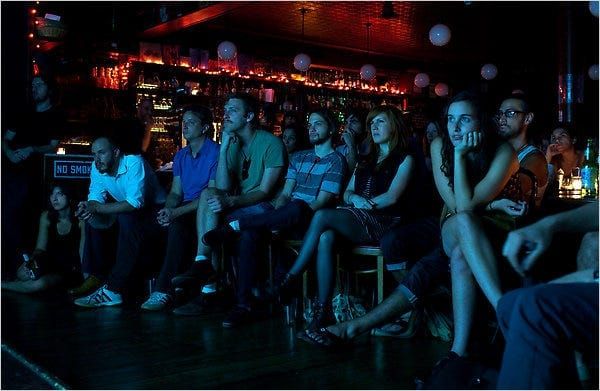
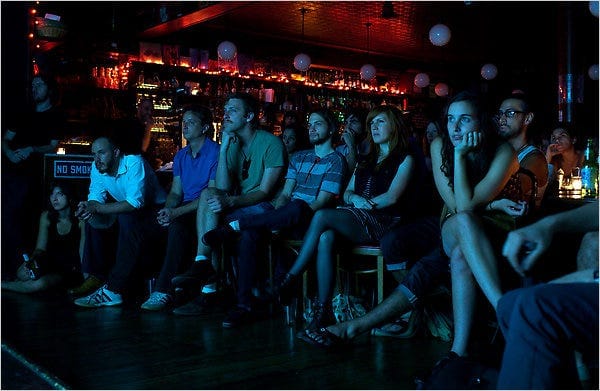
ON a midsummer night a few dozen people, many in glasses and with messenger bags, gathered at Zebulon, a bar in Williamsburg, Brooklyn, to watch a new low-budget movie called “The Builder.” The story of a contemplative Irish immigrant, it moved slowly, driven by atmosphere rather than dialogue, but the audience watched patiently at small candle-lit tables, beers in hand. It was the antithesis of a typical summer-movie outing, but that was sort of the point.
“It’s just great to see people with drinks and candles,” said R. Alverson, the film’s director. “It’s so much more personal than seeing it in a theater.”
Everything about “The Builder” seems personal. Mr. Alverson, a musician-turned-filmmaker, made it with friends and untrained actors for $5,000, including the cost of camera gear. To release it, he turned to Jagjaguwar, an indie rock label in Bloomington, Ind., whose roster of musicians includes Bon Iver, Okkervil River and Mr. Alverson’s former band. Jagjaguwar put “The Builder” out on DVD, organized a few screenings and hoped for the best.
“As a film distributor, we have no experience,” said Chris Swanson, who helps run the label. “We’re approaching it the same way we did music, like, find a nice room and put the work on display in a dignified manner.”
The audience was small, but Jagjaguwar had already agreed to finance Mr. Alverson’s next feature. It views him as an artistic investment: helping him develop his oeuvre is akin to supporting a band from the release of its first seven-inch.
— —
Jagjaguwar is one of a number of indie music labels and hybrid companies that have turned to film distribution, some following the model laid out by seminal punk labels like Dischord and Touch and Go: stay small and informal, know your audience, and put out stuff you like. In the last few years, both the independent film world and the independent music world have stratified, shrunk by digital sales, a crowded entertainment market and the collapse of major specialty divisions. Money is harder to come by now. But experimentation can rule, and a few players have found that there’s a niche, and a clear overlap, in putting out D.I.Y. music and D.I.Y. film.
Later in the article, there’s an interesting quote from Ryan Murphy, sales director for Drag City, a Chicago-based label:
“If you have an apparatus which is designed to meet a demand, does it matter what kind of demand you’re meeting?” In this case the answer was no: cult content is cult content.
That pretty much goes to the heart of this approach. In one significant respect, entertainment is entertainment: It’s a zero-sum game with consumers who only have so much discretionary time and money to devote to entertainment whether it’s music, movies, video games, or whatever. So in a way, approaching the marketing and distribution of the content should have some parallels. Apparently it does in terms of super-low budget movies targeting a specialized audience.
Hollywood will continue to make big spectacle movies, major genre movies (action, comedy, thriller), and big name talent movies. That’s pretty much what they do best. But I’m trusting that won’t ever dull the desire on the part of movie fans to see fresh, different, unusual, smaller, and more intimate films. As we’ve discussed many times, digital technology has cut the cost and ease of actually making a movie to the point where virtually anyone can afford it. Out of that whole mass of original content, some will find their way into the festival circuit and get some sort of more formal distribution arrangement. But there will always be others that deserve a wider audience. I can envision a day where there is a network of venues across the country that are similar to the house concert phenomenon that has evolved over the last few decades. Call it “home movies” but with a new meaning: bars, social centers, outdoor amphitheaters, and yes, even homes as venues for ultra-low budget films, the filmmakers traveling with the digital ‘print’ from city to city for special screenings, Q&A’s, and direct face-to-face PR, all coordinated by a central web-based entity
Perhaps it’s already out there.
For the rest of the article, go here.
Comment Archive