Did the PC kill Hollywood’s archetypal screenwriter?
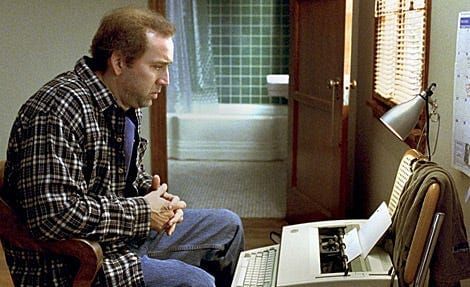
Gather ‘round all you young ‘uns and listen to tales of Hollywood writers gone by:
Long before the days of word processors and computers, the manual Underwood typewriter was the standard for writers. (In Hollywood, screenwriters were often called “schmucks with Underwoods.”) ??
Then came electrics and as Carl Gottlieb, the screenwriter of Jaws, recalls, “People switched to electrics always did so with a bit of reluctance because once you switched there was no going back to a manual. ?The muscles you needed in your fingers and wrists to operate a manual typewriter went slack because you didn’t have to hit a carriage return, you didn’t have to press the keys to make the key strike and leave an impression. But the technology was still similar and understandable. You could change a ribbon, then they created white-out ribbons to correct mistakes. IBM was really at the forefront of all that. And you used carbon paper to make copies because Xerox machines were expensive and they weren’t everywhere like today.”
Ah, the image of the hard-boiled Hollywood screenwriter and their typewriters:
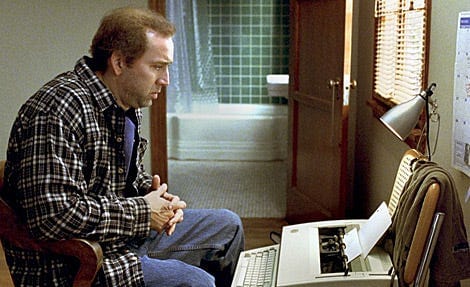
That’s William Faulkner in Hollywood by the way. And then came computers;
Bob Gale got his first computer in 1980, which was an Atari 800 hooked up to a black and white television, one of the only home computers you could buy at the time, other than a Radio Shack TRS 80, nicknamed the “Trash 80.”
“The idea of buying high technology from Radio Shack just didn’t cross my mind!,” he says. (Gale had previously written his scripts with Bob Zemeckis on a $35 manual typewriter.)
I wrote my first screenplay on my wife’s Apple IIc. Man, I thought I was styling with those 5 1/4 inch floppy discs. They could hold up to 20 whole pages of content! And they were… floppy.
The bigger question is what impact does working on a computer have on one’s writing?
“With computers and word processors, rewriting became effortless. If you didn’t like something, you’d delete it, start a new file and start again. You didn’t have to mechanically preserve your pages, or crumple them in a ball, throw them out and start again,” says Carl Gottlieb, screenwriter of Jaws and The Jerk with Steve Martin.
“So it became almost too easy to rewrite. You could write down anything, and a computer would make it look as if it were formatted perfectly and it would look like a finished product, although it wasn’t. The finished product in the old days, in the pre-computer era, was the result of a lot of polishing, a lot of handwritten notes, a lot of cutting and pasting, a lot of manipulation of paper and ink. And when you didn’t have to physically manipulate paper and ink, you could rewrite at will and unless you had a heightened sense of discipline, the quality of writing would decrease because you didn’t have the thought.”
“There’s something about the mental time it takes to compose a thought and set it on paper physically that’s very important,” he continues. “Every sentence is the result of some thought or some process. Especially if you’re a fast touch typist, and you can type almost as fast as you can think, you’re basically you’re transferring your thinking to a mechanically finished state, perhaps before it’s intellectually finished. There’s something to be said for the introspection that’s necessary for creation. As much as we would like to create spontaneously, the written word requires a little bit more of an intellectual process.”
On the other hand:
W.D. Richter, who wrote the 1978 remake of Invasion of the Body Snatchers and directed Buckaroo Banzai, loves the fact that now changes can be made much easier than before. ??
“It’s so liberating,” he says. “You literally think about the mechanical complexity of making a change (with a typewriter). What will it entail? How much retyping? I had a typist who made changes to my scripts by cutting and pasting and there would come a point where she’d have to retype some of the manuscripts all over because they’d be a foot thick with staples. So I used to be mindful of, ‘Am I using too much of her time?’ And you just couldn’t try stuff before. I’m working on a script right now that if I were doing it longhand or on a typewriter, I wouldn’t be as far along.”
What do you think? Does using a computer impact your writing at all? Make it better? Is there a downside? And does anyone out there still use a typewriter?
For more, you can see the two articles from which I sourced these quotes from TG Daily: here and here.