Dispatch from The Quest: Rob Pilkington
Last week as we did here on GITS, the Quest writers focused on the second week of Prep. Today’s dispatch: Rob Pilkington waxes profound on Steven Spielberg:
Try as I might, I can’t muster a single, useful syllable on prep this week, so if you’ll indulge me, I’d like to veer off topic. Not too far, of course — I still wanna talk about movies. Because movies are totally awesome, right? YEAH. WHOOO! F*CKIN’ MOVIES, DUDES! -crushes beer can on forehead-
But yes — this week I want to share something that happened to me. Something that happened to me and Steven Spielberg.
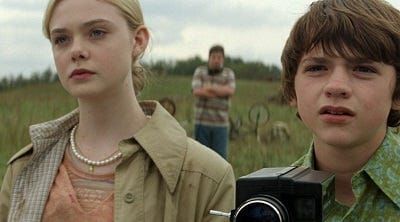
I’ve had complicated relationship with Mr. Spielberg — one that has already brushed the pages of Go Into The Story. Over a year ago, I had taken a crack at my own screenwriting blog, and in its first week I had written up my befuddlement concerning Super 8 and its marketing’s reliance on Spielberg’s name. Whether he remembers it or not, Scott generously pumped my post right on these hallowed blog pages. Scott! Retro-active high five!
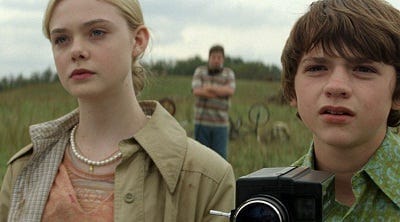
And there it was: to the Internet screenwriting community at large I had officially registered with the Anti-Spielberg party. Our picket signs are pretty reasonable: Down with overwrought sentimentality. Down oppressive musical cues. Down with incessant doe-eyed characters ready to swallow whole worlds into their pupils (see below). We had a strong platform. I was comfortable being a card-carrying member.
You’re probably thinking “this kid hasn’t a soul to speak of.” But let’s be honest, in the last ten years Steve hasn’t given us a whole lot whoop and shout about. War of the Worlds felt like a “Mystery Science Theater” audition for my friends and I. My father and I were stunned silent walking out of Kingdom of the Crystal Skull. And I think it’s fair to say I wasn’t the only one ready to close the book on this guy when, after being absolutely shaken by Schindler’s List and Saving Private Ryan, we all heard his next project was about a Nazi-fighting horse.
But this was more than a mere disappointment. I felt bitter about this and my disdain was strong enough to spin back towards his other past films. As a Kubrick nut, he left me confounded and frustrated with A.I. And Jurassic Park, a film I worshiped in elementary school, was suddenly revealed as an evocative warning against scientific hubris that was criminally reduced to some grumpy guy learning to like children. Even those shark POV Jaws shots ground on me after I learned he had only resorted to them after big rubber puppet malfunctions. I was younger. More cynical. Partially college educated. And this was a goddamn outrage.
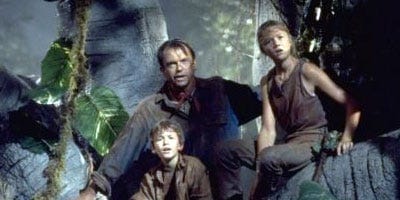
An outrage that hurt deep for a reason I hadn’t really considered: Spielberg was the first filmmaker I could ever name. I remember running, screaming from my father’s living room during Jaws, and my mother’s (unrelated) affinity to have it on every time it aired on cable (spoiler alert: Jaws is on television every other f*cking day). I recall being mesmerized by E.T., and as I mentioned, Jurassic Park rocketed my grade school fascination with dinosaurs into the stratosphere. It was crack cocaine for 9 year old boys.
I even remember the night my mother found Duel on television, Spielberg’s 1971 television movie about a LA salesman who, on a road trip through the California desert, is stalked by a mysterious tanker truck whose driver we never see. Stephen King: take a knee.
But this childhood bedazzlement faded quick. I still liked a few Spielberg films as I got older (Minority Report comes to mind), but overall, I had soured. Alex Cox (Sid and Nancy, Repo Man) called Spielberg not a filmmaker but a confectioner. I was in the midst of discovering Kubrick, Hitchcock, Tarantino, Scorsese, the Coens and so many, many others. It was hard not to agree.
Flash forward to: THIS LAST WEEK. I have a newly minted living room set and HD TV. After receiving my collection of DVDs from Boston, I look and find Munich, a Spielberg film I liked and had apparently bought. I put it in… and was quickly, harshly schooled in why I had purchased it in the first place.
But that wasn’t just it. Working on other Quest materials (and desperate for white noise) I treated myself to three docs on Netflix. Guess who appeared in all of them?
As an unproven upstart director in The Last Mogul, he told the most powerful man in Hollywood that we wouldn’t do Jaws because he “wanted to make films, not movies,” (heard he took the gig anyway, though). In The Inheritance, the daughter of Amon Goeth (Ray Finnes in Schindler) grapples with culturally distorted deeds of her father. It’s Spielberg who places the call that sets her straight. And in Imaginary Witness, Schindler’s List is regarded as the cinematic apex a worldwide cultural understanding of the Holocaust (and still faulted for its sappy ending).
Regardless of the conclusions any of these docs made, I was jolted. Memories of these films flooded back to me. These films and their visceral and romantic mastery, their nimble juggling of thematic focus and enthralling set pieces. And for the first time in years, I remembered my blubbering description of Giovanni Ribisi’s final scene in Saving Private Ryan to my mother after a screening last week when I was thirteen.
And all at once, like a not-too-distant rumble of a Tyrannosaurus Rex stomp, I was felt something I hadn’t since I was 14 years old:
Steven Spielberg is f*cking awesome.
He really is. His commercial successes are perhaps solely responsible for my childhood interest in filmmaking, and his later, somber, historical films are branded into my adolescent experience as a moviegoer. I can’t think of a rival that matches his latitude for genre, commercial entertainment, thematic gravitas, and he produces content often, nearly every year. Hitchcock puts an uncomfortable arm around you. Kubrick abandons you inside his labyrinth. Spielberg just flat out goes for your jugular. And in doing so, he formed a fascination in me I wouldn’t be here without. Now it feels obvious why I temporarily resented some of his work: it so frequently had Houdini-like access to both the things I subconsciously clamored to see and wanted to achieve.
And it’d be absolutely insane to hate on that anymore.
Does this mean I suddenly think War of the Worlds is a good movie? Or that I’m dying to see War Horse? Hell no. But it does feel good to have the perspective to re-introduce myself to such a careful and varied body of work. It’s true: Spielberg isn’t a writer, but he sure feels like a contributing author to the story that got me here. Here loving movies.
And that’s what happened to me during the Quest this week.
Cheers.
This week I watched Raiders of the Lost Ark for the umpteenth time and I was reminded of how movies Spielberg directs are always good for a dozens of cinematic moments where we are reminded of the visual power of the medium. Since Rob was such a Jurassic Park freak when he was a youth, here is just one tiny bit of visual business from that movie:
A shot of the T-Rex in the sideview mirror with the words: “Objects in the mirror are closer than they appear.” Think about that. A director is confronted with an enormous challenge in making a movie, among them a million decisions about this, that and the other thing. Yet Spielberg’s mind operates in such a manner that he insists on including this tiny visual joke. You think, “Well, who’s going to notice that,” right? In fact the moment was parodied in Toy Story 2 [Rex in the sideview mirror of a toy car] and there is even a Facebook page dedicated to it.
Takeaway? Get in touch with your inner Spielberg and think visually when you write!
About Rob: Boston writer headed for LA. Lover of Kubrick, Nolan, McDonagh, and the Coens. Okay, good talk. Back to writing. Twitter: @HeroesAreBoring. Note: Rob has officially relocated to LA.
Comment Archive