“Festivals Grow Up, Even as Screens Grow Small”

Cannes. Sundance. Toronto. Venice. Telluride. Tribeca. Anyone familiar with the movie business will see those cities lined up and think of one thing: film festivals. How did they come to be? And why is the so-called “festival circuit” important? And in light of changes in technology and consumer habits, will it remain so? NY Times film critic Manohla Dargis has an interesting article today delving into the subject, jumping off from the recent opening of the TIFF Bell Lightbox in Toronto:
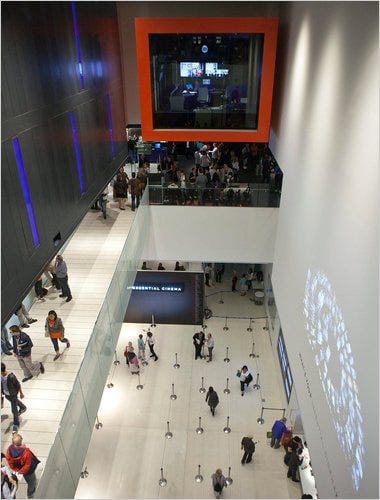
Designed for maximum public attention and attendance, the Lightbox is wrapped in soaring glass walls intended to invite your gaze and comes with five screens (more than 1,300 seats), a pair of galleries, two restaurants, a bar and a gift shop — as well as three learning studios and a research center. The five-story complex and the 38-floor condo rising above it eat up 175,000 square feet in the city’s west downtown entertainment district.
More background per Dargis:
“Up in the Air” had its official premiere at the 2009 Toronto, the first leg on its ultimately disappointing long march toward the Academy Awards. It’s a good bet that at least some of the higher-profile titles at this year’s event, including “Black Swan” and “The King’s Speech,” will be among those on track to be championed, dismissed and, following the inevitable backlash, reclaimed for your consideration in time for the next Oscars. That Toronto has become a significant launching pad for the American industry’s new releases and award hopefuls might seem paradoxical or worse, but it’s hard not to wonder if the Lightbox could have been built without Hollywood and its red-carpet imperatives. Bazin likened festivals to religious orders, but there’s always more than devotion at stake.
Those who help pay for festivals have other interests, including cultural capital. Festivals give the wealthy something to spend their money on and everyone else who can afford a ticket a place to gather in common cause. Festivals also serve cities, refurbish neighborhoods, attract tourists: as Mr. Cowan noted, the Toronto International Film Festival and its host city evolved together. The roles festivals play, however, reach beyond civic boosterism — it’s worth remembering, as the scholar Thomas Elsaesser does in his study “European Cinema: Face to Face With Hollywood,” that Venice, the world’s first festival, was partly a propaganda exercise by Benito Mussolini. It’s from that inglorious beginning that an extraordinary system — a network, to borrow Mr. Elsaesser’s word — has emerged as a genuine rival to contemporary Hollywood.
Festivals have long complemented traditional distribution channels by generating early public word of mouth (positive and negative) and by stirring up valuable publicity for movies before they hit theaters. Now, however, festivals constitute a web of relations that lasts the entire year, during which films and their makers travel the world (from Berlin to Toronto) attracting audiences and media attention. “This originally European phenomenon,” Mr. Elsaesser writes, “has globalized itself, and in the process has created not only a self-sustaining, highly self-referential world for the art cinema, the independent cinema and the documentary film, but a sort of ‘alternative’ to the Hollywood studio system” in its current incarnation.
And to think that the first film festival of them all in Venice started as a “propaganda exercise” by Benito Mussolini. But then the inclination toward propaganda still exists in festivals, only now it’s called buzz.
So on the one hand there are people in the indie film world who are doubling down on the importance of the “big-screen experience,” as someone in the Dargis article advocates, and on the other there are filmmakers like Ed Burns who veers in the opposite directiong in this Deadbolt interview:
THE DEADBOLT: With Nice Guy Johnny kicking off the Tribeca Film Festival Virtual, what do you think of these new distribution methods, including iTunes, as a way to reach more people?
BURNS I love them. I think anyone who is still interested in making small films has to fall out of love with theatrical distribution. When I was in my twenties, me and my friends, if you were into indie film, you went down to the art house theater or the specialized movie theater and you made sure that you saw that film its opening week.
[Ed Burns] Today I think it’s a little different and you can watch a film on your phone, on your computer, even now you can get them on You Tube. So I don’t think the theatrical component is as important as it used to be. If you allow yourself to fall out of love with that, I think you can reach the people that will love your film.
I mean, I think the tricky thing that everybody is trying to figure out now is how do we monetize that? I think if you keep your budgets really low, I think we’re going to find a place where you can make low-budget personal films and at least break even, or make enough that you can go make the next one. I think that’s where we’re going to be in a couple of years.
And yet there is Burns’ latest film Nice Guy Johnny with its formal premier at the Tribeca Film Festival. Here’s the movie’s trailer:
Interesting times…
Comment Archive