Go Into The Story Interview: F. Scott Frazier
My conversation with the screenwriter whose movie credits include XXX: Return of Xander Cage and just announced deal to adapt popular comic…
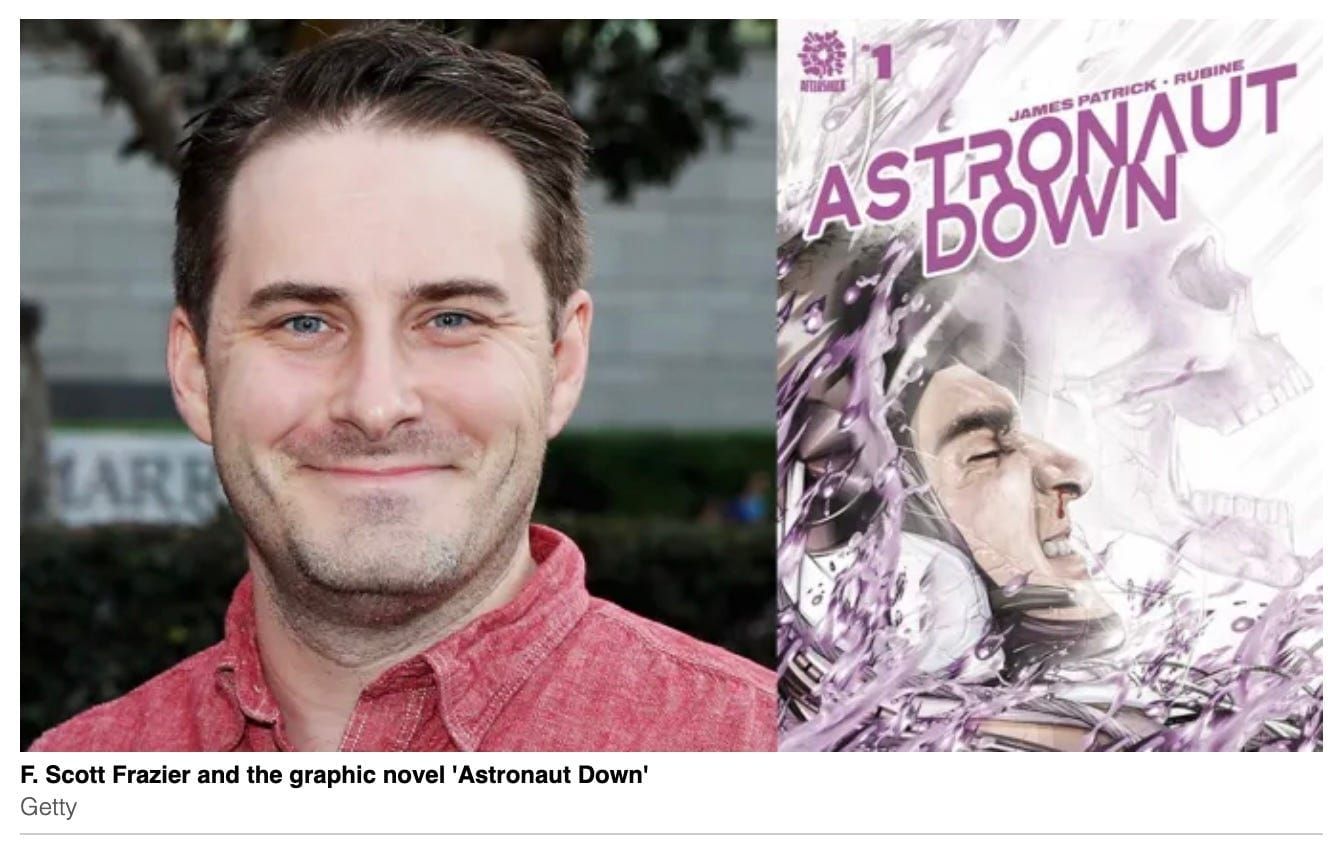
My conversation with the screenwriter whose movie credits include XXX: Return of Xander Cage and just announced deal to adapt popular comic Astronaut Down.
I’ve known Scott for well over a decade. He’s sold multiple spec scripts and been active writing in the action and science fiction space.
I thought of him yesterday when it was announced he’d signed a deal to adapt Astronaut Down for Netflix.
Here is my 2011 interview with Scott.
Scott Myers: How did you become interested in screenwriting?
F. Scott Frazier: I was born and raised in Los Angeles, and my dad was a television writer during my childhood. So I’ve always been around the industry. I knew at a young age I wanted to be a writer but I didn’t know exactly what I wanted to write. I don’t really have the patience for writing books. And from that I became interested in writing movies. And for the better part of my adolescence and my young adulthood I poked at it as a hobby but never really took it seriously.
You spent 9 years working in the video game industry, then quit to pursue screenwriting. Before you achieved success as a screenwriter, did this thought ever cross your mind: “What the hell was I thinking?”
Absolutely. I had that thought at least three or four times a week. I was living on reserves from my day job and a charitable grant from my fiancee. (At the time; now my wife!)
But that fear I think pushed me forward and forced me to work at an extreme pace. That first year when I didn’t have anything finished, didn’t have a job, didn’t have any contacts in the industry, I was writing almost nine hours a day. Forcing myself to finish as much as possible before I had to go back and get a day job.
Fear and the threat of absolute failure are really great motivators.
How did you learn the craft? Did you have any formal education or did you cobble together what you know? If the latter, are there any books or screenwriting ‘gurus’ who have been a particular influence on you?
I got my job right out of high school, so I never spent any time in college or in any screenwriting program. There’s definitely a collection of screenwriting books on my shelf. But early on, I realized that while they had a lot to offer in terms of storytelling, they didn’t do a good job of teaching me how to write an actual screenplay.
I would look at pages I had written and compare it next to a professional screenplay and I wouldn’t be able to figure out why mine looked and read differently than theirs.
So I took the screenplays I admired and copied them. Not in content, but in the way they described scenes, the way they structured dialogue, the way they made the movie come alive on the page. And in doing that, I started to figure out my own style and my own voice, which I don’t think I would have found just sticking to the advice of the screenplay books.
I love reading books on screenwriting. But I make sure when I read the advice they have to offer, that what I internalize is only the stuff that ends up being true to me. Everything else I just dismiss.
You have written and sold four spec scripts which if there was a Spec Script Hall of Fame, you would certainly be in it. Let’s go through the projects one by one. First THE NUMBERS STATION. Here is a plot summary from the trades:
A black ops agent is assigned to protect a female operator who works out of a “numbers station” deep in the Arizona desert. The two eventually have to fight to survive after they come under attack.
What was the genesis of that idea?
I had heard a NPR news program about this husband and wife who go out to the desert on the weekends and listen for secret shortwave radio signals. I thought it was a really interesting piece and went and did some research on numbers stations. I found out there was a really cool “conspiracy” about what these broadcasts are for.
The more I dug, the more I thought it would make a really compelling backdrop for a movie and went from there.
What was the general time frame for writing THE NUMBERS STATION (i.e., how many weeks/months did you spend in prep, first draft, rewrites)?
THE NUMBERS STATION was one of the first scripts I ever finished, back when I still had my day job and was writing as a hobby. When I quit my job, I knew I needed to have a finished project as quickly as possible, and THE NUMBERS STATION, being the closest to completion, I decided the thing t do was to rewrite it and get it to a place where I was happy with it.
Which is a long way of saying the first draft took me 5 years, and the rewrite took me 4 months.
Was THE NUMBERS STATION one of the two scripts you had written that landed you representation with the management company H2F Entertainment?
Yes. TNS was actually the second script I sent my manager after I got the immortal question, “What else do you got?” Based off of the first script I sent them, and TNS, I signed on as their client.
So May 5, 2010, THE NUMBERS STATION sells to Furst Films and ContentFilm. How did that happen?
Because TNS was such a small movie, my managers and agent weren’t planning on taking it out wide. While we were in the middle of taking out my first script, they received a call from a producer that was looking for a low budget thriller. They sent it along and the producer became interested, and during negotiations, they sent it out wide to drum up more interest. This is when the Furst brothers and ContentFilm got involved.
Where were you when you found out the good news and what was your choice of celebratory libation?
I was actually driving down the 405 to meet with the Furst brothers when I got a phone call the meeting wasn’t necessary because Ethan Hawke had attached himself to the script and that ContentFilm was interested in buying it.
I remember turning off the 405 in the middle of rush hour and driving back home up Sepulveda. It was the most surreal drive of my life. And if I remember correctly, i think we celebrated with a bottle of wine.
And more good news: This month THE NUMBERS STATION goes into production. Can you tell us about the movie’s cast? How was it working with the film’s director Kasper Barfoed?
John Cusack and Malin Akerman are playing the leads. Kasper and the Furst brothers have been wonderful collaborators. Through the entire process from preproduction to greenlight to production, it’s been the perfect experience. I’ve been waiting for all of those Hollywood horror stories to come true, but it’s been nothing but clear sailing.
Moving on you say “in August 2010 we [you and your reps H2F and WME] sold an as-yet-unannounced spec script.” Is there anything you can tell us about this project? Genre? Setting? How about just one word from the story’s logline?
The one word I can give you is “the.”
The genre is right in my wheelhouse. Spy-thriller-action movie. We recently got an amazing director attached and we’ll be going out to cast very soon. Hopefully we’ll be able to announce it very shortly.
From a career standpoint, how important was it for you to get that second project set up?
In my view, success breeds success, and once you sell a spec, you find out that actually getting one made is even harder. So the more possibilities you have, the more irons you have in the fire, the better it is for your career.
When may we expect to hear some particulars about this project?
Maybe at the beginning of the new year? I know the producer is very excited about making a big announcement once a cast is in place.
Wait, there’s more. On February 25, 2011, you sell LINE OF SIGHT to Warner Bros. Here’s the plot summary from the trades:
Plot details are being kept out of sight, but it is described as a high-concept action film set around a large-scale threat on American soil. (But no aliens are involved.) Also key script is that the story is told via a POV.
Where did this idea originate? What was the time frame for developing and writing this script?
My manager, Chris Fenton, has always said that every general meeting you take is a lottery ticket. I had met Alex Heineman at Joel Silver’s company off of one of these general meetings. And in November 2010, he came to me with an idea that I got excited about almost immediately. We developed it together and I wrote the script over Christmas vacation. We did some minor rewrites in January and sold it in February.
Could you give us a bit more about the story being told “via a POV”?
Warner Brothers is actually keeping a lot of that under wraps right now and while I wish I could tell you…
THE NUMBERS STATION is, I believe, budgeted at around $15M. However by the sound of it, LINE OF SIGHT appears to be a significantly bigger budget movie. Did taking on a story much larger in scope affect the way you approached writing the script? Did it add any pressure to your process knowing the studios would perhaps take a more critical view of the content in order to justify spending a lot more money?
I’ve actually always been more comfortable with bigger movies. I grew up in the era of the summer blockbuster and that kind of larger-than-life storytelling has always appealed to me.
I would actually say that NUMBERS STATION is more the anomaly and that it’s a smaller more intimate story with a handful of characters. My orignal intention when writing NUMBERS STATION was to make it myself for $40,000 in somebody’s basement.
The size and scale of LINE OF SIGHT is definitely more my speed in terms of going forward in my career.
What’s the status of that script?
LINE OF SIGHT is currently in development at Warner Brothers with Ben Affleck attached to star, produce, and direct.
Given the fact you have written and sold three spec scripts, where does that put you in terms of open writing assignments and pitches? Have you been pursuing either or both? What’s that experience been like?
Throughout all of 2011 I’ve been going on non-stop pitches and assignment work. It’s draining but it’s also the business side of being a screenwriter. And I feel like I’ve found a balance between chasing jobs and still having time to write my own spec scripts.
I think it’s necessary for new screenwriters to be getting out there and meeting creative executives, studio executives, and doing this part of the dance. But I firmly believe that the currency of the screenwriter is a finished script. Not an outline, not a take, not a beat sheet, not a rough draft. A finished script. You just have to be careful you don’t fall into the trap where you stop writing and spend three years chasing jobs.
If I may assume your second project is an action story, that would make three specs in the same genre. Is this a reflection of your specific area of interest as a writer or is it more of a business decision, choosing to work in one genre to establish you in Hollywood as an action writer?
No, it’s more due to my interest than anything else. I love watching all kinds of movies from action movies to romantic comedies, but the types of stories that end up speaking to me the most are movies with a definitive heartbeat of action and adventure. I am somewhat varied when it comes to tone, but otherwise I’m an action writer through and through.
Okay, time for some craft questions. How do you come up with story ideas? How important do you think the story concept is to the overall marketability of a screenplay?
Mostly my story ideas come from the world around me. Like that NPR story for example. I’m a voracious reader. And I also like to question things that I see or hear about.
I think it’s very important. People want to see new, fresh ideas. And while I know it’s trendy to do remakes and sequels and prequels right now, the original story is always going to trump the repeated story. Even if it’s something like Avatar which is the same but different. People always seem to respond more to creativity than to brands or previously seen characters.
Which of the aspects of prep (i.e., brainstorming, character development, plotting, research, outlining) do you tend to devote the most time and focus to?
Probably structure and plotting. The first notecards I’ll ever put up on the wall are the end of act one and the end of act two. I like to know basically where I’m headed before I start writing the script, but my outlines are usually pretty light when I get into a rough draft. I’ll have a vague sense of what kinds of characters I need for the story — who the protagonist is, who the antagonist is — but I usually don’t plan anything beyond that.
I also like to plan my set pieces pretty well in advance. So for something like LINE OF SIGHT, I brainstormed 100 different beats that I thought would be cool from a POV perspective.
During the brainstorming phase (which I usually don’t spend more than a week on) I’ll also have random bits of dialogue, random scene descriptions, random character moments, random action beats written down on note cards or on a white board to use as kind of like a road map through the rough draft.
Is there a specific approach you use to dig into your characters and develop them? If so, what are some of those techniques?
Like I said, on my rough draft, I try not to think about the characters outside of their purpose for moving the story along. Though I’ll typically find some character moments within the rough draft, I tend not to focus on it until the rewrites, where I’ll spend an entire rewrite pass working on a single character’s scenes and dialogue and moments.
When I do this, I typically like to read back the script in one sitting and make notes along the way. By the end of it, I’ll usually have a pretty good understanding of where the characters went wrong and where they can be strengthened.
Do you have some key screenwriting principles you keep in mind at all times while developing and writing a script?
To me, the best stories are always about conflict and change. If I don’t have either one of those things in every scene, I stop myself and reevaluate.
Name three movies for which you wish you could have written the screenplay.
BACK TO THE FUTURE
GALAXY QUEST
RONIN
Finally what advice can you offer to aspiring screenwriters about the craft?
Worship at the altar of done. Finish your rough draft. Then rewrite it. There comes a time when you have to realize that not every scene can be perfect the first time you write it. And there comes a time when you realize that the truly great scenes can’t actually be constructed until you’ve seen the script as a whole entity.
Okay, so in the time we started this interview process, you actually sold another spec script “Autobahn”. Here is how it’s described in the trades covering the deal:
“Autobahn” is described as “Fast and Furious” meets “Taken.”
Is that an accurate description of the storyline?
Yeah, that’s pretty accurate. Mainly because, along with the help of along with the help of a bunch of my screenwriter friends, I came up with that tagline a couple of days before the script went out.
What was the origin of this script? A character? A situation? Or did you literally sit down and say, “I’m going to write ‘Fast and Furious’ meets ‘Taken’”?
No. It was entirely built around a situation. It had been an idea in my head for a while, but hadn’t really gone much beyond a couple-page write up that I had done a few months ago for my reps to get excited about the idea.
I actually didn’t really realize what kind of movie it was until I finished it. That’s when I was able to come up with that tagline.
From the time you started with the story concept to the time you did a final edit, what was the basic time frame for writing “Autobahn”?
Well, like I said, I had the initial idea sitting around for a couple months, but hadn’t done any prep work on it.
I was actually having a pretty creatively-stagnant summer this year, where, for about four months, I had done nothing but pitches and outlines and rewrites. I hadn’t written anything original for a while.
I sat down and wrote the rough draft in ten hours. Almost as a test to myself to see if I could do it as sort of a creative purge. My intention was never really to do anything with it, and for about a month after I had written it, I didn’t read it or show it to anyone.
My manager kept asking me to see the draft, and even though I was sure it was terrible, when I showed it to him, he got really excited.
After that, I spent probably about three months rewriting the script, fine-tuning it, and taking that rough draft and turning it into an actual movie.
So, all in all, I probably came up with the idea in April of this year and finished it up the first week of November. But in those seven months there was definitely a lot of down time, second guessing myself, and endless rewriting.
What excited you about writing this project? What was your point of emotional resonance with the material?
From the moment I came up with the concept, I knew it was an exciting way to do an action movie. And from there, it was just about writing really ordinary characters inside of an incredibly extraordinary situation.
How did this deal happen? It seemed like the script went out in the morning and sold that night. Was it a preemptive purchase or were there other outfits vying for the project?
I kind of leave the business stuff to my reps. I feel like I’ve lucked into the best agents and managers in the business. And, for me, my involvement with the strategy in taking out the script ends when I email them the final draft.
All I know is that the afternoon we sent the script out, I got a phone call saying we got a pre-emptive offer that was a great deal, and I said take it.
The company that bought “Autobahn” is described as a “British production company/financier Between the Eyes.” What was the thinking of you and your team in going with this outfit as opposed to a Hollywood studio or prod co?
Again, I don’t really know the strategy outside of my guys sending the script to people who want to make the movie. The last couple of years I’ve found getting a movie made is even harder than selling that first spec script. And anybody who shows a passion for getting something into production is, in my mind, a leg up on competition.
The title “Autobahn” suggests the story is set in or at least has something to do with Germany. If that’s true, was your choice to set the story in an international location influenced at all by the increasing revenues from the foreign market? In other words, were you specifically attempting to target international audiences figuring that would help your story’s sales appeal given Hollywood’s increased focus on that market?
It was definitely a consideration, but I generally tend to think in international settings. I would say more than half of my own scripts take place, or could be set, in international locations. I’m personally kind of bored of movies where the climax always takes place in Los Angeles.
I assume you were aware of another spec script “Autobahn” that sold earlier this year. Did that impact the strategy re your script? Was there ever any thought to changing the title?
I found out about the other AUTOBAHN about a week before we were planning on taking the script out. A few other titles were discussed, but nothing that got everyone excited enough. So we stuck with AUTOBAHN.
The fact you have these three other projects — “The Numbers Station,” “Line of Sight,” and the mysterious project with a “the” in the logline — plus you have been going up for OWA’s and doing pitches, this brings up the subject of stacking projects. Assuming you prep other projects while writing something, how do you manage that? Do you find it challenging to switch mental gears from one project to the other or not? Are there any organizing systems or software programs you use to manage multiple projects at once?
You definitely have to be able to stack multiple projects in order to get to that next step in your career as a screenwriter. Like I said, I was doing a lot of pitches and going out for a lot of OWAs earlier in the year. And for those, it’s just a matter of writing everything down. Keeping good notes. And kind of giving your brain the freedom of thinking of multiple ideas at once.
On top of that, I’ve always preferred having multiple scripts going at once. Usually two. Sometimes three. What I think is important about juggling scripts is that you’re working on them at different stages. For example, I’ll be writing one script as a rough draft, while at the same time, rewriting another script, and polishing a third. The kind of skills and brain space that you need for each of the stages of a script are really kind of different from one another. So I use that to my advantage to maximize my output.
Selling four spec scripts in two years, the logical question to ask is how good that feels, but let me go the other way with this question. Are there aspects of the business of screenwriting you have discovered that have proved to be problematic? For example, balancing all of those projects or working too much.
I think there is definitely a maximum amount of work that can be done simultaneously. But I’m not sure if I’ve reached it yet. There were a couple times this year where I definitely felt overwhelmed, but I’ve been good at multitasking, and I just found a way to make it work.
To me, one of the keys of making that next step from someone who sells a spec to someone who is a screenwriter is being able to have a lot of plates in the air. So that’s what I like to do.
Finally do you have any interest in directing? Moving into producing as well? What is F. Scott Frazier doing 10 years from now?
I’ve never really thought about directing, but it does seem that writer/directors have a somewhat easier time getting movies off the ground, just because they bring two elements to the table rather than just one.
If ten years from now I’m writing big, entertaining, popcorn movies, I’d be incredibly grateful.
For 100s more exclusive Go Into The Story interviews with screenwriters and filmmakers, go here.