Go Into The Story Interview: Gary Whitta
My conversation with the 2007 Black List writer.

My conversation with the 2007 Black List writer.
Gary Whitta’s screenwriting credits include After Earth, Rogue One: A Star Wars Story, and The Book of Eli. That script was named to the 2007 Black List. Gary also wrote the novel Abomination. Here is my conversation with Gary.
Scott Myers: So, you’ve been a journalist. You’ve managed and been editor of magazines. A video game designer and consultant. You written comic books. You’ve hosted podcasts. You’ve written movies and TV. And now with “Abomination,” you’ve added author and novelist to your list of accomplishments. My first question is, did you plan all this, or did it just happen?
Gary Whitta: It kind of just happened. I always knew I wanted to be a writer. As a kid, I was an avid writer of short stories and my own little comic books, and at school English was the only class that ever interested me. I never went to college, pretty much straight into the workforce at the age of 15. I knew pretty early on that I wanted to try to make a living as a writer because it was really the only career I could imagine for myself that wouldn’t bore me to death. But what shape that would take, I wasn’t sure.
I flirted for a little while with being a video games programmer, because when I was growing up the two things I loved were movies and video games, but the idea of making movies seemed a very distant possibility for a kid growing up in England. I would watch Hollywood movies, but the idea of ever going there and making films seemed like another world entirely, very unreachable.
But making video games… in the 1980s when I was growing up, computer games were mostly made by a single person sitting in a bedroom and coding. So I thought maybe I could do that. I picked up a book about machine code, assembly programming and I immediately realized, my brain’s just not wired that way at all. I’m not good at math. I’m not good at science. I’m very much more right‑brain than left‑brain. I’m good with words and creative things and imagination, but logic and math and numbers, I’m awful. So I was never going to be a games programmer.
But I also loved reading video game magazines and I thought, “Maybe I could do that. I could be a game reviewer.” I started bashing out my own video game reviews and sending them into the 8‑bit games magazines of the time. And for a long time, I put the film thing away as I got taken down the video game path very quickly. I got my first job as a video game reviewer when I was 15 and really went down that road. I worked as a video game journalist for many years.
Eventually that job brought me out to the US, to San Francisco, because the magazine I was editing in the UK, PC Gamer, launched an American edition and they asked me to come out and look after it. And that seemed like a great opportunity. I love America, had fallen in love with San Francisco on previous visits. And it also had rekindled the possibility of maybe doing the screenwriting thing, because I thought, this gets me 9/10 of the way geographically there, to the world where I’d be interested in writing this kind of stuff. It felt like a necessary move if I was ever going to take screenwriting seriously. The idea of writing the kind of films or television that interested me as a kid in the UK always seemed very remote as long as I remained in the UK, because I grew up on a lot of American entertainment. I grew up on Star Wars, and Star Trek, and Battlestar Galactica, and Big Trouble in Little China. I think there’s a little bit of institutional snobbery against science fiction and genre entertainment in the British film and television world. So, getting closer to Hollywood seemed the only way that would ever be reasonable for me to write the things that I wanted to write, the things that I grew up loving.
And so, PC Gamer got me to San Francisco, and I worked on that magazine for a long time. I often tell people, it was really circumstance that pushed me into being a screenwriter. If my magazine career had continued without a hitch, I might still be doing it today, and I’m sure I’d be perfectly happy about it. I don’t know if I ever would have found the courage to make a leap and leave a perfectly safe and satisfying job behind to go do something as risky as screenwriting. But what happened was, I lost my job. I got laid off in 2000 when the big dotcom crash happened. So now I’m sitting around thinking, I always promised myself that I would try screenwriting, but I never had time when I was working. Now, I’ve got nothing but time. And I had enough money saved to live very frugally for about a year, and I spent that year writing screenplays.
That was the beginning of the screenwriting career. It certainly wasn’t planned, aside from the idea of having a vague notion, a vague dream of what I wanted to do. There was never really a specific plan. I think most writers would tell you that. I mean, some writers, they go to film school and they have a formal entryway into the film industry. But for the majority of people, it’s not like that. It’s a combination of having a dream, having a persistence to pursue the thing that you want to do, and a bit of luck and being in the right place at the right time as well.
Scott: How did you go from that background to learning the craft of screenwriting?
Gary: My first ever attempt to script was in 1988. I still have a printed copy of it. Any time I really want to cringe, it’s a good thing to page through. It was pretty difficult to learn much about screenwriting back them because there was no Internet. These days, not that it’s easy, but it’s much easier for aspiring writers who want to learn about the craft and see how it’s done to go online, go onto message boards, to connect with other writers, to read blogs, to download screenplays.
When I was a kid, I would study movies by watching them, but it wasn’t easy to see what they looked like on the page. Finding a copy of a script prior to the Internet was not a particularly easy thing to do. So I tried to teach myself a little bit. I picked up a couple of books. I still remember the very first I have about on the subject was “How to Write a Screenplay in 28 Days,” the title of which appealed to me because I’m very impatient. I read a bunch of screenwriting books, but all I really learned was that I’m not very good at learning from books. I’m more of an autodidact. I’d rather make my own mistakes and learn from those mistakes and through practice and repetition.
So I would try to teach myself as best I could. I would sit with Die Hard, which I think to this day, you could teach a week long screenwriting master class based purely on that movie. It really does work like a Swiss watch. It’s so beautifully constructed. I was 16 when it came out, and I wore out the VHS tape watching it not just because it’s a great movie but because at that point, I was starting to develop an appreciation for why great movies like that one worked. It doesn’t happen by accident. There is a structure. There are techniques and practices that make the film compelling, and I wanted to try and figure out what those things were beyond appreciating them for the effect they have on you. I wanted to get under the hood and see how the machinery of the film operated.
Not having a screenplay to access, I would sit with my VHS tape and I would reset the tape counter so that there was a timer running through the movie and I would make notes to myself, trying to reverse-engineer the film as I watched it. That was how I started to learn. I wrote a few scripts based on what I thought I was learning, and they were all terrible. But it was start.
Then my games career kind of took over, and by the time when I came back to taking a serious crack at screenwriting around 2001, there were many more resources available, it was much easier to find scripts online and study them. It was almost a little overwhelming, how much stuff there was out there compared to the pre-Internet age. And it can be even more overwhelming today, where there’s a whole industry that’s sprouted up around screenwriters trying to break in. I often caution writers not to get too carried away in reading books and going to seminars and convincing themselves there’s only one way to write a script or that there’s some magic formula. There are certainly rules and guidelines and things that you should study and learn. It’s good to know them, but you can often get too hung up on rules. Although there’s a couple of books I might recommend, I am more likely to recommend you read great screenplays. You can go online right now and find the 20 or 30 best scripts from the past year. So watch great movies and read great scripts is what I tell people to do. It worked pretty well for me.
Scott: Your first spec sale was “Reaper”.
Gary: Yeah, that was a long time ago. I have a poster on my wall from when we first set it up that says, “Coming 2005.” And I’m told by the current producers that it’s still coming! That’s a constant reminder to me that sometimes, films can take a very long time to make, if ever. The development of scripts into movies often moves at a glacial pace, you really do need a lot of patience in order to not get frustrated, that’s something you learn very quickly.
Prior to “Reaper”, I had broken in by getting a manager with a sci-fi spec I wrote called “Oliver”, which was a very ambitious post-apocalyptic adaptation of “Oliver Twist”. A piece of writing that got my foot in the door and representation, but it wasn’t really the best script to try to sell right off the bat. It was very elaborate, not cheap to make, as a first-time writer you’re unlikely to sell a piece of material like that. So my managers asked me what else I had — which, by the way, is a question you always need to be able to answer, always have more than just one idea to talk about. So I rattled off a bunch of ideas. I said, “I’ve got this one. It’s a supernatural war about a private detective who gets a job working for the Grim Reaper.” They responded to that idea as something they’d have a better chance of selling, so I wrote it and we did sell it to an independent production company. Since then it’s been through several directors, the original producers went bankrupt, it’s changed hands several times and yet somehow it’s still alive and we’re finally trying to get it make later this year. It’s funny, since the movie that is about the gray area that exists between life or death, this the movie itself refuses to die and also has so far refused to get made. It’s been very stubborn in both directions.
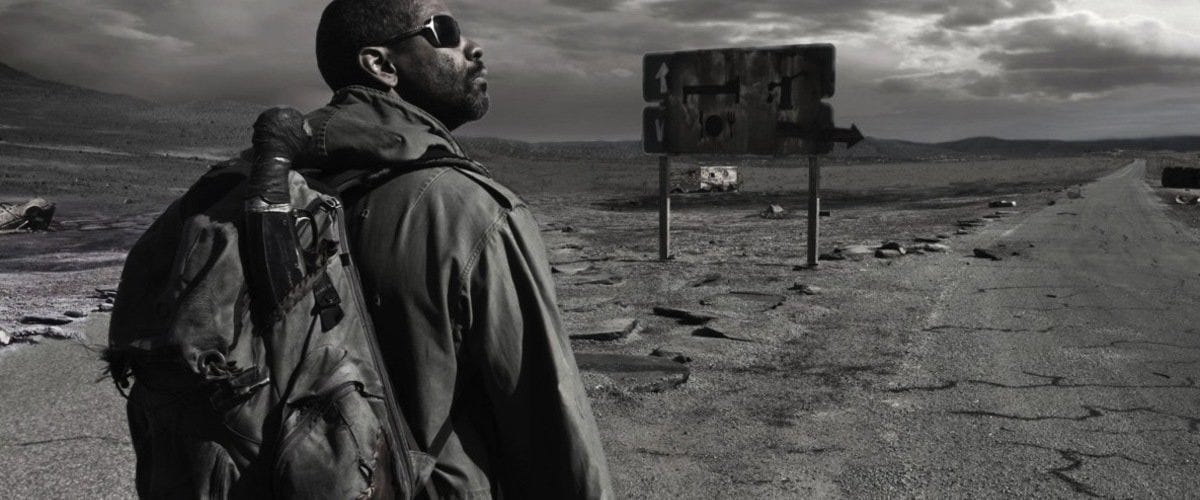
Scott: Before we talk about your new novel, “Abomination,” I’d like to explore the movie The Book of Eli, which you wrote. I watched it again recently and really enjoyed it. Here’s the IMDb summary: “A post‑apocalyptic tale in which a lone man fights his way across America in order to protect the sacred book that holds the secrets to saving human kind.” What was the inspiration for the story?
Gary: It originally had really pulpy roots. It started out as me just wanting to do a classic wandering hero movie. I grew up on a lot of classic samurai films, on Westerns, iconic characters like The Man With No Name, Zatoichi, and even Obi-Wan Kenobi. Star Wars was, of course, very much influenced by the great samurai and Western heroes that came before it. I’ve always loved that romantic notion of the wondering nomadic hero, the warrior prophet. He’s a peaceful man, but if you get in his way, you’re going to regret it. I’ve always wanted to do my version of that character, it feels very mythic to me.
For a long time, Eli was a very pulpy character. I was trying to find some way to elevate the character and come up with a idea that would make the film more than just a piece of popcorn entertainment. I needed something more substantive to carry the film thematically. The idea of the Bible, how it may be the last copy and why it would be so important to protect a piece of literature and who else might want it and for what reasons… that was the light bulb moment that gave me enough red meat to feel that there was a real movie there.
Scott: Urban legend has it that you wrote this script on spec and didn’t tell anyone about it including your agents and managers. Is that right?
Gary: That’s absolutely true. There’s always a battle in this business between what attracts you creatively to writing something and then what the potential for that piece is commercially. I may have an idea for a script that I really want to do, but it’s such an out-here idea that the idea of it ever getting made as a film seems very, very remote.
You’re always looking for that balance between art and commerce. For me, it needs to be an idea that I can get creatively excited about, while also having the confidence that at the end of the process it has enough commercial appeal to actually sell it and see it get made. But with Eli, I kind of threw all that away because I was really so in love with the idea creatively that I didn’t care if it passed the commercial smell-test. The idea of a crazy old man with a Bible in one hand and a sword in the other just didn’t seem like something that would sell. And it was really violent too, the original script it more violent than the finished film, we had to tone it down quite a bit. But creatively I was so excited by it that I just didn’t care. I knew that if I called my managers or my agent and told them the idea that they would talk me out of writing it. So I never picked up the phone, I just went and wrote it.
It didn’t seem like so much of a risk because it was already pretty well formed as a story in my head. One of the interesting things about Eli is that it’s not particularly complicated. It has very few moving parts in terms of the structure and the mechanics of the plot. So I didn’t have to spend a lot of time breaking the story. I knew who the characters were. I felt like it was something I could write very quickly. And I was so enamored with the idea that I felt that the only way to get it out of my system was to write it out, exorcize it that way.
I wrote it very, very quickly over the course of about a week. I did a vomit draft in six or seven days, 20 pages a day, 20 hours a day, working really, really feverishly on it. When it was done, I sent it to my agent, and I don’t think they knew what to make of it at first. Again, if I had pitched them the idea, they probably would have talked me out of it. But we sent it out and we sold it. I think in the end, it’s a lesson that in trying to find that balance between creative and commercial appeal, you always err on the side of what excites you creatively. That’s the only way to write honestly. A lot of people like to chase trends. They see a hit movie, and then they want to try to emulate that movie. That does not feel creatively satisfying to me at all.
Scott: If I could drill down into the protagonist of the story of Eli, played by Denzel Washington, you mentioned that you’re fascinated with these classic wandering hero types and The Man With No Name from the Sergio Leone Dollars Trilogy. Yojimbo comes to mind, the 1961 Kurosawa movie.
Joseph Campbell refers to a hero as someone who gives him or herself over to a cause bigger than themselves. Eli certainly qualifies. He’s got this goal with the sacred book to give it to someone who can put it to good use.
He doesn’t even know specifically where. He’s heading West. In some ways, it’s like, he’s given himself over to something requiring almost blind faith. I’m curious, were you at all influenced by this idea of the Hero’s Journey?
Gary: Yeah, it’s interesting. The Joseph Campbell stuff is not something that I ever really studied in any depth until I started working on Star Wars, at which point I really immersed myself in it because it’s such an integral part of why the Star Wars movies work as well as they do. When you see a story that really, really appeals to you ‑‑ one that resonates with you down to your bones ‑‑ they always come back to those classic mythic heroe’s journeys. That’s why we’ve been telling the same stories to each other for the last 5,000 years. I think a lot of those lessons we learn simply by osmosis, by watching the classic heroes like, as you say, Yojimbo, and Seven Samurai, and Star Wars.
With Eli, a big theme of his character was selflessness. It’s funny, a lot of people who saw the movie assumed I was a Christian because it has this a religious message. If anything, I’m an atheist. But I thought it was a fascinating mythology and I’ve always loved the idea of the basic Christian message of “love thy brother as thyself”. That’s the one thing Eli takes from the Bible, he has lived that message, and that’s what I hoped people would take from the movie, the idea was it’s not just good enough to go around saying that. You’ve really got to live your life by that principle. And so Eli has given up the last 30 years of his life in service of this mission that is not about him. It’s much, much bigger than him. He doesn’t even necessarily fully understand why he’s doing it, but he understands it’s important enough that he’s going to sacrifice his life for it. I’ve always felt like that he somehow knew that once the mission was done and once he had delivered that book, he would probably die. Because in his mind that’s why God put him on earth, to do this one thing, and once it was done, he was done. So yeah, I was always very attracted to that idea. You see it in “Abomination” as well, this theme of selflessness and caring about others more than you care about yourself.
Scott: I’d like to drill down into The Book of Eli. You’ve got the sacred book, which is essentially the only remaining copy of the King James version of the Bible. You’ve got this ruthless, lawless, post‑apocalyptic world. But in some ways, why not the Magna Carta? Why not the Constitution? What was it about the Bible that drew you to it?
Gary: I actually did play around with ideas of it being something like the Magna Carta or the Constitution of the United States. I think that version could have worked also. A lot of what the movie is about is the importance of the preservation of knowledge and understanding where we came from so that we can learn from that and chart a better course for the future. That was always very, very important to me, and I’m glad they stayed true to it, that when Eli gets to his promised land at the end, the library in Alcatraz, that it wasn’t in any way presented like a temple or a holy place, but as a place of knowledge and academia and culture, and these were scholars who viewed the Bible as simply a historical artifact rather than something to be worshipped and followed. Malcolm McDowell, at the end, is very much an academic and is really trying to collect and preserve as much of the old world that has survived as possible, so that when we finally reboot civilization, we have a better understanding of where we came from.
My sense is that whether or not you agree with the message of the Bible or whether or not anything in it is true, one thing you cannot argue with is that it is one of the most influential literary works in the history of human civilization. It’s one of the few books that has impacted the course of our entire history as a species. So it’s a fascinatingly important book, and the idea of intellectual stakes really interested me. If this really is the last copy, and if this one disappears, what does that mean? The next generation of humankind grows up with no sense of “This is what we used to believe.” That doesn’t mean we should necessarily believe it going forward, but we should know that this is what we once believed. And maybe that’s why we almost became extinct as a species, because we believed some of this stuff.
Scott: We get the idea that the Bible, for Eli, represents purpose in life. On the other side of the equation, you’ve got this antagonist figure, Carnegie, played by Gary Oldman. Mayor of this town. He’s been sending out minions trying to find these books, so presumably looking for the Bible as well. What does the Bible represent for him?
Gary: Eli and Carnegie were always meant to be the two expressions of the theme of the film. As antagonist and protagonist, they have these two different perspectives. Eli is a man of faith, but he’s very private about it. He protects the Bible. He’s very guarded around it. He doesn’t want other people to look at it. He doesn’t proselytize or try to spread the word in any way. He’s a man of very personal and private faith. That is something that has sustained him and strengthened him through thirty years of hardship. This is supposed to be the way the movie talks positively about faith. The idea that things happen for a reason and that there is a greater picture and it’s not just about us is very, very comforting to us and we can draw strength from that… I’m quite envious of people who are able to believe that. In that regard, spiritual faith is a very valuable thing.
Where it starts to become dangerous, and this is the part of the story that Gary Oldman’s character speaks to, is when you get into the world of organized religion and how religion can often be perverted. So much of the terrible things that happen in the world are caused by people are taking what they read in these ancient holy texts to insane extremes. So the idea that Carnegie, who’s old enough to remember the world before it was destroyed, and remembers the power of those words and how they can be used to motivate and compel people… that’s what the Bible really is to him, a tool with which to control people.
When Carnegie talks about how the Bible is not just a book, but a weapon aimed at the hearts and the minds of the weak and the desperate… that’s obviously a twisted view but I think also a realistic depiction of how the Bible is exploited by many people today. There are people, clearly, who can be influenced and driven to do what we might think of as crazy things because of what can be interpreted in those pages. So those are the film’s two thematic poles ‑‑ Eli representing a very positive and personal and spiritual and private iteration of faith, versus what Carnegie is trying to do, utilize that faith for his own selfish gain.
There’s a great line that inspired me a lot when I was writing the book. Alan Ladd in Shane says, “A gun is only as good or as bad as the man who wears it.” I felt like that was the expression of religion in this movie ‑‑ that in Eli’s hands, faith is a very positive and powerful and empowering thing, but in Carnegie’s hands it has the potential to be something destructive and dangerous.
Scott: You’ve got a really nice twist at the end of the story involving the Bible. I don’t give it away for people who haven’t seen the movie, but suffice to say that the title, The Book of Eli has a double meaning.
There’s the actual book, the Bible that Eli’s carrying, and then there’s the knowledge that Eli’s carrying within himself, which based upon what you were saying is quite interesting. It’s like he’s internalized the meaning of it, and then of course that twist at the end where Gary Oldman’s got the book.
Gary: It’s funny, I struggle a lot with titles. I often have a hard time writing a piece until it has a title. I was very lucky with Eli that the title suggested itself to me quite early and I always loved it and I always felt exactly as you say, it has a cool double meaning to it when you get to the twist ending. As much as I personally don’t believe in God, in the fictional world of this film, God absolutely exists. I don’t think there’s any sensible interpretation of the film that allows you to rule that out. The whole idea is that through the entire movie you might well think that Eli is a crazy man. But when you realize what he did at the end of the film and the circumstances under which he did it and you reevaluate the film in that context, it’s impossible to reach any conclusion that doesn’t validate some of what Eli’s saying ‑‑ that God really was talking to him and helping him along his journey. So the idea was there was a validation of his faith and hopefully, again, a triumph of good over evil in that the book ends up in the hands of people who will treat it soberly and correctly and appropriately as simply a historical text.
Scott: Really, a wonderful homage to the fact that the Bible was oral tradition for hundreds and hundreds of years. What we see Eli doing at the end, recounting it word for word, it’s a really wonderful image there.
Gary: Yeah, it’s a reversion to the most ancient form of storytelling that predates the written word, sitting around the campfire and telling stories. During the Dark Ages, when so many texts were destroyed, it was a similar thing. Part of the inspiration here was definitely “Fahrenheit 451” where the written word is on the verge of extinction and so the only way to keep literature alive is by reverting to an oral tradition.
Scott: One last question on The Book of Eli. Toward the end of the movie, Eli quotes the Apostle Paul from Second Timothy, “I have fought the good fight, I have finished the race, I have kept the faith.”
I thought, “That’s the perfect description of his accomplishment.” I’m gathering that you’re not a particularly religious person, so how did you hit on that specific Bible verse as a capstone for Eli’s life in the story?
Gary: Again, because I’m not a particularly religious person, I just went out and bought a Bible and I read through it. Eli actually quotes the Bible a lot more in the original script than he does in the final movie. But we kept the ones that we felt were most important. Adam and Eve’s expulsion from the Garden of Eden is in there. That little Timothy quote, even though it’s not one of the more well‑known quotes, felt perfect for Eli at the end of his journey.
One of the things that I’m really, really proud of, one of my favorite thing in the film, is that final speech that Eli makes in voice-over. I don’t know how many people got this, but certainly what I was intending was for that monologue to be the ultimate expression of Eli’s selflessness. If you think about what he did, he spent 30 years walking across this hellish wasteland and putting up with all kinds of impossible conditions, dedicating his life to this mission that he had been given. Then, when he dies and he offers up his final prayer, he’s not talking about his great accomplishments or asking for any credit. He’s expressing thanks for all the things that he was given along the way. He’s grateful for the blessings that he’s had in his life. I don’t think you need to have a religious interpretation for that to have meaning. It’s this simple idea of count your blessings. Don’t complain about what you don’t have. Be thankful for what you do.
Scott: Let’s get to your novel “Abomination,” which you can get right now from Amazon. Here’s some background on the story setting:
“After the fall of the Roman Empire, chaos and bloodshed swept across the remains of Western civilization like a plague. Consumed by fuel of warfare, you’re pledged into a century’s long era of illiteracy and cultural desolation from which few historical records survive.
Some believe that the true history of this Dark Age was deliberately concealed by its surviving scholars, too incredible to be believed, too terrible to be retold until now.”
My first question for you is why a novel? Why not a screenplay?
Gary: Screenwriting is my first language, that’s what I’m most competent and experienced at doing. I understand the cadence and the rhythms and the craft to screenwriting better than I do any other form, so when a new idea comes along, I usually look at it as a movie first. But after working in the trenches of Hollywood screenwriting now for 15 years, I think I’ve become quite good at anticipating all the reasons why a studio or a producer might say no to a project. And there are a lot of reasons, especially with original pieces. Eli was a small miracle in that it was a very out of left-field spec script, not all that cheap to produce, with a lot of controversial, potentially non‑commercial subject matter. So to see it made and certainly see it made at the level that it was, with people like Denzel Washington, was insane. That hardly ever, ever happens. We live in a world now where almost everything is a franchise. Hollywood has become very risk averse. It’s essentially now in the business of adapting properties that have already proven themselves to have an audience, whether it be Hunger Games or Star Trek or whatever. I enjoy those movies as much as anyone, but their dominance has made it very, very difficult for people to break through with original ideas. People often forget, Star Wars started as a spec script. Every big franchise started with an original piece of material.
That’s a long way of saying when I thought of the idea for Abomination, I went through the checklist of what a movie executive might say in terms of rejecting this as a spec script. With Eli, it was really my naivety that got me through this process. The fact that I was not quite seasoned enough back then to recognize that it was really unlikely to be made meant that I was able to write it. I don’t know if I would write it today.
With Abomination, I had a similar feeling of not knowing if I could sell it as a movie, but I really wanted to tell the story and I didn’t want the work to go to waste. Often times you write a spec script and if a handful of people in Hollywood don’t respond to it, that’s pretty much it, it’s done. It will sit on a shelf and that story will never find an audience because the screenplay itself is not the finished product. It’s the foundation for what you hope will one day become a finished film. The idea of putting all this work into an idea that I was really attracted to only to then see it probably not get made… I didn’t want to go through that again. Like every writer, I’ve had unsold specs and it’s really disheartening every time.
I thought maybe there’s another way to tell the story where I don’t have to ask anyone’s permission to put it in front of an audience. Write it as a novel and I could either find a publisher for it, which again, is not terribly easy to do. I knew that even if publishers rejected, I could always go to Amazon and publish it myself via their Kindle system and it would find an audience. There’s no one in that process between me and the audience. We’ve come a long way from the days of vanity publishing where there was a stigma attached to publishing your own book. We’ve had some really great pathfinders, people like Hugh Howey and Andy Weir. The Martian, which Andy wrote and initially put up for free on his website, has gone on to be a New York Times bestseller and is being made into a movie by Ridley Scott. We’re seeing more and more of these legitimate success stories that have bypassed the traditional route to getting a creative work into the market and in front of an audience.
Scott: What does it mean to tell a story in prose? What are some of the things that would allow a writer to do that where it might not be quite so easy in a screenplay?
Gary: There’s a fair amount of back story in Abomination, which in a film is often hard to manage. The characters spent a lot of time on their own because it’s a very solitary world. It’s very much an intimate character piece, so I wanted to be able to spend time inside the heads of the characters. Again, in film, that can be tricky to do but it’s the perfect kind of story for an intimate form like a novel.
Scott: I’ve read where one of your original inspirations, perhaps, the original story for Abomination was to write a story featuring monsters. Could you unpack that a bit?
Gary: I grew up watching a lot of pulp, popcorn entertainment so all my ideas start with some of that DNA in it, I think. There’s initially always a schlocky, pulpy idea at the root of it, which is good because it means there’s probably a commercial idea there, something that might have broad appeal.
With Eli, as I mentioned, it was the idea of wanting to do The Man With No Name, do my version of a classic pulp lone hero. But I know that there has to be more to it than that than just pure pulp, I don’t want to be in the business of creating stuff that you can enjoy for a couple of hours then you’ve forgotten about it the next day. There has to be some thematic foundation, something that resonates. Something a little bit more substantial or creatively nutritious to make you feel like you saw something worthwhile.
With Eli, that came through the religious subtext. With Abomination, I started out wanting to like a really gnarly, old-fashioned monster story. I grew up with the Universal monster films… Wolfman, Frankenstein, Dracula and Creature from the Black Lagoon, all that great stuff. John Carpenter’s The Thing was also a hugely influential film for me. So my initial thinking was, how can I come up with an idea that would allow me to create the most horrific, gnarly, sickening, disgusting, horrible monsters you can imagine? Then, beyond that, again, I try to find a story that’s a little more substantial than that, the real, relatable, human story underneath.
Scott: The story starts off feeling like it’s going to be this big war epic. You’ve got Alfred the Great, the church, monsters, magic and the English versus marauding Viking warriors. Then, as it goes along, it evolves into something much more personal involving two rather tragic hero characters who eventually intersect.
You started off with this idea of wanting to do a monster movie, but you knew you wanted to elevate the material. I’m guessing that it was these characters that drew you in that direction.
Gary: Yeah. It’s very much a character piece which, again, is why creatively I wanted to write it in prose because it gave me that ability to write interior monologue and spend a whole chapter what will probably be five or ten minutes of film without ever hearing that character speak but living inside their heads. We actually did that in the first then minutes of Eli, those opening scenes are very quiet with no dialog and you’re just following Denzel, getting a sense of what it’s like to live in this desolate world. But it’s very difficult to do extended portions of a movie that way.
And yeah, as you say, the book kind of does the opposite of a typical movie structure, which tends to escalate in scope and scale. All the big battle stuff is in the first third, and then the story contracts to just be about these two particular characters. Again, anticipating the movie development version of that story, I can see the guy across the table saying, “The movie needs to get bigger as it goes along, not smaller.” And if we were ever to do a film adaptation of it, it’s entirely possible that we might move elements of the story around to try and make it fit more of a typical cinematic structure. For the time being, I had this story that I wanted to tell and I didn’t want it to necessarily have to fit in a Hollywood movie shaped box.
Scott: That dynamic — part monster, part man type of an aspect of one of the characters — it poses a question we see in a lot of stories whereby key characters are confronted by this question, “Who are you?” That issue of self‑identity, you said selflessness earlier, that issue of self‑identity that’s a pretty key component to both of these two characters, but particularly the one.
Gary: Absolutely. I mean, all the really good monster stories whether it be Jekyll and Hyde or Frankenstein or The Incredible Hulk. Somebody mentioned The Fly to me the other day. It’s another good example. They’re all stories about identity and the monster within.
One of the characters in Abomination speaks to that theme quite directly. If there’s one idea that says, “This is the theme of the story”, with Abomination it is the idea that we all have monstrous parts of our personality deep down inside. It’s a constant daily battle, to live the better version of ourselves and defeat our inner demons and be a good person when often times our lesser angels and the circumstance of the world around us are taking us in another direction.
That is a constant fight that all of us have every day. A monster story like Abomination allows me to you externalize that and there literally is a monster that our hero is struggling to control. All good science fiction, all good fantasy is supposed to do this. You take something that resonates us in the real world and you find an extraordinary way to illustrate that idea. There’s a great quote that I wish I could take credit for — “Science fiction is not an escape from it reality, it’s a way to understand it.” And I think that’s what all the greats have done. If you look at Bradbury, at Asimov, at Vonnegut or Ballard, all the great science fiction authors have found ways to speak to the human condition and what’s happening in our society by taking those everyday themes and exploding them out into these very imaginative, outlandish explorations of those ideas that put them into sharp relief.
Scott: You’ve got another theme at work, too, with the magic that’s involved in the discovery of these nine scrolls with ancient incantations. Once mastered by the archbishop, they have a shocking transformative effect.
You mentioned Frankenstein. That echoes the original Frankenstein story. The archbishop in effect Dr. Frankenstein, right? He starts off with good ambitions whic gets consumed, that whole absolute power corrupts absolutely thing.
Gary: What you see in stories like Frankenstein and The Fly is, in part, the idea you can stumble on idea that is so powerful that it’s very easy to become corrupted by it. Our technological development often outpaces our moral and ethic development. As soon as we develop a new technology, one of the very first things that we figure out to do is how to we weaponize it. Very, very quickly, after we split the atom, we had figured out how to make a bomb out of that technology and on and on it goes.
Scott: What was the process like for you writing novels as opposed to screenplay? You’re freer from a page count perspective. You don’t have to worry so much about the narrative being an externalized reality. Did you enjoy the process?
Gary: Yeah, it was really nice that to not have to worry about page count for once. Often, my first drafts of screenplays are really, really long. Close to like a 170 or 180 pages when really it should be close to 110‑120. Then, a lot of what I do in the rewrite process is trying to cut it down and figure out what I do and don’t need. That’s not to say that when you write a novel, you’ve instantly bought yourself license to warble on and on — you still want to cut the fat and make the story as lean and as well-paced as possible. But it was nice to be free of that numerical restriction.
In many ways it felt like starting over. A lot of what I have learned in fifteen years as a screenwriter went out the window because it didn’t apply to the story I wanted to tell in the form I wanted to tell it in. Writing in prose is very different, and I had to give myself the license to do things that usually I wouldn’t be comfortable with, like spending time in the head of a character or devoting a whole chunk of the story to background. It took a little while to get comfortable doing that because all those years of screenwriting conditioned me to avoid those things. Once I got past that phase… it’s like breathing liquid oxygen in The Abyss. The initial panic subsides and you acclimatize to your new environment and you realize it’s actually pretty cool, this new environment. By the end of it, I probably had more fun writing it than I have any screenplay that I’ve written — with the exception of Star Wars — because I was able to give myself so much more license dramatically than I usually would in a script.
Scott: So, the book’s rolling out and you decided on this really interesting publishing strategy. In fact, I’ve never heard about it. I’ve read an article in the Wall Street Journal about it. Inkshares, could you describe what that’s about?
Gary: Yeah, Inkshares is very new. They’re based here in San Francisco, where I live. And their approach appealed to me for a couple of reasons. They’re an online startup and since I come from kind of a techy background I liked what they were trying to do. The internet has created this tremendous democratization in the creative marketplace where a lot of the gatekeepers who traditionally decide what gets presented to an audience have gone away. Now you can fund a project on Kickstarter, you can create a show on YouTube and just get it out there. And now it’s the audience that decides if it’s something worthy of success, not the old gatekeepers. We’re seeing this in publishing too, with a huge surge in the digital self-publishing movement, and now with Inkshares, with offers all the benefits of a traditional publisher with a lot of the freedom you’d associate with self-publishing. Abomination, like all Inkshares books, was crowdfunded. We put up a couple of sample chapters and some stuff about what the book was, and people could decide if they wanted to pre-order a copy. If enough people pre-order to fund the initial publication of the book, it gets published. And Inkshares is then able to tap into the resources of a “real” publisher — distribution, production, marketing, all the stuff that is often very difficult to do when you self-publish without any support.
Scott: It sounds like a terrific idea, and hopefully Abomination will be a big success. Before we get in some craft questions, I’ve got to ask you one question about the Star Wars movie. You worked on Star Wars Anthology: Rogue One, the film that Gareth Edwards is directing. It’s due out in 2016. What was your experience working on that project?
Gary: As I’m sure you can imagine, I’m really not in a position to say very much about it. But I worked on it for the better part of a year, breaking the story and writing the initial screenplay, and I had a fantastic experience. Gareth is one of the most talented filmmakers I’ve ever worked with, and he’s going to make a terrific film.
Scott: You’re also doing an adaptation of Mark Millar’s Starlight. how’s that going for you?
Gary: It’s been going really well. Basically I came right off of Star Wars and went onto Starlight. It had been waiting in the wings for me to finish on Star Wars. And it’s a big relief to go from a project where I’ve been able to say literally nothing to one where the whole story has basically already been published in comic-book form. There’s a lot of secrecy around Star Wars, but you can go buy the Starlight comic right now and essentially see at least in its original comic book form the story that we’re going to be telling you this time.
Scott: That’s great. A few craft questions for you. It’s interesting to hear you talk, because several times you’ve mentioned putting on the producer or studio executive hat when you’re looking at story ideas. How important do you think the story concept is to the overall strength and commercial viability of a spec script?
Gary: It’s funny, you don’t really hear that term “high concept” so much anymore. It was a big thing in the ’80s, and then it kind of went away. Put the thinking still very much prevails. If you have any ambition to see your story realized as a big movie, something that is not going to be super‑cheap to make, I do think you have be able to boil that idea down into one or two sentences that makes people say, “I would see that movie”. Because there’s nothing more depressing than pouring your heart and soul into a story and writing a script, and then seeing it not sell because at the end of the day there was never a simple, compelling idea at the core that people can grasp and get excited about.
So, I do try to submit everything that I write to this test before I really invest in it. Is this something that has a realistic chance of getting made? Is it something that people would want to see? I try to always take into consideration before and during the writing, simply so that I’m giving myself the best chance of seeing some satisfaction at the end. I don’t want to spend my life writing movies that I deeply care about, but which have no chance of anyone ever seeing.
Scott: I’ve read when you were first starting out, you didn’t do much in the way of outlining or prep writing. But I’m assuming that’s evolved over time. So, which aspects of prep do you tend to devote the most time to?
Gary: It went back and forth. When I was just starting out, I didn’t prep or outline at all. I would just dive straight into writing the script. And of course, that is not the way to do it. You will very quickly write yourself into all kinds of corners It’s a very amateurish way to do it, born of impatience and enthusiasm, but a lot of writers probably start out that way.
From there, I kind of rubber‑banded in entirely the opposite direction — I would very, very rigorously structure things. And I would write these really long, 30 or 40‑page treatments. Once the treatment was done, I had the satisfaction in knowing I wasn’t going to write myself into a corner. I know exactly where the story was going. The problem with that is that that made the writing process itself a little bit boring, because I had the story so well worked out ahead of time I hadn’t left myself anything to discover while writing. Trust me, writers hate writing treatments. It’s like writing the script but without any fun of writing the script. It’s helpful but it’s a joyless process, because the fun part is having the idea. The fun part is figuring out when a story clicks into place and you have that “eureka” moment. It’s really, really edifying. It’s so much fun to do that. That’s what we love about writing, when you get that little adrenaline hit. If you do all that in the treatment and don’t leave any of that for the actual script, the emotional process and the fun of writing the script can be quite flat.
Where I’ve ended up now is somewhere in the middle of the two, where I will outline and I will give myself a basic backbone of where the story is going. I’ll leave enough open and vague so that I still have latitude in the writing of the actually script to make those discoveries and find the little things as I go along.
With Eli, the outline was literally one page long, just a simple beat sheet of the 10–12 key story points that laid out the basic structure. So I had a handrail as I went along. As long as I held onto that through writing a story, I wasn’t going to get lost. But a lot of the cool little details and specifics and things that happen in the film came through in the actual writing of the draft. Because I tend to be most creative and have my best ideas when I’m knee-deep in the real writing rather than one step removed from it, which is where you are when you’re doing a treatment or an outline.
Scott: Does that extend to developing characters?
Gary: With Eli, yeah. I’m much, much more interested in character than I am in plot. It’s why Eli has a really simple plot. Abomination has a really simple plot. I like to think of the best stories as thin on plot but thick on character. Look at Beverly Hills Cop. Can you remember what the actual plot of the film was? Very few people can, but they all remember the character of Axel Foley. Because he’s what was what made the movie fun. We all remember that character. What was the actual plot of Pirates of the Caribbean? Do you really remember? Probably not, but everyone remembers Jack Sparrow.
So for Eli, all I had written for the story was that one‑page beat sheet. But I had pages and pages of character stuff written about Eli and Solara and Carnegie, who they were, where they came from. I wanted to know the characters really, really well before I started writing. By having just the basic outline of a plot and a really deep sense who the characters were, I felt the actual writing the movie became much easier.
Because if as a writer you’re in a situation where, for example, your character walks into a room and there’s a guy there pointing a gun at him, if you don’t instinctively know what your character would do, how they would react, I don’t think you’ve done enough work. You should know those characters as well as you know yourself.
Scott: What do you think about when you’re writing a scene? Do you have specific goals in mind?
Gary: It’s good to know your basic input and output. What do you have coming into the scene and what do you want to come out of it with? What do you want the scene to achieve? Sometimes it’s about servicing a single idea. Often, when I’m in the very, very beginning of the story process, I’ll write a little note, a little idea. It could be a specific line or a moment or a scene or a twist. I don’t even where or how it’s going to fit into the story, but I know I want it in there somewhere. With Abomination, there’s a moment like that, an idea I had very early on that I knew I wanted in the story no matter what. And I was lucky to be able to keep it in there because often the development process doesn’t allow it. Sometimes, you have an idea like that for years, that little moment or line or idea that you really want in the story. When you finally get to the point where you’ve developed the story enough to write it, you realize the greater demands of the story don’t allow you to have that moment anymore. It’s got to be sacrificed.
Scott: You say you tend to write long, maybe even a 180‑paged script. So you finish the draft. Now you’re facing the rewrite. Do you have a rewrite process?
Gary: The first draft is what I’ve come to know as the vomit draft or a dump draft because it feels like it comes out of me so quickly… well, you get the idea. It used to be with me that I’d start each writing day by reviewing the previous day’s pages. But that would usually wind up with me, spending the whole rest of that day rewriting them and I’d not get any new pages down. I’ve since learned not to do that. Never look in the rear view mirror. Keep writing, keep moving forward. So I don’t review the previous day’s work anymore. Vomit out that draft, let it sit for a bit, and then come back and take a look and see where you are. Then you can start the process of initially trying to get it down to some length.
I tend to write my first drafts very, very long, throwing in everything, and I’ll take a saw to it later. A scene that might start as 12 pages of dialogue might end up back down to two or three pages, or even no dialogue at all, or maybe I’ll just cut the whole scene. It’s surprisingly satisfying to write a bunch of stuff and then realize later that the script’s better off without any of it and just kill it.
Scott: This isn’t so much a craft question, but it’s one I get asked a lot by aspiring screenwriters, which is, “Do I have to move to LA?” You live in San Francisco. That doesn’t seem to inhibit your ability to work in Hollywood. I’m interested what your thoughts would be on that whole “You have to live in LA” thing.
Gary: I personally don’t think that being in LA is necessary to break in as a writer, but it certainly can’t hurt. I would hesitate to advise anyone to just quit their job and throw everything into a U-Haul and drive off to LA on a wing and a prayer. There are too many sad stories that began that way. If you want to be an actor, then you do need to be in LA, because you are the product. You have to go to auditions. You have to do that stuff. But you can write a decent script from anywhere. The difficulty begins once people start to get interested in your script. At that point you are going to have to go LA to go to meetings and for development.
Scott: You’re very active on Twitter. What is it for you that works about Twitter?
Gary: Part of it is because I work from home, as many writers do, and it’s a very solitary experience. I used to work in a collaborative office. When I edited magazines for a living, I was surrounded by 10 or 12 other very creative people, and we used to goof off and mess around and chat while we were working. Once I moved away from that and sat in a little private office on my own, just me and the screen, I started to realize how much you rely on having other creative people around you to feed your own creativity, to keep the motor running. When you sit in a vacuum and you’re staring at a cursor blinking on a blank page, it can be much harder to start that engine.
Even though it can be a tremendous tool for procrastination and distraction, I became quite active on both Twitter and Facebook because that is my way to supplement what I no longer have, which is other voices around me when I’m working, to stimulate my creativity. And it really has become a very legitimate networking and business tool. I’ve met and become quite friendly with a lot of other writers and filmmakers and people in this business that I never would have met otherwise. I’ve had several legitimate work opportunities that have come up purely through the contacts I’ve made on social media that absolutely would not have happened otherwise.
Scott: I would certainly recommend people to follow you on Twitter (@garywhitta) because you post some really interesting things and get into some good conversations.
Gary: It’s mostly stupid stuff about cake, but every now and again there’s something in there that might be worth reading.
Scott: Or darts. You did this thing when you were over in the UK recently, and you were obsessing about watching darts on TV.
Gary: Oh, you’ve reminded me. I’ve got to find a way to try and find a way to get darts on American television. It’s going to be a struggle.
Scott: We started off the interview with all these things you’ve done in your life, and now you’ve added novelist. What’s next for Gary Whitta? TV? Directing? Poetry?
Gary: [laughs] I have a comic book that’s coming out next year. Again, talking about projects having a second shot at life, the very first thing that I wrote even before Reaper, the thing that first got me into the business, was post‑apocalyptic Oliver Twist story called Oliver. I mentioned before the frustration of when you write a spec script and you put a lot of work into it, and it’s something that’s just not destined to ever really be seen by people. But with Oliver I was determined to tell that story in one form or another, so years later I revisited the script and reverse‑engineered as a comic book story. I found a very talented artist by the name of Darick Robertson, who is now the co‑creator of this with me. I’m writing it, and he’s drawing it. That’s going to be coming out from Image Comics early next year. I’m glad I will finally get to scratch that particular itch because there’s nothing worse for a writer than an untold story.
Scott: One last question, Gary. It’s the obvious one. I’m sure you get hit up with it all the time, which is what advice can you offer aspiring screenwriters, TV writers, comic book writers whatever about learning the craft and breaking into the business?
Gary: I just tell people to read really great scripts. I do think there are some books that are worth reading. I’m not aggressively against the how-to books, but I think you can get too caught up in the world of screenwriting gurus and people that profess to have the secrets to writing a blockbuster movie. Mostly those people are full of shit. There’s one book I really like called “How Not to Write a Screenplay” by Denny Martin Flinn, who wrote Star Trek VI: The Undiscovered Country, and that was one of the few that I read that I felt like had really good, practical advice. It wasn’t necessarily telling you what to do, but was making you aware of various pitfalls and how to avoid things that aspiring, newbie writers very easily fall into. I thought that’s one of the few screenwriting books I ever read that made an impression on me. And if a writer is trying to give me advice, I’m always looking at their qualification to give that advice. Denny Martin Flinn wrote one of the best Star Trek films, so I’m much more likely to listen to him than the guy who’s got no writing credits but apparently holds the secret keys to Hollywood success. I always find that very strange.
I’m quite envious of writers starting off nowadays. They’ve got this vast resource through the Internet of great, great screenplays that they can go read and learn from. And I encourage people not just to read scripts of great movies that they’ve seen. It can be very instructive to look at a movie that you love and then read the original script and see how what was on the page was translated into the screen and what changed and what didn’t. But when you’re reading a script for a film that you’ve seen, your memory of the film is always there informing what you’re reading on the page. So I think it can be much more instructive to read great scripts for films that haven’t been made, or that you haven’t seen. Read those because the objective of a screenwriter, of a screenplay, is to communicate and paint a picture of what the movie is going to look and sound and feel like and the emotions it’s going to evoke in your mind purely through words on a page. And it’s a very, very difficult job to do, but when it works well, when you’ve read a great screenplay, you feel like you’ve seen the movie.
Jon Spaihts’ Passengers is a script that I point a lot of people to. Just a tremendous, tremendous script. I read that script, and it felt like I had seen the movie. That’s one example, but there are many others. Look at the Black List every year and read those scripts. Read The Imitation Game. Even without seeing the movie, that’s a fantastic script. So that’s my advice, devour really good scripts from really good writers and learn from them. By all means read the books, learn about formatting, learn about three‑act structure and that stuff, but don’t feel beholden to it. Allow yourself to experiment, to bend and break the rules you’ve learned. The more that you try to adhere to some kind of screenwriting formula, the more likely you are to end up with a formulaic screenplay, and who wants that?
For my interviews with dozens of other Black List writers, go here.