Go Into The Story Interview: Gillian Weeks
My interview with the 2022 Black List writer.
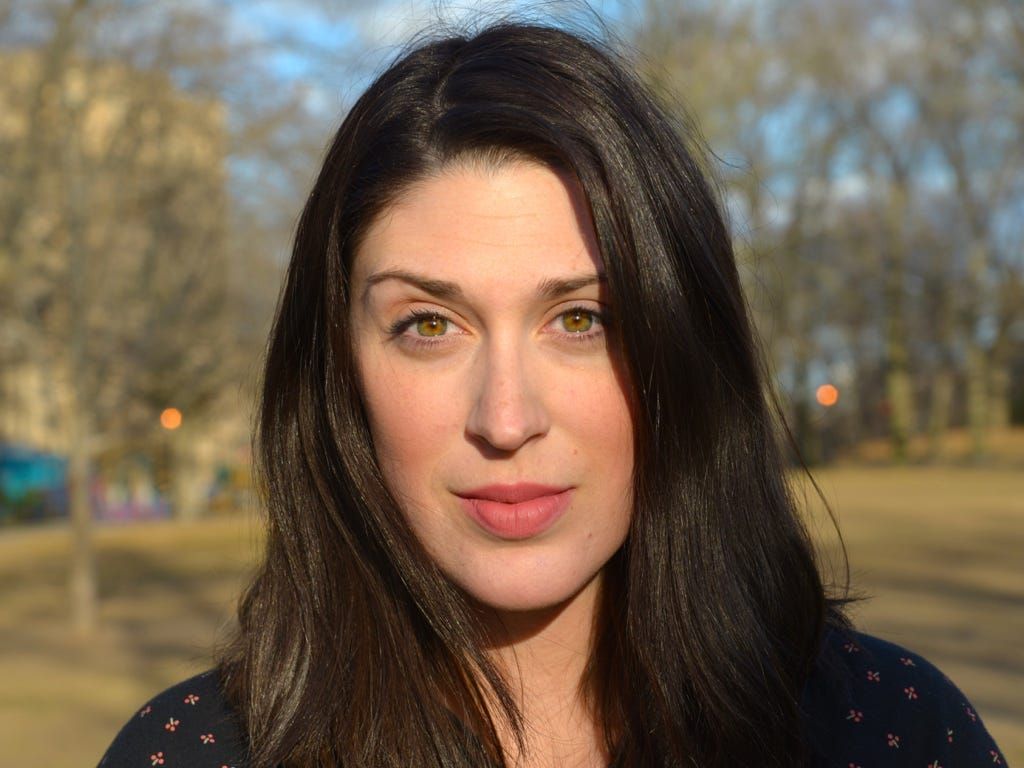
My interview with the 2022 Black List writer.
Gillian Weeks wrote the original screenplay “OH THE HUMANITY” which made the 2022 Black List. I had a one-hour conversation with Gillian about her background, her award-winning script, the craft of screenwriting, and what being on the Black List meant to her.
Scott Myers: How and when did you start getting interested in writing, and in particular screenwriting?
Gillian Weeks: I started acting as a young kid. But I don’t mean in Hollywood. I grew up in rural Oregon, a small town outside of Eugene.
I got a flier in my school mailbox when it was in third grade, saying, “Auditions for a local community theater production.” It was for an original musical by a 19-year old prodigy, basically the Northwest’s Lin Manuel Miranda. The show was very ambitious but he was putting it on at a tiny theater, and he needed to cast some kids. I sang “ Frère Jacques” for my audition.
So my first foray into theater, into storytelling, was an original story conceived and mounted by someone I knew. I got to participate in the process. I think that had to have seeded in me the idea that anyone can write a story. And anyone can, with their own determination and chutzpah and help from their friends, put on a show.
Then I went on from there to be in dozens of musicals and plays, mostly in local community theater productions. Eugene had a very good local theater scene.
At the same time, I knew I wanted to write. I was 12 when I got my first paycheck as a writer. I was in a program at the local newspaper, The Register-Guard, where once a week writers under 20 would write and edit a section of the paper. This is before, of course, local newspapers died.
Scott: Then you go off to Williams College and Oxford University. Your focus was political economy, right?
Gillian: In college I began to imagine myself as a journalist rather than a writer of fiction or drama. Ideally a political reporter. I was also very practical about all of it. I don’t think it occurred to me that I wanted to make a living from being in theater or as a novelist or any of those things. I didn’t consider screenwriting as a career.
Scott: That interest in journalism, didn’t you first work in documentary?
Gillian: That’s right. I wanted to go be a longform journalist but instead, the job I was able to get was as a PA in reality TV, and then that turned into a development job. This was the golden age of reality television. This is during the writers’ strike, actually.
Scott: I was going to say, that’s when it all blew up, in 2008.
Gillian: Exactly. There was money to be made, there were shows to be sold. I was in development at a couple different production companies. In some ways the worst job, but a very good job for an aspiring writer.
Because what it is, is scouring the world — going out there and meeting interesting people, finding the strangest, most fascinating subcultures you can, and then figuring out how to stitch it all together in the form of a narrative. Then to package that together and pitch it to networks and, hopefully, sell the show.
It was good training for storytelling. It also had me out there in the world, having strange adventures and meeting people of all walks of life. But ultimately, the shows that they would become were not interesting to me.
What I hadn’t realized at the time what that it was preparing me to write. Instead of sitting behind a computer and imagining real life, I was out there living it, witnessing it.
A few twists and turns that lead me to Alex Gibney’s company, called Jigsaw Productions. That was wonderful, because you have terrific access given his reputation as a director, and the opportunity to develop shows that are investigative. I got to work with some of the very best journalists and directors. Those were ones that I felt very proud of, and ultimately were beautiful pieces of work.
But all during this time, from the age of 22, I was waking up at the crack of dawn to write scripts in my bedroom. Very poor ones at first, but they got better.

Scott: I noticed this theme. A script about the invention of in vitro fertilization, a script about Jonas Salk, your Black List script about the Hindenburg. Is that a natural extension of your interest in documentaries and historically based stories or did at some point they brand you as “historical adaptation writer?”
Gillian: It’s a bit of both. The first true-story script I wrote was about the invention of IVF. My husband had come across the obituary of Bob Edwards, who was the inventor of IVF. We knew there was more to the story but there wasn’t a book or a documentary that had put it all together.
I received a grant from the Sloan Foundation through the Tribeca Film Institute, and that allowed me to do the primary-source research, to find an expert advisor and to feed myself while writing the script. Sloan actually funded the project a second time through another fellowship with the Sundance Institute. Because I had that support and encouragement, I was able to write this script that I’m now very proud of.
That script, called Let There Be Life, led to the opportunity to write the story of the polio vaccine. It’s similar, in the sense that it’s a midcentury story about a very enigmatic scientist. Those are hard people to write about because they tend to be very internal and very circumspect with the way that they talk about their motivations. Then the task is figuring how to dramatize the act of science, which doesn’t necessarily lend itself to a film treatment.
The Hindenburg script also began with my husband — airships were another of his esoteric interests. And one day he just mentioned, “You know, if you read between the lines of these histories of airships, you realize that there is a lot more than meets the eye.” He suggested that the Hindenburg disaster was actually a story about politics, not pyrotechnics. That got my attention, and I started looking into it.
In the course of my research, I found a new book that hadn’t even been published yet called “The Hidden Hindenburg,” by Mike McCarthy.
Mike had serendipitously done an incredibly deep dive into the historical records, and was able to find out more than anyone ever had about the political backdrop and the bureaucratic conditions that led to that disaster. That was a story that hadn’t been told.
Scott: Here’s how your script “OH THE HUMANITY” is described on the Black List:
“A dark comedy about the Hindenburg disaster, the mostly true story about one of the biggest fuckups in history, the assholes who tried to cover it up, and the female gossip reporter who made some Nazis very angry.”
What made you think, “Hindenburg? Comedy? That’s a good concept for a script.”
Gillian: This will sounds strange, but I think one of my strengths as a writer is that, while my tastes and interests seem sophisticated, I actually have a short attention span. I’m honestly a bit of a philistine.
What I mean by that is I take on topics that have a potential to be very heavy or complex, but I always think about what is the most entertaining way to tell it. You can take even a dark chapter of history and ask “How can I inject the story with as much fun as possible?” That doesn’t always mean it’s comedic. It can be suspenseful or terrifying. It just means that I don’t forget my job is to entertain.
But in terms of Oh the Humanity, and why it’s a dark comedy — I suppose I was just so struck by the idea of Nazis in New Jersey. It seemed so funny to me, these assholes running around like chickens with their heads cut off, trying desperately to cover up an absolutely epic fuckup, and then doing it all in a place as ordinary as New Jersey.
But I’m always punching up. The joke is on the people in power, both Germans and Americans. It’s about accountability and how, if we can shine a light on what’s happening in our country, even today, there may be a chance of averting disaster.
Scott: I would see this almost like a social satire. That choice right there, when I was reading it, Gillian, I said, “This is like antiTitanic.”
Gillian: [laughs]
Scott: You know what I mean? Titanic builds toward the big thing, it’s a drama with a romance and Jack and Rose. Your script literally starts off with the tragedy. You don’t even show the crash. You just see it like lights reflected off the event.
Let’s talk about that decision right there. You’re not building toward the Hindenburg exploding, like some sort of Erwin Allen ’70s movie. No, this is something entirely different. How did that spin out in your process?
Gillian: When you sit down to write something, you think about what’s the best way of doing it, but you also cross things off your list. Like, what’s the wrong way? I suppose it felt just deeply sad, to tell the story that ends in disaster.
To me the interesting story was not the crime but the coverup. They couldn’t allow the truth to come out because they were playing a game of perception, and the symbol of national German pride burst into flames in America. Everything was at stake.
Scott: I consider myself a fairly knowledgeable person about history. I’m also a Led Zeppelin fan, I saw them in concert twice, but they had the swastikas on the side of the Hindenburg? I didn’t realize that.
Gillian: Before I started educating myself more about the whole chapter of history, I imagined that Nazism was reviled from the very beginning and that they were always our enemy. It really couldn’t be farther from the truth. There was a very strong pro-fascist movement in the US. Flying an airship with swastikas around New York City was not a scandalous act, it wasn’t a provocative act. It was just PR.
But by 1937, Germany had become a very dangerous place to be for a lot of people. It certainly wasn’t a secret, particularly among Jews in America, that it was an anti-Semitic state. I’m sure that some people in New York looked up into the air and felt a sense of doom.
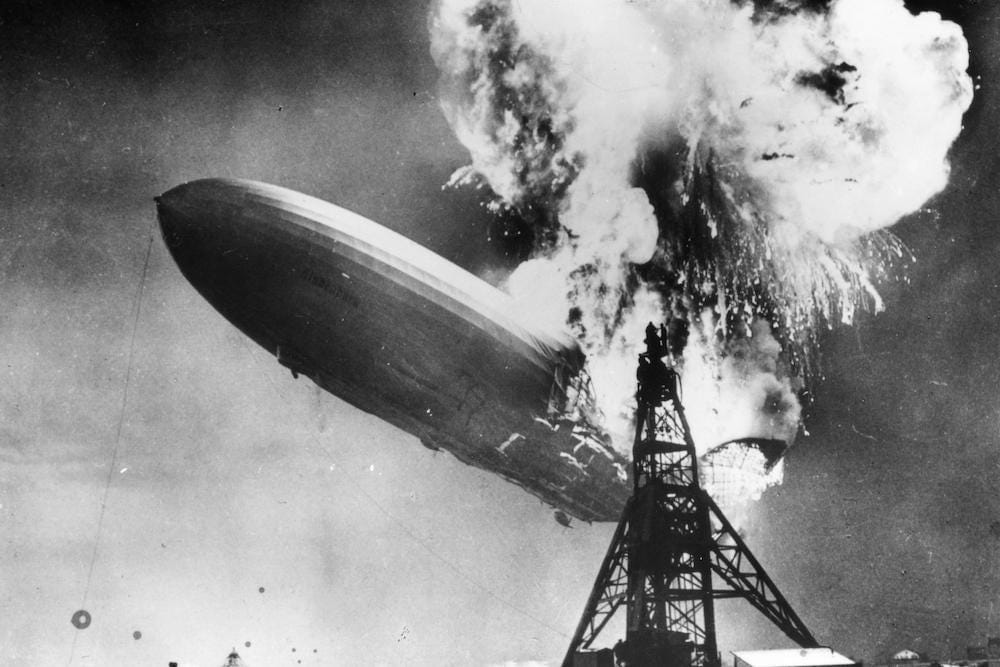
Scott: Let’s talk about some of the characters in the story, the key players, why you chose them, and whether some of them were based in historical fact while some may have been fictionalized. It’s an ensemble story, but the Protagonist is Gertrud. She’s a German citizen. She was a passenger on the Hindenburg. She survived. She got hurt This is how you introduce her in the script:
“The pursuer is Gertrud Adelt, 34 German. On better day, she’s a glamorous globetrotter and acid tongue sauce box. One hell of a good time. Now her red skirt is covered in mud and ash. Her white blouse smeared with blood. She’s hysterical.”
Is this based on an actual individual?
Gillian: It is based on a real person. Gertrud Adelt was a journalist. She was married to Leonard Adelt, who was also a writer, and was writing the biography of one of the ships captains. That’s why they were on board. I talked to her grandson who is a professor in the US now. He filled me in a little bit more about his relationship with her and how she struck him.
So Gertrud is based on a real person and the fact that they as a couple had unique insight about the true cause of the explosion, and that insight was suppressed. In the days and the months following the disaster, they were surveyed and monitored by the Nazi government. They had visits from the SS. Their family back in Germany were threatened and intimidated.
The liberty I took is that, although she was a journalist, and she wrote for Film und Frau Magazine, she wasn’t a gossip reporter specifically. Yet she did have the set of skills that would make her capable of finding the truth.
Scott: You’re on two lists in Hollywood: midcentury male scientists and brassy broads. There you go. [laughs] OK. Then there’s Hugo Eckener also a historical figure. Here’s how you introduce him:
“We consider a portrait of visionary, Adolf Hitler. This is in Germany after the conflagration in New Jersey. Then we consider the scowling man sitting directly beneath Hugo Eckener 67, Germany, tall barrel-chested with silver hair mustache and an urbane soul patch. A man who will never get used to not being in charge.”
He literally was the guy behind the Hindenburg?
Gillian: Yes. Hugo Eckener was extremely famous. He’s not a household name these days, but it is difficult to overstate what a worldwide celebrity he was at the time. He was on the cover of “Time” magazine. When he came to New York for the first time, they threw a ticker tape parade for him.
He was hugely famous in that time because he had captained the Graf Zeppelin, which was the predecessor to the Hindenburg, that flew around the world. It was a great feat. It had this flawless record of flights between Germany and Brazil, back and forth. It went everywhere. It was a real point of pride for the nation.
Then he worked with engineers to design the Hindenburg. But most of what we’ve known about his involvement with the Hindenburg was based on his memoirs, called “My Zeppelins.” His version of his own life story is one where he had stood proudly against the Third Reich. He was a thorn in Hitler’s side from the beginning, he never quite got in line, so he says. It’s true that he was not a member of the Nazi Party officially. But based on Mike McCarthy’s investigation, there’s a very different telling of events. He was much more of a collaborator than he presented himself.
Scott: Not to minimize this, but a lot of those people who were Nazi sympathizers and involved in that are sort of like the Hollywood producers when a movie bombs, “No, I had nothing to do with it.” They run away from it.
Gillian: “It’s true, I was barely there.”
Scott: “It wasn’t my fault.”
Gillian: “Oh, I always said it was a bad idea”
I will say that, although Gertrud is the protagonist, it was Hugo’s character that inspired me, and the script is almost a two-hander.
Hugo begins as a guy who’s not a fan of Hitler or Goebbels. He’s doing this reluctantly. He’s doing what he has to give himself a shot at having a career in the future and building another airship. But in the end he becomes the person that he claims to hate in the beginning. When push comes to shove, he will do anything for power.
Scott: That’s an interesting point, a connection between the two. They haven’t yet met, but both of them are essentially fired, and yet they’re given an opportunity, like the guy says, “Well, you go to the United States, massage this thing, plant this conspiracy theory,” or whatever, going back to the Hindenburg, “We’ll let you build a bigger one.”
Then for her, she’s fired from her gig as a journalist, “Well, if you go and massage this thing, then we can…” They’re both bound at the hip with the same sort of survival instinct, in terms of their professional careers.
Gillian: Yeah. They’re both given assignments to clean up the mess, and they should be on the same team, but then their paths diverge. He chooses to follow those orders and she decides that instead of accepting this assignment, she’s going to do the right thing, which is to find the truth. She realizes that, in spite of being this gossip reporter who doesn’t care about the truth, in this case, she has to make that choice. It’s a choice that everyone in Nazi Germany had to make in some way along the way.
Scott: From a morality standpoint, I suppose, it’s interesting. You’ve got these two characters, one’s in a descent, one’s in an ascent. It’s smart writing. You’re a good writer!
Gillian: [laughs] Boy, I’m going to write that on the wall, so I can glance up at it when I frequently doubt my abilities on the page.
Scott: That’s a proof that you’re a writer, that you frequently doubt. [laughs]
Gillian: Yes, every day.
Scott: My favorite character in your script is this guy Carl Syrup. You must have had so much fun writing this character. He’s assigned to Hugo to go over to the United States, to basically make sure he toes the line. Here is how you describe him when introduced in the script:
“A Sergeant, Carl Serup, enters wagging several small paper bags and dressed almost identical to Goebbels. A chummy psychopath.”
How did Karl emerge in your writing?
Gillian: I spent a lot of time researching the propaganda ministry and the internal apparatus to see what kind of things they actually do. In reality, there was a large group of government officials who went to New Jersey to try to contain the story. In this case, I have had just Carl and Hugo, to keep it cleaner.
With Carl, I wanted to send up Nazis’ stiff formality and vanity, a rather effete form of masculinity. And I needed someone to make the jokes, when the actual task that’s in front of the other characters is very serious.
Scott: He’s just a funny character. I want to get to EJ Connelly, who’s like a special agent who it’s you describe when you’re introducing:
“Squishes toward them in the mud in his city boy shoes. He’s got a handsome face, a pencil mustache, and a hardcore cop bravado.”
He comes in thinking the Hindenburg disaster is some sort of Communist thing. He’s the portent of the whole ’50s HUAC, right?
Gillian: Yeah.
Scott: Was that character real, or was this a fictionalized character?
Gillian: Oh he’s very real. He was an important deputy of Hoover’s. His rise started in the Prohibition days, at the birth of the FBI, then worked a lot in organized crime. By 1937, he was pretty high up within the FBI.
Also around that time, the FBI became very fixated on communists, and the way they were seeking to undermine the US government. If you look at the historical records, the FBI did investigate accusations of sabotage, and they pursued them very seriously.
To the FBI’s credit, ultimately, they were like, “There isn’t anything here,” but everyone had been quite eager to have that be the explanation. Not just the Nazis, because that helped them save face, but also the FBI.
Scott: One last character I want to mention is the South Trimble character, you describe as, “It’s like if Bill Clinton was born rich. He’s a big man, with wire rim glasses and a dapper suit. He speaks with a melodic Kentucky accent, especially when he’s negging a European.”
Gillian: He’s a historical figure. He oversaw the hearings. He was indeed from Kentucky. I was doing genealogical research and found a source that described them as large landowners Kentucky, for many years.
They were real fixtures in Washington. His father was a Congressman and served as the Clerk of the House of Representatives for 15 years. Then his son became a lawyer with the Commerce Department.
I’m jumping to some conclusions about his attitudes around race and class, but given where he came from, he provides a link between the American South in Jim Crow days and German ethnonationalism.
Scott: Now, I want to step back a little bit, put our screenwriter hats on here. You’re, of course, I’m sure quite aware with these so-called screenwriting rules. Things need to happen here on this page, there on that page.
You make some really interesting narrative choices in your script. For example, there is this thing about the break into Act Two happening on 25.
In your script, I would say that it’s not until Trimble is introduced on 31 and we establish that there’s going to be this hearing, that that’s where act two begins.
Do you at all think about any of this stuff? Like, where these page counts need to happen?
Gillian: I think that the rule about act one, act two — to the extent that there are rules — that’s a fairly good one. I personally see that act two transition happening a little sooner. To me, it’s when both Gertrud and Hugo get their assignments and they’re sent on their way. The game begins.
To me, a lot of those so-called rules are fairly intuitive. In a character’s journey — where they succeed and where they’re thwarted and those low points and ultimate triumph — I think that comes from a place of, how do I want to be feeling? How do I want my audience to feel at various moments along the way? You have to hear the music.
Scott: I want to talk about the comedic tone. It’s such a variance about humor. Your narrative voice. For example, when you introduce the nurse Rivero:
“Nurse Rivero, 40s Puerto Rican, the unfuck with a bold word supervisor.”
Then there’s slapstick moments:
“Karl and Hugo are wrestling over a swastika pin which Karl’s trying to force into Hugo’s lapel. Hugo gets poked.”
How did you sort out the comedic tone of this thing where you felt like there was a consistency to it? Was it a trial and error thing, or did you have that in mind right from the get-go?
Gillian: Two important things. Very directly on the tone — it starts as a comedy with a fair amount of laughs. Then, it’s like boiling a frog, where by the end of the movie, we’re in a pretty dark, earnest place. We’re talking about the Holocaust by the end. I wanted to slowly shift that over time so that we would accept the gravity of those moments at the end.
The other important thing to point out is how the script was developed. It all started with three sentences about this idea in a general meeting with some producers from 21 Laps.
Scott: 21…Shawn Levy’s…
Gillian: Yeah. I developed both the polio movie with them and this one, at that same time. I pitched them three sentences because it truly was all I had at that moment. They were like, “This is really interesting. Let’s keep talking about it.”
I worked with them hand-in-hand, over a long period of time, to develop it. They got the rights to book that it’s based on.
They felt that a pitch for this feature, without a director, wouldn’t sell. I would have to spec it. But before I spec’d it, I wanted to write a treatment. But instead of writing it as a dry document — because treatment are really awful reads — I set out to write it as if it was a “New Yorker” article. A lot of those descriptions that you just read out loud, those were from my treatment, because I wrote it in this very literary style.
Then, when I sat down to write the whole script, I wrote it incredibly quickly because I knew exactly what I wanted to happen in every scene and how it would feel, and the tone of it.
That’s not to say that there’s many drafts of it, but of all the things that I’ve now written, it’s probably seen the least amount structural change. Because we’d worked hard on that treatment, going into it.
Scott: When you pitched the three sentences, was the dark comedy aspect of it included in that?
Gillian: Yeah. At the end of my first general with them, Dan Levine, who’s the president of 21 Laps and a very smart guy, he said, “We’re sort of interested in very timely historical pieces. What else do you have?” I said, “Well, I’m pretty sure that Hindenburg blew up because of a bunch of bureaucratic bullshit from the Nazis. I feel like that could be funny.” [laughs]
That’s where we began. Then, we found the book.
Scott: I want to talk about one more thing about your choices, and that’s the dialogue. You normally think, World War II, that era, German, they’ve got this sort of a vicious… [laughs] Goebbels is like, “The Reich has many enemies and sabotage is a far more appealing story than ‘Oops!’”
It’s like a bunch of Americans talking in 2023. Where did that come from in your thinking?
Gillian: Let me talk about comps for this movie and where it might fit in. One that lived most in my head was “The Death of Stalin” — I love Ianucci, and that film was extraordinary to me. The balance that he struck with the comedy and the truth of Russian mass incarceration and murder. I thought it was quite perfect.
The other one was Jojo Rabbit, another Black List script and the way that that also injected a lot of comedy into this very dark chapter. Those two were definitely in my head. Both of those scripts use modern language to depict that era.
I didn’t want to go too far. There were definitely lines in there that we pulled back where the language felt too anachronistic. It’s a tricky balance, but I feel like there’s now enough precedent, that people are used to watching historical pieces that feel a lot more modern.
Scott: Jojo Rabbit does provide a nice bridge for you.
Gillian: Yeah.
Scott: This is your first Black List script, right? What was that like? Were you paying attention on the second Monday of December?
Gillian: I certainly knew it was happening, but it also coincides with school dropoff for my son.
[laughter]
Scott: Priorities.
Gillian: To tell you the truth, it’s been a lifelong goal of mine to end up on the Black List. I was dropping off my son at school. Then, I started getting texts from my colleagues and friends. I got in the car and put on some Beyoncé and had my own little private celebration at stoplights. In classic LA style.
Scott: Congratulations. I want to ask you one specific craft question because you have done so many of these historical, I guess you call them adaptations. What are some of the unique challenges of writing those type of stories? There’s the historical truth. Then there’s the emotional truth. How do you balance that out? What are some of the challenges that you face when you write those type of stories?
Gillian: Yes, I’m writing my fourth true story script right now, and then I’m writing a true story pilot after that.
There is something very magical about a film based on a true story. They help us process both famous events we watched or read about from afar, and also our our lives. Our brains are constantly trying to turns bewildering experiences into narratives. I just do it for a living.
The way I see it, how closely you hew to the historical truth depends on the story you’re telling. If you’re writing about the invention of the polio vaccine, which is a very famous story and an important part of American history, you have a much larger responsibility to get it right. In the case of this script of “Oh the Humanity,” I felt a lot more freedom to depart from the historical truth so long as I got the central conspiracy right. In the end, I was actually a lot more faithful than I could have gotten away with.
At the same time, no one’s going to watch your movie if it’s not breathtakingly fascinating from the very first moment. And the best way to do that is by knowing as much as you possibly can about your subject. You have to behave like a journalist or an academic. You have to get in there and find things that no one’s ever found before. It’s the smallest details that end up becoming important because they offer a way to enliven mundane daily life, or a way to reveal character, or they become a symbol of a core theme that holds the whole damn thing together. And when you come across roadblocks when you’re writing, you can go back to that initial trove of information, like a detective, and ask, is there a clue that I missed?
For my interviews with dozens of other Black List writers, go here.