Go Into The Story Interview: Murder Ink
My conversation with Brandon Broussard, Hudson Obayuwana, and Jana Savage, the writing team behind the 2021 Black List script “Homecoming.”
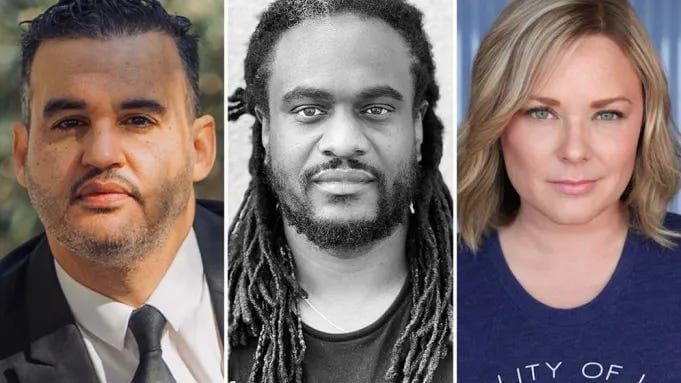
My conversation with Brandon Broussard, Hudson Obayuwana, and Jana Savage, the writing team behind the 2021 Black List script “Homecoming.”
Murder Ink consists of three writers (Brandon Broussard, Hudson Obayuwana, and Jana Savage) who wrote the comedy feature script “Homecoming” which not only landed on the 2021 Black List, but also sold as a spec script to Lionsgate. I had the opportunity to talk with the trio about their backgrounds, the inspiration and writing of “Homecoming,” and where their careers have gone after making the annual Black List.
Scott Myers: I’m here with Murder Ink, three writers who wrote “Homecoming,” a 2021 Black List script. Let’s dig down into each of your backgrounds. Since the script takes place at Howard University, maybe one way to do that, we’d look at each of your respective educational backgrounds.
Brandon, you went to Howard, then you got a fellowship at USC?
Brandon Broussard: I did.
Scott: How did you get interested in the writing for film and TV?
Brandon: I went to undergrad at Howard studied political science after that. I went down to Houston to work for my family. After I got fired by my family, I had a very serious conversation with my mom about the direction of my life. We decided that I needed to do something I really love.
I found screenwriting to be something that I really was drawn to. I went back to Howard for grad school for screenwriting. I knew from my very first course that that was what I was intended to do.
The first night, I wrote 30 pages. I was like, “Oh, yeah, this just feels like what I’m supposed to do.” Cut to, I ended up making a feature film while I was in the program that I ended up putting in a bunch of film festivals.
That’s how I met Hudson. He was actually one of the four lead actors amongst them. We’ve won a bunch of awards, and yeah, seeing the audience react to it, I was like, “Yeah, I’m on the right path.”
Scott: Hudson, you went to Howard as well. That’s where evidently you and Brandon met. Your background is in film production and theater arts, including acting?
Hudson Obayuwana: Yeah, initially. I’m from LA originally. I went to junior high and high school in St. Thomas in the Virgin Islands. When I was here in LA, my mother worked in and I grew up and around the arts. My mother was the box office and ticket manager for UCLA at Pauley Pavilion. She was the ticket manager at the Hollywood Bowl.
I was a young kid backstage at plays and concerts and meeting people. I was always exposed to the arts. That trend continued when we moved down to the Virgin Islands when I was in junior high. She managed the box office again at the local amphitheater at the university down there. My very first job, I was working on a stage crew building sets, running light shows, and stuff like that. When it came time to decide what I wanted to do as a major, I was just like, “Man, this is what I love, what I’ve been around,” but I wanted to act. I came to Howard as an acting major.
I realized the theater program at Howard is very intense. You’re taking dance, stage makeup, play, movement, all these things that I was completely not interested in.
Jana Savage: Acting like a cat.
[laughter]
Hudson: Yeah, pretending to be. I remember I had a professor, she had us folding sheets. She was like, “I don’t believe you.” I was like, “That’s because I’m not holding any sheets, lady. This ain’t for me.”
[laughter]
Hudson: A friend who was a couple years older, a good friend of ours, Logan Coles, who was a writing and producing partner with Chadwick Boseman, he was there at the same time. He was a mentor and advised me, “Man, it seems like you should go down to the school of communications,” which I did. I was able to still keep my acting credits.
I knew that film and TV was more where I wanted to be. I moved down there and saw flyers for an audition for this male version of “Sex and the City.” I auditioned. Mr. Broussard cast me. That was the start of our journey. I came out to LA, also thinking that there was going to be big check waiting for me. It was a PA check. [laughs] That’s how we got started.
Then, Brandon moved out here. It was around the time from “The Dave Chappelle’s Show.” People were starting to put their own original content on YouTube. There was “Lonely Island” and “Awkward Black Girl,” which Issa Rae obviously turned into “Insecure.”
We thought we would fill that void and started a sketch comedy show. That was the beginning where we were writing, producing and directing our own stuff. That was my entrée into like, “Man, I want to do this writing thing.”
Jana: We found out very quickly that Dave Chappelle was a big part of that void.
[laughter]
Jana: Nobody bought that show.
Hudson: We thought we were going to be the next Chappelle Show, but without him we just had a show.
Jana: We were young and hungry.
Scott: Was this “Purple Stuff TV?”
Brandon: Yes.
Scott: I watched a couple of those videos, not quite Chappelle.
Brandon: Oh my gosh.
Jana: No.
[laughter]
Hudson: Not quite.
Scott: Jana, how about you? You might have the most circuitous route, Boston University, Economics and Spanish?
Jana: Yeah. I grew up in Maine. I always, in my head, wanted to be an actor but never did anything about it. My mom, actually, she’s a choreographer and a dance teacher. She would do regional theater. She never let me be in her plays, A, because I couldn’t sing, and B, because the rehearsals were at night. And with school and everything it would be too much. That didn’t stop me from pretending that I was an actor in my daydreams, though. But as I got older I was like, “Well, that’s kind of silly. People from Bangor, Maine, don’t become actors.”
But I wanted to explore, go somewhere. I went to Boston. That was the closest city. I needed a major, so I ironically picked the major I knew I wouldn’t have to write any papers for, Economics. I loved Spanish, so I minored in it. That backfired because once a week, I’d have to write a paper, but in Spanish.
After my freshman year in college, some of my friends from high school, somehow, they raised like 100 grand to shoot a film. I got a small part in it and I was like, “I’m hooked.” I was afraid to tell anyone that I wanted to be an actor. I don’t know why. I’m pretty sure everybody was like, “Yeah, that makes sense. You’re loud, and you like attention.”
[laughter]
Jana: I secretly started taking acting classes that I paid way too much for in Boston. Then BU was just starting a program. It was almost like an exchange program, but instead of out of the country, it was LA. We were one of the first years that it was happening.
I was in the School of Arts and Sciences, and this was the School of Communications. I went in and I was like, “Can I come?” They were like, “I guess.” Everybody else there was communications and I wanted to be an actor, but I had some really cool internships. I interned on “The West Wing” and “Malcolm in the Middle.” I was like, “OK, I have to be here.”
I was only a junior at the time, but I was luckily ahead in credits. I went back and graduated in three years so I could come back to LA. I was focused solely on acting for, let’s see, the first, I don’t know, eight years I was here.
Then I ended up auditioning for Purple Stuff. They didn’t cast me because they’re jerks. But I had to write my own jokes for my audition and they ended up asking me to come write with them.
I got my revenge because I was like, “Yeah, I’m really good writer.” Then I was like, “No, you have to teach me.”
Hudson: She turned in her first script in Microsoft Word.
Scott: In Spanish.
Jana: In Spanish. I’m going to impress them.
Hudson: Got all the tabs right. She got the margins right…
Scott: Let’s talk about Murder Ink. The legend is that the name came about because you’d written a script and someone said, “Well, you killed that script.” True? False? What’s the story on Murder Ink?
Jana: It’s actually because Ja Rule used to be our fourth member.
[laughter]
Jana: Then the Fyre Festival happened, and we were like, “We can’t have that.”
Brandon: We’re like, “Get out of here. Get out of here.” The bread lunches were Jana’s idea.
[laughter]
We were writing after Purple Stuff. Occasionally, we’d get little gigs. They paid money for six weeks or something to try to write something for YouTube or whatever. What we were finding is that we had the best synergy, because the three of us would stay after everybody else had left and rewrite all the scripts together. I was still writing stuff on my own. I’d written a pilot that got optioned by a production company.
Then they asked, “Hey, we have this feature that we’re trying to shoot. We’re going to shoot it in about a month, but it needs to be written. The caveat is that, it has to be rewritten in 10 days.” I’m like, “I don’t think I could give you something of any kind of quality in 10 days, but I do have two friends that I work with that we write in together sometimes. TV‑room style, we could probably give you something you would like.”
We went off and rewrote the script at the time and turned it back in, in 10 days. We wanted to celebrate but it was late on a Friday night and all we had in the fridge was some cheap beer and flat champagne. We drank that.
At the time we said, “Hey, we should call ourselves cheap beer and flat champagne.” The executive called the next day and was like, “Man, you guys murdered that script or killed that script.” We’re like, “Oh, I think that’s a better name, Murder Ink.” Now we still have a tradition.
Jana: We do have a tradition.
Brandon: Whenever we finish a script, we do drink cheap beer and flat champagne, but that’s not our name.
Scott: No.
Brandon: That was how the Murder Ink was born.
Scott: That’s a great name for a country song. [sings] Cheap beer and flat champagne.
[laughter]
Scott: Let’s talk about “Homecoming.” Plot summary here:
“Ten years after graduation, one of New York’s most eligible bachelors and his eccentric wanderlust wingman try to pull their recently divorced friend out of his rut by taking him back to Howard University’s legendary Homecoming for the best weekend of their lives.”
The script made the 2021 Blacklist. I’m sure that many people supported it in the industry because it’s flat out funny, but I also imagine that the more enlightened in development also admired it because it’s a very well‑crafted script. The characters are entertaining, there’s a solid structure. Plus, there’s attention to more sophisticated screenwriting stuff, setups and payoffs, callbacks, runners, and so forth. I’m guessing that the inspiration must have been from you guys having gone to Howard. Talk to me about where the genesis of this came from?
Hudson: Jana, you want to talk about your experience there?
Jana: Yeah, let’s talk about my experience at Howard. I did not go to Howard, we already covered that.
Brandon: We can both chime in. Hudson and I we’re both promoters at Howard University and were throwing parties when we were there. We actually had to compete with a guy who owns the biggest clubs there and was notorious for having slapped a friend of ours who’s 6'6". A big brother that I would never think to slap. He had no problem slapping him. He made an insane amount of money from his parties, because thousands of people would go and he was charging $100 plus a pop.
The other quick thing I’ll say about Homecoming is that, my freshman year at Howard, I wanted to go home. I was homesick. I was like, “This isn’t for me. I made a mistake in choosing Howard.” Then people kept telling me, “Wait for Homecoming, see how you feel after that.” Sure enough, Homecoming happened and it was this life‑changing experience. It’s joy and hanging out with your friends like you’re in a movie, which is how we ended up writing a movie about it.
Hudson: Piggybacking on everything Brandon said, we’re very vocal about the fact that Howard was extremely instrumental in us being the men we are today. It’s this breeding ground of Black excellence. You have all these young people at a time in their lives where they’re trying to figure out what they want to do and gain their confidence. And you’re surrounded by people that look like you. The president is Black. The captain of the football team is Black. We have Rhodes scholars and frats. This cacophony of people from all over the diaspora and you see that, we’re not a monolith. You’re meeting people from the south and from France and from Nigeria and all over the place, is a special place to be figuring out who you are in your formative years. On top of that, it’s one of the best party schools in the country.
We wanted to hide the medicine in the candy of that environment and have this epic, fun, universal story that anyone could enjoy and relate to, but have this place that was very special to us as the backdrop for that.
Jana: We love writing all sorts of genres, but comedy is where we started and it’s pretty much in the DNA of everything we write, even if it’s not necessarily a comedy. We’re coming off an era where people didn’t want comedies, people didn’t want rom coms. There were all these important movies coming out but there was also a lot of trauma. We wanted to write something joyful. We wanted to see three Black men loving and having fun and experiencing joy. That was important as well. It’s obviously a big, broad comedy, but the higher purpose is to see people of color being successful and joyful. That felt revolutionary in this moment.
Scott: There’s a couple of story dynamics I want to ask you about that struck me as having universal appeal. The first is nostalgia. Hollywood’s completely mainlining nostalgia. It’s like all the TV shows, reboots and remakes or they recall the past. I was thinking about it as I was reading your script. There is nostalgia in the story itself. The characters are going to revisit their past.
It’s ten years past their time when they were in college. There are certain things going on that they remember and whatnot, but there’s also the feel of the script, in a way. The character types, the storylines, it’s like a contemporary retelling of a movie that I would have thought I could have seen in the ’80s or ‘90s.
Were you conscious of the whole nostalgia thing?
Brandon: I’m so glad to be having this conversation.
[laughter]
Hudson: One of our favorite parts in our process is the research. When we figure out what it is we’re going to write, we do research, which pre‑COVID looked like the three of us crammed together on Brandon’s sofa, watching movies.
When we did “#RealityHigh” for Netflix, we were watching “Clueless,” “Fast Times at Ridgemont High,” and all the John Hughes stuff . We were driving Brandon crazy because Jana and I were quoting all of these high school…
Brandon: Oh, my God.
Hudson: …teen movies word for word.
Even when we were doing this one, we were thinking about a lot of the films like “The Hangover.” We were thinking about Brandon’s all‑time favorite, which is “Swingers.” We’d get to go back and look at these movies and thinking about this core group of friends and their relationships.
That’s absolutely something that resonates with us in terms of looking back at old films that meant something to us and seeing what worked about them and applying some of those things to our characters and our story.
Jana: Not to speak for the Black men on the call, but something that I hear often from my partners is that when they were younger, they wanted to see people that look like them in certain genres.
With #RealityHigh it was seeing people of color in a John Hughes type movie and with this, it’s the idea of seeing them in a big, broad comedy. That’s what’s so exciting about doing this movie. We’re currently in the process of rewriting this script for Lionsgate and it’s interesting to have these conversations.
It’s very exciting to think about the actors and seeing them shine in that comedic way. Like you said, it’s so specific, but it’s so universal. That’s cool.
Brandon: Reiterating what she already said, we are huge fans of “Wedding Crashers,” of “Meet the Parents,” of “There’s Something about Mary,” going all the way back to “Animal House,” to “Old School,” and like Hudson said, “Hangover,” and “Bridesmaids.”
There aren’t Black broad comedies like that with the exception being “Girls Trip.” What Jana said, “Why can’t we see our story? Why can’t we turn the camera a little bit and see the same kind of film, but with people that look like us?”
Scott: I was thinking about that. I doubt that you were putting on your producer’s hat when you were making the decision to write this thing. I’m sure it was more like, “This seems like great fun and a great way to work a story in this context.”
Jana: We weren’t thinking about budget.
Scott: Beyoncé?
[laughter]
Hudson: Before we sent it out, we threw that little joke in the action line with like, “Unless you think we can actually get her, we don’t actually see Beyoncé.”
Scott: You totally broke the fourth wall there, but I think that was appropriate.
Howard University is one of the most notable HBCU schools. Your script also celebrates the place. I’m curious whether you were thinking, “You know what? From a producing standpoint, that’s an untapped thing.” Riffing off what Jana was saying, you could do a comedy in this type of space that would fill a vacuum in a way. Did that even come into your thinking at all?
Brandon: I know that Howard is a draw. I was more thinking that Homecoming was an untapped place. It’s such a huge event for Black people. One of the things we joked about was including a line like, “We know everybody got a text from their friend a week ago saying, ‘Are you going to homecoming?’”
It’s such a universal thing. Almost everybody Black in this country, especially if you’ve gone to an HBCU, gets that text. Then the idea that other people that aren’t Black don’t know about that is crazy to us. It’s like, “This is like New Year’s Eve.” This is just a universal thing that happens every single year that we either go to or don’t go to, but we’re very aware of it.
Hudson: We knew we were shooting for the stars. As a writer, people say, write what you know. There have been other movies set at fictional HBCUs and we knew that. To film at Howard, we were writing an environment, a campus, the surrounding area that we were familiar with and had that DNA of what we knew. People from DC have read it and said, “Man, we could tell you guys are really from Howard.” Producer-wise, we know we’re going to have to jump through some hoops to actually film at Howard.
Scott: We talked about that nostalgia thing, but there’s another thing going on here, which I think is universal. That’s regret. Everybody lives with regret. They wish they had done something or they wish they hadn’t done something.
You’ve got two‑lead characters, both of whom have some regrets about what in their case didn’t happen with regard to their respective romances. Was that something that you were consciously thinking of? Or is that something that naturally flowed and working with the characters and writing the story?
Brandon: Both. I know for me, I definitely have regrets from college. I have the ones that got away that don’t even know they got away. All those things that you wish you did. We did know going in, that is a very universal concept. The idea that you wish you could go back to your high school reunion or your college reunion to show somebody who you are now. You wish you were that person back then. It resonated from me. It was a reality for me.
Jana: It’s funny you bring it up because that’s something that we’ve even leaned into further in this current draft. This idea of feeling they missed out and how hard they’re trying to now create their second shot.
It’s also fun to have the Sweet Milk character who lives with zero regrets even when he should. In some ways, he’s so sage. The sage who’s like, just live in the present. I obviously did not go to Howard, but I look back on my college experience and I have so many regrets because I was so shy. I made three friends and I was like, “I have three friends. I’m OK.” I didn’t immerse myself in a college experience. So, I had regrets of not living my life to the fullest at that time of my life.
Scott: Did that resonate with you, Hudson, the regret thing as a theme?
Hudson: Yeah, absolutely. With everything that they both said. There’s that, if I knew then what I know now. There’s this wish fulfillment of going back and like Brandon said, there was the girl you had the crush on or the guy who was a jerk to you. Now it’s like, “Oh, I never had that opportunity to say this,” and wanting to recreate those moments or hope you get that opportunity. [laughs] If that opportunity did come up again, it rarely goes the way you wished. You can’t even have a do over.
It’s a very universal thing. That wish fulfillment of wanting to go back and see people you interacted with, who knew you in another time at another place, and have a do over of story.
Scott: One of your characters, Thad, we’ll talk about in just a bit. He even says, “As I was saying, you can’t put a price on memories, but you can create new ones. Here’s to new beginnings.” I hope that line stays in the future drafts. Let’s talk about some of these key characters in “Homecoming.”
The protagonist is JB, last name Bland, which says a lot about this guy. He’s the recently divorced New York City bachelor. Here’s how you introduce him in the script:: “JB, 32, African American, the guy that puts a napkin in his collar before eating fast food.”
It’s interesting to hear that the story may have generated from this guy. When did JB come along? Was he pretty early on in the process, or how did his character emerge into being?
Brandon: I feel like he was the first person we were talking about. We knew that we wanted a guy like that. JB was the one that we had to put more work in, because we always felt like he was going to be the engine to the story. We were trying to figure out, what is his reason for not wanting to go back? What’s his reason for his friends wanting to pull him back? We played with a couple different ideas. Really to pull the curtain back at one point, we were like, “Did his wife die?” We’re like, “No, that’s too sad, nobody wants to watch that sad‑ass movie.” It’s like, what’s that balance of something fun that doesn’t feel too heavy, but at the same time we do feel sorry for him and we do understand why he’s in a rut. Then we root for him when he goes back.
Hudson: There’s this idea of one for us, one for them. We have OWAs that come up and our own projects that we’ll work on. When open writing assignments get presented to us, if we find something about it that resonates with us, then we go for it. Then, as we build it out, we’ll fall in love with it.
The projects that we’ve done that were our own babies and our original ideas, we tend to insert ourselves and our friends into a lot of them. All of these characters are some amalgamation of us and our real‑life friends. We might have taken this person’s name, a piece of this profession, a piece of this personality, made some tweaks that made more sense for a movie or story.
Scott: Another character is Professor Winters. Where did that character come from?
Hudson: The is based on a teacher of mine who I had a crush on. That teacher who was hot and you pined after but that also had influence on your life.
Brandon: I know for me, there was a Dr. Griffin, not that I pined after her, but who definitely, we had a fantastic relationship as student/teacher. I went and read poetry at a poetry reading she did and she pulled me aside afterwards and was like, “You can write.” I ended up meeting her in her office and she helped me publish. Even to this day, we still reach out to each other. I sent her pictures when I had my son and stuff.
Hudson: What kind of pictures?
Brandon: A picture of my baby. What type of mind have you got, sir?
[laughter]
Scott: Let’s talk about Thad who’s JB’s best friend. Wingman I think you described him. His last name, is it Savage? Bland and Savage. “Thad, 32, the Fresh Prince of Wall Street whip smart swaggy, AF and his tailored suit.” Where did Thad come along in the story-crafting process?
Brandon: First, let’s give credit to Jana’s mom whose last name is Savage. Jana is Jana Savage. That’s where we got the…
Jana: Actually not Savage anymore, but my dad’s last name.
Brandon: It didn’t hurt for dad to be Savage, whereas JB is Bland.
Hudson: I mean, I’ll take credit for, but I never thought about the dichotomy of Savage and Bland. Two names because they’re both real names of ourselves and friends. Obviously we speak to that about JB and him having a bland personality and joke about that, but we pay that off with the Savage.
Brandon: In my mind, I am Thad. In reality. I’m a nerd and I’m probably way more JB.
Hudson: We knew Sweet Milk is like our Zach Galifianakis. Then you have JB who’s our Ed Helms. We needed our straight man who was our voice of reason but could go left if he needed to. Somebody who’s fun, but stands out from the other two characters. So, we took inspiration from friends. We have friends who’ve done very well, are doctors and lawyers, and now we have a friend who works on Wall Street. And he has all these incredible stories about blowing money in the club and he just lives this really fast, fun life. So we tried to balance those elements while making sure that he’s really likable.
Jana: I think too of his journey of ‑‑ as much as he does want to help his friend out of his rut, his journey is one of him being a bit selfish. He’s really going to fulfill some things for himself. He wants to show people that he is now all the things he wasn’t back then. It’s another thing we’ve leaned into even further in his character ‑‑ him realizing that he’s trying to get JB to have confidence, but there’s a lot of confidence that he actually lacks.
Scott: Yeah, in some ways, you subvert the expectations. You’re expecting that the focus is going to be on, at least in the draft I’m reading, on JB and his arc with regard to the professor. It really happens mostly with Thad in relation to this woman, Dana. It’s almost like he’s projecting onto JB something that he himself wants to do. Does that feel like a fair assessment?
Jana: Oh, yeah, absolutely.
Scott: Okay, let’s talk about Sweet Milk. Now, this, I think, must have been a very fun character to write, I would imagine. Here’s how you introduce him in the script:
“Sweet Milk, 30s, an eccentric brother in harem pants, matching tunic, Yeezy boots, and a flat brim women’s fedora that only he could pull off that.”
I’m a big fan of Carl Jung and character archetypes. This guy is like trickster, personified. He gets in and out of stuff. He’s an ally, he’s an enemy.
How much fun was it to write this character? Where did this character come from? Was this someone that you knew? Is that how this character came to life?
Hudson: Yes, and yes.
Jana: I think for me, it was so fun because I love absurdist humor and my writing partners do not. So, we tend not to write it because collectively, that’s not our voice.
Sweet Milk allowed me to pitch some ridiculous things that I would normally be told to “save for my play,” which is our response to things that we know are not going to go in the script. That was my part of the reason I loved Sweet Milk so much.
Brandon: Jana, I thought you were going to tell a story about a Sundance.
Jana: Oh, yeah.
Brandon: For years in the writers’ room, we had told Jana about the Legend of Sweet Milk. He was a wild dude who could get himself out of any situation so cut to Sundance…
Jana: Yes, I’ve heard the legend of Sweet Milk, and all of a sudden we’re sitting, having dinner and this person appears at our table.
Hudson: He runs up to the table, he sits down. He’s like, “The feds are after me, whoa.” Then he doesn’t rush off, he just completely stays in character. And we’re like, “Jana, meet Sweet Milk.”
[laughs]
Jana: I was, “Oh, OK, that makes sense.”
Hudson: Now I get it. She was like, “Oh, he did not disappoint.”
Brandon: Later that night, we found out he was there because he was in the movie, “Sorry to Bother You,” which Boots was premiering at Sundance. He texts us later and says he can get us into the party.
Hudson: You can’t go into full detail here for spoilers.
Brandon: I’ll say this. He said that he could get us into the Sorry to Bother You party and you read the script. Anybody can download the script. That night, that story that we put at Homecoming actually happened at Sundance and I was the one that got yanked out of the club. So, I really was JB in real life.
Hudson: With Danny Glover in the bags of ice, that was a true story.
Brandon: All that.
Scott: You’ve already broken the code here, you’ve got Danny Glover.
Brandon: Right here.
Scott: How did you script this thing? There’s so many characters, so many subplots, so many setups and payoffs. How did you figure out the plotting on this thing? Must have been quite a process.
Jana: We have a process we do every time. First, breaking our characters. That’s where we always start is the characters. We take the time to write these long descriptions and where they come from. Then we move into the broadest of the broad beats. That’s definitely something that we do on a board.
Brandon: The character descriptions inform the plot. Even with a pitch we’re doing right now, we’re trying to figure out what it was. We’re like, “All right, let’s remember our process. Let’s go off and write these characters.” Of course, we write the characters, and then we’re like, “Oh, there’s the story in here.”
Just really quickly, and this is not a direct answer to the question, but I think that we always evolve as writers and always get better with every experience. We had come off doing our second rewrite on a spec script that we sold to New Line. As frustrating as that process was, it took a couple years, we learned so much in that last pass with our setups and payoffs, and what the studio wants it. We had also learned a lot working on Universal Studios about trailer moments. After combining things we had learned from multiple studios around the town, it was the perfect timing to write Homecoming. Because we were using all that knowledge.
Jana: Obviously, there’s three of us, we come from very different backgrounds. We have very different opinions. We have different sensibilities. You put three people in a room, a virtual room, every point is debated, every character. By the time we have our first draft, we beat the shit out of it, the three of us. That helps. It’s so overwhelming. Like you’re saying, there’s so much in any script. There’s so many characters. There’s so much detail. There’s layering. For us, sometimes there’s three people to catch it, it’s like a filter. [laughs] If one of us misses it, someone is going to catch it when we do our layering pass. We have our rough draft and then we have our layering pass, and that’s always very important.
Hudson: Tracking.
Jana: Tracking.
Hudson: To complete the original thing about process of like, we start with the characters, then we get into the broadest of broad beats. Then as we say, “OK, we know these are the main beginning, middle and end of our story and a couple of things we want to see in between.”
We just continue to flesh that out and we’ll outline. I know different writers have their own process. Some people would sit down at a computer, look at the screen and start typing some stuff. But we outline to death. We know going into it the beginning, the middle, the end, every single scene, heading, what happens from start. Before we start writing, we know everything that’s going to happen in the movie. We take a good amount of time to outline and we’ll have a 25‑page outline before we start writing.
Brandon: Then lastly, I’ll say, it’s also the magic. Because some shit happens in the room that you don’t plan for. It’s like X happens and that triggers Y. An example in Homecoming is, we didn’t originally have Sweet Milk knocking JB’s phone into the fountain. We had this problem because we had a draft where he’s supposed to get professor Winters number. It’s like, “Why can’t he get in touch?” Then we got him knock off his phone in the fountain and it didn’t work anymore. I was like, “He’s going to have to write it on paper. And that can get destroyed. Then he won’t have a way to contact.”
Hudson: Then when he was in the Uber, it was literally one of those things. This might have been a whole different draft. It was like, “When she throws up, he uses the napkin.” That’s one of those in the room things.
Scott: I want to ask one more question about tone. How did you determine the tone of this thing?
Hudson: A lot of arguing. [laughs]
Jana: Hangover,” that’s a movie that we all love. For us as long as the characters are grounded, we can put them in insane situations, because then their reactions can still be grounded. That’s kind of why it works for us collectively our tone of humor. As long as that’s happening, then it works for our Murder Ink voice.
Brandon: Part of the debate would be like, “They had a tiger in a car, and we were OK by that point.” It’s like, there’s a certain point in the movie where the audience is along for the ride, and they will forgive some things. It’s like, “It’s OK.” Or in “Bridesmaids,” she pooped in the middle of the street in a wedding gown. But it was still a debate. Sometimes we were worried. We sent it off like, “I don’t know. Did we go too far? Did we do too much?”
Scott: Those are the trailer moments, right?
Jana: They are.
Scott: Let’s cut to December 13th, 2021, which in the rest of the world is December 13, but in Hollywood in the morning, that’s the second Monday of December is the Black List annual rollout. Were all tracking it?
Jana: We were tracking it for sure. We had a feeling. Our agents…
Scott: APA, right?
Hudson: Yeah, we’re with APA. On the film side, we’re with Halle Mariner and Adam Perry.
It wasn’t something we thought about when we were writing this. We wanted to write something that we wanted to see, that we thought was fun and funny and would be universal. We didn’t write this with the intention of Getting on the Black List. That was never the goal.
Jana: In general, it’s a goal but…
Brandon: We didn’t know of comedies getting on there like that. I never thought it was a possibility
Hudson: When our agents mentioned that they thought there was a shot that this could happen based on the feedback that they were getting from the executives and people around town who were reading it, we were like, “Oh, wow, that’s really cool.” It’s not something we were thinking of or had the date circled in our minds before that. Then, when that day came around, [laughs] we were definitely like…
Jana: Damn, we want this.
Brandon: We were reading the tea leaves. There was a video that came out to tease that the Black List was having their rollout. We heard them say something about name of a writer’s group that was named after rappers and that they didn’t know you could do something like that. I was like, “Oh, shit, maybe that’s us.” Still the morning, we were waiting and refreshing our Chrome pages or YouTube pages, trying to see if it was going to be us.
Because even still, I felt like we were one of the last announcements or something like that. We were waiting and waiting and waiting. Then as soon as Hudson saw it, he sent us all screenshots It’s a huge deal. We follow Franklin Leonard on Twitter, I follow you. I followed you for years. It was a big deal for us when it finally happened.
Jana: Felt real good.
Scott: Let me ask you a few craft questions because this is a unique situation. I’ve talked to writers who are partners, two artists, but three? I think this may be the first time.
I’m curious about this thing with regard to layering you mentioned earlier, that layering process. Layering is after you’ve worked on the story and written the first draft or so? What does that mean to you?
Jana: We know the themes and the characters’ arcs and the main things that are really important about a script. Sometimes if you try too hard to accomplish everything in a draft, you’re never going to get it done. Obviously, when we write our parts of the script and come together, we’re all cognizant of those elements.
One of us, usually me because I’m a control freak, I’ll make a list of tracking and layering and things that we’re like, “You know what? Let’s make sure when we go through that this is tracking or this theme is tracking, and this character arc, we’re hitting the things.”It takes a little bit of pressure off when you’re trying to go through and structurally make sure the story’s there. Also, it allows you to infuse the script with the things that are important. Sometimes you overdo it, you put too much in, but, again, it’s easier to pull back than if it’s not there.
Brandon: Part of the layering just happens naturally. We are layering as we’re doing the beats, and we’re building on that. We’re constantly building on the thing that we just made. When we expand to the outline, we’re layering in there as well. We’re looking at some of those setups and payoffs definitely early on.
Once we’ve got this 25‑page outline well say “Jana, you’re going to take this section. Brandon, you’re going to take this section. Hudson, take this third because this seems like it suits your voice best.” We go off and write. We all add our own little things. When we come back, we write the hell out of each other.
We’re layering again so much through that whole process of rewriting one section at a time. Then, we put all three together. We literally go through it and do another pass over that. Throughout the process, I feel like we do four passes on the script before we ever send it to anyone. That’s once it’s all assembled and stuff.
Sometimes, when we don’t think it’s funny enough, we’ll do an additional pass just for punching. We’re like, “This is not hitting enough or it’s not raunchy enough.” You got to have the raunch.
Scott: That opens the door to the next thing. How do you all write? You’re all in LA, right? Is that right?
Brandon: Yeah.
Scott: Do you get together? Do you just divvy things up?
Jana: We used to. Pre‑pandemic, every day we were together. I miss it. It’d be nice to be together some of the time. It’s obviously super convenient to be home. You can just hop on. We’ve adapted to Zoom for sure.
Brandon was saying, we do much of the process together and then we break off to write our sections. That allows us to stick to the outline, but also you get to infuse your own ideas and things. Generally, we always work together all day. We never get sick of each other. [laughs]
Brandon: Really? How about that?
Jana: We never fought or any of that.
Scott: Do you feel at this point, when you’re going off to write stuff on your own, that you have a shared voice in how you approach tracking a scene or the scene description? Do you feel like there’s a commonality there? Do you feel like, “This is me. I’m going to put it out this way”? How does that work?
Hudson: We try to be respectful. When we outline, we know that there are certain things that we’ve all agreed upon, what we all feel is best for the story and for the characters, what makes sense. There is a little bit of room to play. There’s liberty.
Like Brandon was saying, when we assign the sections because we know, “OK, this is much more Brandon’s voice or this is much more Jana’s. This section is more her sensibility,” so we’re leaning into each other’s strengths. There’s room to play, but then also have to know, “OK, I took a shot there. I know you guys might not like it.”
Sometimes those things work and sometimes there’s absolute gold that comes out of that and we’re always very objective. That’s one of the great things of us learning to work together, because people are always curious how a three men, three‑person team works.
There were times early on, we had to learn how to disagree and how to argue and fight about things and not take it personal and still be able to be productive. With one of our first projects, we always talk about how we were having this knockdown drag out, two and a half hour, three‑hour fight about…
Brandon: Was like six‑hour fight. It was the whole day.
Hudson: It was about, if it should be a Ginuwine or Bobby Brown reference. Then when we actually filmed the movie, that whole scene got cut.
[laughter]
Hudson: It didn’t even wind up being in a movie, so we were arguing about it for no reason whatsoever.
Brandon: Was literally a line. We weren’t going to see that person in the film. It was a line.
Hudson: A line. It was a line. We were really going back and forth. We’ve learned, “OK, is my pitch better? Is what they’re pitching better? Is this my ego wanting to hold onto exactly how I wrote it? Or is this objectionably better?” We had to have those kinds of arguments and fights early on.
We still argue when we’re passionate about things like, there’s three of us, so we have the rule of three. If two people feel one way you might get outvoted. But sometimes there might be something that’s missing, even if Jana and I might feel one way, Brandon may be like, “Man, my instincts are telling me, something’s missing here. That’s not quite it.” We’ll take the time to sit down and figure it out till we’re all satisfied. We don’t move forward till everybody is good with something.
Brandon: We develop a language with each other as well. In addition to saying, “save it for your play” we call stuff a “Detroit player” if we’re trying to explain something in the script that seems too absurd and need a character to call it out as absurd. One of the things we recently say to show respect for each other “now that I’ve stepped back.” For instance, “I’ve had a second to take a step back. I know that I was standing my ground for the last 30 minutes or whatever, but you’re right, I’ve taken a step back, and I see your point and we could keep it moving.” We have so much language like that, that’s developed over the years and has made our process a lot smoother.
Jana: TIO. I’m trying to make TIO happen.
Brandon: TIO is like fetch it’s not happening.
Jana: Talking it out.
Brandon: Talking it out, just talking it out here, TIO.
Scott: That’s funny. Do you all have like, “Oh, this one’s good with dialogue, or this one’s good with scenes?” Do you have it broken down like that, or do you basically all step into every area of the writing in terms of who’s considered to be the expert or the best to compete?
Brandon: I think that we have strengths, but we also definitely compete. There are certain scenes we’re like, “Let’s all take a stab at it,” because we want the best. We try not to have egos, like Hudson was saying, it’s just, “Let’s all three write this scene, and then let’s come back and objectively look at them and let’s choose the best one.”
Maybe we’ll Frankenstein them and put pieces of it together. Maybe somebody will knock it out of the park and we’ll say, “Oh, we don’t need to look at my shit,” because clearly Jana wrote…
Jana: I feel like through the years of working together, we’ve all become very well‑rounded. Whereas when I started, I didn’t even know how to write. I didn’t know how to do anything.
Brandon has good strong instincts. Hudson writes with a lot of heart. I write a lot of dick jokes. That’s what I bring to the table.
Brandon: In the clutch, if you need a closer to come through with a joke, Jana will come through usually with a pretty heavy hitter.
Jana: They always get cut, but I feel like dick jokes are making a comeback.
Brandon: [laughs] I will never have as much heart as Hudson, as much as I try. I’d like to. My fiancé would like me to.
Hudson: Brandon fights me on the heart.
Brandon: I do. I’m like, “Why are we sitting down on this scene for so long?” I need to get out of it, but he’s right. It happened with “Homecoming.” They loved the stuff we sat on it.
Jana: Literally, Brandon gave me notes on a film I just shot. He’s like, “I feel like these scenes are too long, but also I may just have a cold, cold heart.”
Brandon: At least I’m self‑aware, at least.
Scott: I’m often reminded of Franklin Leonard. He has a tweet where he said, “People don’t go to movies for plot. They go to feel something.”
Brandon: That’s true.
Scott: You all are writing, directing. Five to ten years from now what’s going on with you all?
Hudson: The goal is for Murder Ink to continue to evolve, and it’ll eventually become a fully functioning production company. Brandon directs, Jana is an actress, I’m interested in becoming more experienced on the producing side. If we can write something that we love and are passion about and have the ability to go out and execute it, find the money, and produce it that is great. We want to get to a point where we don’t necessarily have to have a big brother, or somebody holding our hands through the process. If we can create the content and direct the content and produce the content, that’s definitely a goal for us. But it’s also our goals to not just do our own projects. We love to collaborate. The idea of being able to collaborate with other creatives is a plus.
Scott: You got those high school kids that Jana knew with $100,000. That’s your funding right there.
Hudson: Keep the hot air balloons scene.
Jana: It’s nice because obviously we have different sensibilities and sometimes there’s an idea that one of us might have or comes our way that the others aren’t passionate about it. As of right now it’s, “OK, well, this is a project that I’m going to work on, on the side.” It would be great to be able to say, “I don’t know if that’s something I want to write, but I’d love to be able to be a producer” and support each other in that way.
Hudson: Jana had a project recently that she did with Jean Smart. She brought it to us and said, “Hey guys, I have this project. Are you interested in it?” Brandon and I weren’t interested but it was, “Yo, do your thing.” We were glad because it was this… it didn’t speak to us, but it was a cool project. She did it and it’s been produced now and they’re in post on it. That’s an example of the thing where it would have been awesome if we had the capability to do it under the Murder Ink banner.
Jana: That’d be a dream.
Scott: Final question: What advice can you offer to aspiring screenwriters about learning the craft and trying to break into the business? I’d like to have each one of you give me your sage wisdom here.
Brandon: I’ll go. What I had found out here is that, it’s so cliché, but it’s not about being the most talented. It’s about being the hardest working person. I didn’t think as a young writer that I realized how much I would have to write because it is not about one script. It is not about one draft of one script. [laughs] There is no silver bullet. You have to write so much to be successful as a writer.
One, because you just need different things in order to catch your fish or whatever. But also you only get better from writing so much and that has been our key to success. With the three of us, it allows our team to be prolific. We are constantly able to have a new script to go to the town with. That’s my biggest piece of advice is always be writing, you have to write so much.
Jana: I say don’t write at all.
But seriously, there are two main things I’ve found helpful — that helped me get to where I am. A, having a life outside of writing and outside of the industry. Finding things that give you some sense of self‑worth that are not attached to this industry. For me, it’s dog rescue. I always felt no matter what, when I was doing that, I [laughs] felt good about myself.
B, is being open to your path looking different than you think it’s going to look. For me, that I thought I was going to come here to be a dramatic actress. I don’t know why. But if I had said no to Brandon and Hudson when they asked me to write because I wasn’t a writer, I wouldn’t be where I am. And I’ve actually gotten more acting gigs that way. It may look different than you think but if you’re not open to it, then you might shut yourself off to some great opportunities. You might meander off your path but you might get to the goal quicker than if you go straight, somehow. I don’t know.
Scott: Yep. That reminds me of Joseph Campbell, he says, or I think he’s riffing off someone, somebody else said that, “Basically, when you align yourself, we follow your bliss, the universe will create doors where there once were walls, and you may not expect to see those doors. There may be doors that lead to something entirely different but that can be the path you need to take.”
Jana: I like to hear that my wisdom reminds you of Joseph Campbell.
Scott: Hudson, how about you?
Hudson: Yeah, I agree with everything they said. I would add that obviously, there’s the clichè, “Writing is rewriting.” People hit you up all the time like, “Man, I’ve got this idea for a script.” I’m like, “Well, write it. Even if it’s not that good, your first draft might not be that great, but just write it.”
This young kid, he had something that he had written. He had gotten into a really impressive room. He somehow got the script to Issa Rae and met with Issa Rae. I’m like, “We’ve met with execs from her company, but we never actually sat down and met with her. You’re doing something right.” She wound of passing on the project, but I was like, “If you have other ideas, even if it’s just a nugget of an idea, continue to develop those as well. You might have a great script, but they may have a project that’s similar, or they’re not looking for something like what you’re pitching. But you could have pitched them another idea you were thinking about.” We’ve definitely been in meetings where they didn’t like something that was generally the first reason we were meeting, but we pitched this little nugget of an idea and that sparked something else.
I’ll tell people, “Whatever that idea is, write it. Think of the other five things you want to write and start fleshing those out a little bit more, too. You’re going to need more than one thing.” If we were sitting around waiting on this one project, waiting on Homecoming to go, we can drive ourselves crazy. You put too much pressure on this one thing. You have to have multiple irons in the fire. I have a friend out here I used to bartend with. He’s been writing his sports movie for 12 years now. Even if this is the greatest script ever, that’s so much pressure on this one project. Just have multiple things that you’re continuing to develop and write your ideas. You’re just going to get better.
Like Brandon said earlier, through the process, we’ve gotten better. One thing informs something else. Even if nothing happened with that project. We have a project that Jana wrote that we all developed the story together. We’ve gotten more business and more meetings from that one project than any others, and that still hasn’t been produced.
Jana: [laughs]
Hudson: …that’ll come around and get produced because we really believe in it. You’ve got to have multiple irons in the fire, would be my advice.
Scott: Work your ass off, create the content, and be open to possibilities. Does that seem like a pretty good summation of the three of what you’re saying?
Jana: I would say so.
For my interviews with dozens of other Black List writers, go here.