Great Characters: Charlie and Donald Kaufman (“Adaptation”)
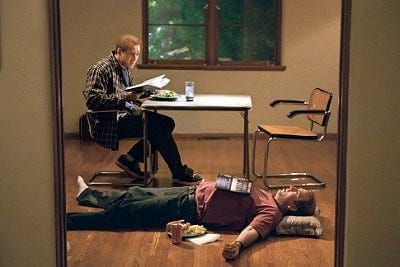
With all due respect to Sunset Blvd. and Midnight in Paris, my favorite movie about screenwriters is Adaptation. Here is one of the movie’s taglines:
Charlie Kaufman writes the way he lives… with great difficulty. His twin brother Donald lives the way he writes… with foolish abandon. Susan writes about life… but can’t live it. John’s life is a book… waiting to be adapted. One story… four lives… a million ways it can end.
It seems like a mishmash of narrative elements. And in some respects it is, especially when the real life Charlie Kaufman writes a script about a fictionalized Charlie Kaufman writing a script about the real life Susan Orlean while seeking help from a wholly fabricated twin brother Donald Kaufman, then inserts himself [Charlie] into the plot of the script he’s writing. Multiple layers, shifting points of narrative attack, and a huge leap in tone in Act Three that left many critics shaking their heads in confusion, but left me with an enormous satisfied grin on my face. And at the heart of it all, the brothers:
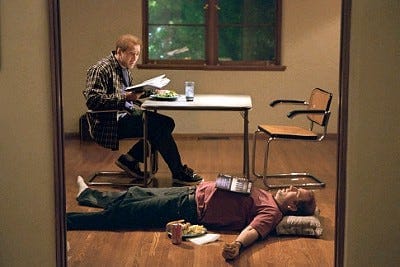
Charlie is a successful screenwriter. We see him on the set of Being John Malkovich. He is admired by producers and studio execs. Repped at a big agency. But he is incurably negative, and filled with self-doubt and self-loathing. Witness the first lines of dialogue in the movie spoken in V.O. over credits:
Do I have an original thought in my head? My bald head. Maybe if I were happier, my hair wouldn’t be falling out. Life is short. I need to make the most of it. Today is the first day of the rest of my life. I’m a walking cliché. I really need to go to the doctor and have my leg checked. There’s something wrong. A bump. The dentist called again. I’m way overdue. If I stop putting things off, I would be happier. All I do is sit on my fat ass. If my ass wasn’t fat I would be happier. I wouldn’t have to wear these shirts with the tails out all the time. Like that’s fooling anyone. Fat ass. I should start jogging again. Five miles a day. Really do it this time. Maybe rock climbing. I need to turn my life around. What do I need to do? I need to fall in love. I need to have a girlfriend. I need to read more, improve myself. What if I learned Russian or something? Or took up an instrument? I could speak Chinese. I’d be the screenwriter who speaks Chinese and plays the oboe. That would be cool. I should get my hair cut short. Stop trying to fool myself and everyone else into thinking I have a full head of hair. How pathetic is that? Just be real. Confident. Isn’t that what women are attracted to? Men don’t have to be attractive. But that’s not true. Especially these days. Almost as much pressure on men as there is on women these days. Why should I be made to feel I have to apologize for my existence? Maybe it’s my brain chemistry. Maybe that’s what’s wrong with me. Bad chemistry. All my problems and anxiety can be reduced to a chemical imbalance or some kind of misfiring synapses. I need to get help for that. But I’ll still be ugly though. Nothing’s gonna change that.
At a lunch meeting with Valerie, a studio exec offering Charlie the job of adapting the non-fiction book “The Orchid Thief,” Charlie states his main goal:
I’m saying, it’s like, I don’t want to cram in sex or guns or car chases, you know… or characters, you know, learning profound life lessons or growing or coming to like each other or overcoming obstacles to succeed in the end, you know. I mean… The book isn’t like that, and life isn’t like that. You know, it just isn’t. And… I feel very strongly about this.
Ironically, of course, this is precisely what happens in the story only with Charlie himself playing the part of Protagonist. Or perhaps Co-Protagonist. Along with his brother Donald:
What narrative function does Donald play? At times, he certainly acts like a Nemesis, bothering Charlie endlessly about nearly everything, obstructing his progress on “The Orchid Thief” and especially so when Donald decides to take up screenwriting. At other times, he is the jolly sidekick, so feels like a Trickster, wanting to support Charlie, but acting in ways that undermine Charlie’s focus. You could argue that he is an Attractor in that Charlie starts off basically repulsed by his brother, but then over time realizes he loves him. Donald even has some wisdom to convey to his brother, especially this poignant moment in their last few moments together:
Charlie Kaufman: There was this time in high school. I was watching you out the library window. You were talking to Sarah Marsh.
Donald Kaufman: Oh, God. I was so in love with her.
Charlie Kaufman: I know. And you were flirting with her. And she was being really sweet to you.
Donald Kaufman: I remember that.
Charlie Kaufman: Then, when you walked away, she started making fun of you with Kim Canetti. And it was like they were laughing at me. You didn’t know at all. You seemed so happy.
Donald Kaufman: I knew. I heard them.
Charlie Kaufman: How come you looked so happy?
Donald Kaufman: I loved Sarah, Charles. It was mine, that love. I owned it. Even Sarah didn’t have the right to take it away. I can love whoever I want.
Charlie Kaufman: But she thought you were pathetic.
Donald Kaufman: That was her business, not mine. You are what you love, not what loves you. That’s what I decided a long time ago.
Donald Kaufman: Whats up?
Charlie Kaufman: Thank you.
Donald Kaufman: For what?
http://movieclips.com/e/HsqwB/0/128.128/
Donald Kaufman is one of those characters to whom I’m not sure you can ascribe a primary character archetype as he hits on the entire gamut of narrative functions in relation to the story’s Protagonist Charlie. Perhaps that’s one of the reasons the real Charlie Kaufman insisted on this writing credit for the actual movie Adaptation: Screenplay By Charlie & Donald Kaufman.
Whatever archetypes Donald may embody, he and his brother are great characters.
And if you think I would reference this movie and not include this delicious moment from a Robert McKee seminar, you would be dead wrong:
http://movieclips.com/e/VMjSt/0/105.032/
UPDATE: Speaking of Kaufman, this news just hit:
Charlie Kaufman is attaching Jack Black and Nicolas Cage and is talking to Steve Carell to Frank Or Francis, the next film Kaufman will direct. Kaufman’s projects are always shrouded in mystery (sometimes even after you’ve seen them), but they are always compelling and this one’s gearing up for a 2012 start.
Just like Kaufman. He comes out with Synecdoche, New York which lost lots of money. So perhaps logic would dictate he’d go with something more commercial next time around? No. Evidently Frank Or Francis is a musical. What a terrific creative voice he adds to the current movie scene.
UPDATE #2: Interesting analysis in comments from Jack Benjamin:
I think it’s hard to analyze Charlie Kaufman’s work like you would another screenwriter. You can see how much he loathes traditional screenwriting theory (the McKee stuff, etc.). He doesn’t really like structure and arc as much as journey, and usually a twisted journey. If you read an early draft of Malkovich you can see just how far he goes. The fact that there is structure and arc in Adaptation is something he seems uncomfortable with, represented by the side of his personality that he detests but still acknowledges (the Donald side). Susan and Laroche are two sides of the same coin too. Susan is seduced by the wild, unstructred, haluconogenic hunter’s life of Laroche and abandons her “safe” writing career for it. On the other hand, Charlie is seduced by Donald’s structured, safe, rote writing style, and in the end he succumbs to it. Of course the real Charlie Kaufman is the Laroche of Hollywood, but the movie is such a great insight to his paranoia and his conflict between creativity and commercialism. I love Kaufman.
I like that: The real Charlie Kaufman is the Laroche of Hollywood.