Here’s a premise for a movie
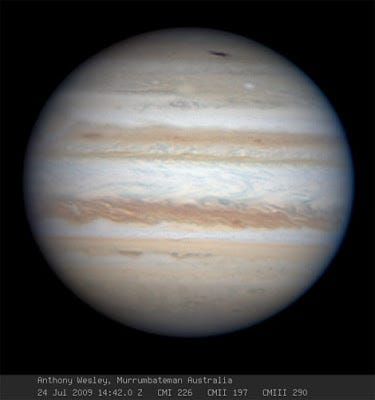
Tell me this Popular Mechanics article doesn’t sound like a premise for a sci-fi movie:
Something invaded our solar system and whacked Jupiter, but professional astronomers were looking the other way at the time. Now, as the shock wave slowly subsides, astronomers are working around the clock to find out exactly what hit Jupiter–and why they didn’t see it coming.
The biggest astronomy sighting of the year happened last week, and the world’s professional astronomers missed it. Anthony Wesley, an amateur astronomer from Australia, spotted a tiny dark patch on Jupiter from his backyard telescope. Something had crashed into the solar system’s largest planet, but no one saw exactly what it was. By the time Wesley called the pros, only the scar was left behind, evidence that couuld change or fade into oblivion at any time. Now scientists are racing to find clues of what happened and solve the mystery before it’s too late.
Leigh Fletcher of NASA’s Jet Propulsion Laboratory (JPL) was one of the first on the case. Through a bit of serendipity, his team had scheduled time at the Infrared Telescope Facility in Hawaii to look at Jupiter. When they heard of Wesley’s discovery, they set aside their other projects and turned their sights to this fleeting “target of opportunity.” The infrared images showed that the planetary blemish continues to shine brightly with highly reflective particles that have been pushed into the upper atmosphere, proving that Jupiter’s new bruise truly is the aftermath of a collision. The next step–finding out what exactly caused the event–requires researchers across the globe to get time on the world’s most powerful telescopes to look at Jupiter before the impact site disappears. There are three main suspects: a comet, a meteor or an asteroid. If astronomers can figure out what the impactor was and where it came from, they might have a better idea how often Jupiter gets these kinds of bruises. In addition, the more scientists know about the rogue objects roaming the solar system, the better they can track those that might make a pass dangerously close to Earth.
So you think Armageddon — and doesn’t that movie blow this idea out of the water? Absolutely not! Armageddon was released in 1998, over a decade ago. Moreover whatever you thought of that movie in terms of plot, characters, etc (Rotten Tomatoes users give the movie a 40% rating), the fact is the film grossed $553M worldwide. In Hwood, which is ruled by a ‘similar but different’ mentality, I think you’re looking at an algebraic equation like this:
Armageddon + $553M + Release 10 Years Ago x Mysterious Jupiter Event = hot new spec script.
Comment Archive