How They Write A Script: Garson Kanin
In keeping with our theme this week of romantic comedies, from “Backstory 2”, one of a series of excellent books featuring interviews with screenwriters, the spotlight here falls on Garson Kanin. Kanin wrote many movies in the 30s, 40s, and 50s, most notably four with his wife actress and writer Ruth Gordon — A Double Life, The Marrying Kind, Adam’s Rib, and Pat and Mike, the latter two starring Spencer Tracy and Katherine Hepburn.
Of special note: Kanin and Gordon wrote all four of their collaborations on their own, then sold them to Hollywood, the first professional writers to work the spec script approach on a regular basis.
Some excerpts from the Kanin’s interview in “Backstory 2”:
ON THE IMPORTANCE OF IMMERSING ONESELF IN THE WORLD OF STORIES
Reading — we always read. My father’s idea of a gift for his children was a book. He hardly ever bought us anything but books. I remember when my father first got us The Book of Knowledge, about twenty-five or thirty volumes (I think) broken up into various categories for young people. We sat down and read the whole damn thing from beginning to end. It took six months.
I was always a reader, from a very, very early age. The writing developed professionally rather late, because I had other careers that came before it. In a nonprofessional way, the writing began early on. My brother, Michael, and I were constantly making up sketches and performing them, even in grammar school, and writing what amounted to short plays.
[Years later] I wasn’t studying it in any way, except by osmosis. I was putting in long, long hours. I was going to the theater incessantly. I went every single night and to all the matinees, and over a period of eight or nine years, I’m sure I saw every single thing on which the curtain was raised in the city of New York — and a lot out of town.
ON THE INFLUENCE OF THORNTON WILDER ON KANIN’S WRITING CAREER
I met Thornton Wilder when I was still an actor. I Was playing an important part in a play by Robert Ardrey called House on Fire, which was produced and directed by the great Arthur Hopkins. Thornton Wilder had been a teacher of Robert Ardrey’s at the University of Chicago, and one weekend he came to New York to see a run-through of the play. Robert Ardrey took me to lunch with him. Thornton didn’t think I was any good in the play and he told me so, so that didn’t make a big hit with me, but on reflection I saw that he was right, and I followed many of his suggestions. I got better in the play.
On that weekend we became great friends. Thornton Wilder was basically an educator. That’s what it said on his passport: It didn’t say “playwright” or “novelist,” it said “educator.” He considered that his playwrighting and novel-writing were a kind of avocation. I think he was wrong about that, but that was his perception of himself.
When he heard that I had never gone to college, he was astonished. When I told him I hadn’t gone to high school much, except for a few months, he was absolutely appalled. Not only that, but worried. He’d say, “What is going to become of you? You’re not equipped for life . . .”
He helped me. He really took me in hand. And he stayed my friend for close to forty years. Coincidentally, when Ruth and I were married, it turned out that Thornton. Wilder was her closest friend in the world, so that was a bond. The three of us would meet frequently, we traveled a lot together to Europe, and then of course Ruth did his play The Matchmaker, and that brought us together a lot too.
He really was the one who encouraged me to write to begin with. First, he wanted me to write a journal. I used to tell stories about things that had happened in the theater, and he’d say, “Write that down. Make that into a story.” So I did. I did that more and more. Finally, when I was in the army, I was complaining to him about the major essence of trouble about being in the army — the boredom. The drills, the chores, the ditch-digging, the basic training were so boring. And Thornton said, “I think you could relieve that boredom by doing something creative. Why don’t you write something?”
By this time I had already directed a number of movies and I was equipped. So I wrote a lot of movies and sold them, too, and was able to bridge those years by writing movies, not always using my own name, of course, because I was so terrified of the army roles. All of the work that I did during the war while I was in the service, both in the United States and overseas, was done sub rosa, because first as an enlisted man and then later as an officer, it would have been improper for me to take any screen credit.
ON WHY HE’S DRAWN TO WRITING COMEDIES
I just think I’m a cheerful, funny guy. I don’t take life all that seriously. I can see the funny side of almost anything, and I enjoy making other people laugh. And I find it much more enjoyable to write in a comic vein.
If I could define what is for me the ideal style and the ideal accomplishment, it is to treat a serious subject lightly. I feel I succeeded with Born Yesterday . It’s a very serious play — and it’s funny. I’ve tried to do that again and again, and I’ve never succeeded as well as I did that time, but I still try. To write a comedy which is a lot of jokes doesn’t interest me at all. I don’t mind making jokes in real life, but in the theater I prefer a play to be something far more substantial. It ought to be laughter based on something a little more meaty.
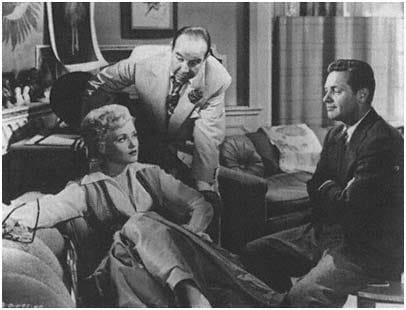
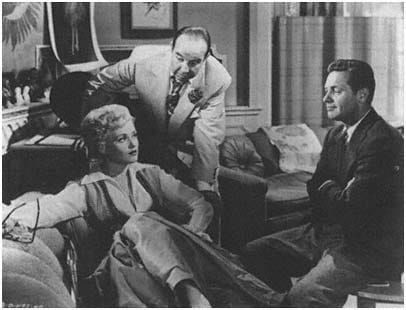
From left: cast members Judy Holliday, Broderick Crawford, and William Holden in
the film version of Born Yesterday, the serious play that turned into a comedy during the writing because Garson Kanin was having “a whale of a time.”
(Photo: Academy of Motion Picture Arts and Sciences)
ON WRITING WITH YOUR ‘UNCONSCIOUS’
Things happen in the novels that astonish me. I can’t believe they’re happening when they do. As Thornton used to put it, “When you sit down to write, you never know what’s going to run down your sleeve.” Because if you’re truly writing fiction or plays well, you’re writing with your unconscious. If you are writing imaginative literature of any kind, whether it’s poetry or plays or films or novels, it’s inside of you, somewhere.
To give you an example: What makes people laugh? Only one thing, not two: surprise. That’s the only thing that ever makes me laugh, or makes anyone laugh. However, it’s not as simple as it sounds for a writer, because there are perhaps 200,000 different kinds of surprises and variations on surprises. But any time an audience laughs, it is because it’s been surprised by the use of a word, by a piece of business, by a look.
So the question is, If you’re writing and you suddenly laugh, if it is true that you only laugh at surprises, how can you laugh at something you yourself have written? The answer is, you didn’t know you were going to write it a moment before you wrote it. You were writing along in an unconscious way. Your conscious mind observes it, your eyes see it, your sensibility digests it quickly, and it makes you laugh, because you really are surprised at what you wrote. That’s one of the most important lessons of writing anything. People who write strictly on a conscious level do not write well.
ON MAKING THE JOURNEY INTO THE ‘IMAGINATIVE SELF’
The most important thing is concentration. The two enemies of any kind of creative work are interruption and distraction. Which is why so many writers feel they have to go away somewhere. When you sit down to write, you have to make a journey, a journey from the real world into the world of the imagination. Part of learning the lesson is learning how. I cannot advise young writers on how to make that journey into the imaginative self. I can tell them what other people have done. I can tell them what I do. It’s not really going to help them until they find their own way.
Now, Ernest Hemingway had a very exact system. Ernest Hemingway always wrote on blocks of paper with pencil. When he had finished work, usually in the late afternoon, he would pick up a handful of his pencils and he would slam them down on his desk, successfully breaking every point of the pencils. Then he would throw the pencils down on the desk and leave his workroom, and he wouldn’t see that room again until the following morning.
When he got up in the morning, he’d get some air and eat some breakfast and do whatever else it was he had to do; then he would go into his study and close the door and sit down at the desk. He had some penknives that he especially liked. He used to acquire them all the time and carry them everywhere. He would pick up one of his favorite penknives and he would pick up the first pencil and he would very carefully, laboriously, brilliantly, carve a perfect point on that pencil. Then he would lay it down. Sometimes he would pause and sharpen his knife; that would be another little distraction. Then he would pick up the next pencil and put another point on it.
He told me once that sometimes it would take four, five pencils — he said on some days when he had a hangover it might take seven or eight pencils to be sharpened — but somewhere along the line, when he finished sharpening either the fifth or the sixth or the eighth pencil, he would put down the penknife and he would pick up the pencil and he would begin to write again.
Thornton Wilder had a way. Thornton Wilder used to get up in the morning and he always liked to go where people were to have breakfast — a lunch counter or a diner. He’d have breakfast and talk to a lot of people; then he would go home and read over the last chunk of material that he had written. Then he would go for a walk. And as he walked, he would mumble to himself some of the passages that he had just read, and he would project his imagination into future roads of that material, and when he felt excited enough, he would go home, go into his study, pick up his pen, and begin to write.
Willa Cather had an interesting mnemonic device. She used to read a chapter of the Bible every morning before she went to work. Sometimes more than one. When she finished reading, she’d put the Bible down and go to work.
Each one was a bridge from real life and the laundry list, from the bellyaches, from the argument with the wife, from the frustration of some idea, from an unfortunate headline in the newspaper — which [reading the newspaper], by the way, is a great mistake. If you’re a writer, what you have to do is get up in the morning and go to work. It’s best to have nothing interfere, no conversation, certainly no newspaper, no television, no listening to news on the radio. You should get as soon as possible from your one form of unconsciousness to the next form of unconsciousness, and not have too much intervene.
I remember Somerset Maugham once said he worked every day for four hours. Ruth pointed to this great big shelf of his work and said, “You mean to tell me that all of that was accomplished by just working four hours a day?” He said, “I never worked more than four hours a day. . . .” Then he raised a finger and said, “But — never less.” So working four hours a day, he accomplished, as we know, one of the greatest bodies of work in English literature, comprised of novels, a couple hundred short stories, many works of nonfiction, criticism, and articles on every conceivable subject, including bridge, on which he was a great expert. And he only worked four hours a day.
ON THE PHYSICAL ACT OF WRITING
We [Kanin and his wife Ruth] would always simply read over the previous day’s work, just to get the “join.”
My own way is to write one page of journal. Journal — meaning anything that comes into my head. Maugham was asked by Ruth, “What if you sit down one morning at your desk and you can’t think of anything to write?” And he said, “Well, my dear, in that case, I sit down and write, ‘W. Somerset Maugham, W. Somerset Maugham, W. Somerset Maugham, W. Somerset Maugham’ . . . until something occurs to me, and it always does.” In other words, he was saying to Ruth, the motor of actually writing itself.
I’m very interested in this particular subject. These days, as you know, we are in the midst of a kind of mechanical revolution, and we have word processors, screens, printers, and all kinds of new devices. My associates here in the office use them. I’m a demon reviser — everything I write is written seven, eight, nine, ten drafts — and they tell me that for going throughout and making revisions, [these devices are] extremely useful and helpful, but I haven’t ever touched one. Nor do I intend to. I’m an expert typist, and that’s as far as I want to go.
I’m the president of the Authors League of America, and I preside at the council and annual meetings, so I know a lot of writers. In the last couple of years, it’s astonishing how much they’ve been talking about their word processors. It’s almost as though they’re talking about mistresses; they’re talking the way writers used to talk about girls. They criticize each other’s choices, and they have very sophisticated and esoteric combinations of the typewriter and the printer and the kind of paper they prefer to use. One very important drama critic told me that if he didn’t have his word processor, he couldn’t write!
Somerset Maugham never wrote anything except with a fountain pen and a block of paper. Then you think of Charles Dickens and everything he turned out: everything was written. Or Balzac — we know that is how Balzac wrote because he only wrote at night. He was a terribly social man and he lived on excitement — parties and balls, theater, and opera. So he was out every night of his life, and he would come home at midnight or beyond, he Would brew an enormous pot of coffee, and then he would sit down and write till daybreak. Then at daybreak he would go to sleep until the afternoon. Then he would get up, take care of some business, and then get ready for the next social event.
Of course, he died at forty-nine, so it’s not such a hot recommendation for his routine, but he did turn out an enormous number of books. And that wasn’t easy, because he used to rewrite incessantly. He rewrote so much that finally there was not a single publisher in France who would publish him. They would set up his work and send him the galleys, and he would rewrite the whole damn thing in galleys. They’d set it up with corrections and send the galleys back, and he’d rewrite it again. By the time they got him into print, he had used up seven or eight sets of galleys, which made the cost prohibitive and which is what drove him into publishing his own work at his own expense.
The methods of writing are extremely individual, but I’m sure if I spent ten minutes digging into this, I could tell you a dozen more names of important writers, novelists, playwrights, poets, who never in their lives used anything but a fountain pen and a block of paper. . . .
ON THE WRITING PROCESS HE AND HIS WIFE USED IN THEIR COLLABORATION
Moss Hart used to say, “In a collaboration, there’s always a sitter and a walker. One guy sits at the typewriter and the other guy walks.” In his collaboration with George S. Kaufman, I think Moss was the sitter and Kaufman was the walker. In the case of Ruth and me, we used to talk, talk, talk, talk endlessly, and then after the talking I would put it down on paper. Then, after it was down, she would go over it and revise it extensively. Or sometimes there would be scenes which she had dreamed up or created, and she would do the first draft of those.
It was a very eclectic way of working, without any particular system. I think systems in writing are created out of the necessity, aren’t they? Created out of the necessity of the moment, of the deadline, or of where you are in the world physically. When we were in the country, we used to get up at six o’clock in the morning and go to work very early on. . . .
ON THE IMPORTANCE OF WRITING GREAT CHARACTERS
It is also just writing good parts, which is the essence of writing a play or a film. You have to write good parts for actors to play. If you don’t, you’re not going to get good actors.
Usually, if you write one smashing part in a play, it can be enough, if the other parts are at least adequate. It’s been pointed out to me, what makes Born Yesterday what it is, is that it has not only one marvelous part, but two and sometimes three — if they’re lucky in the casting of the third part. They’re good acting parts.
And I would say to young playwrights, especially, don’t worry so much about the story. There are no original stories. All the stories have been told in one form or another. The only thing that makes a successful play is the delineation of character. Be sure you write good parts. Interesting, dramatic, amusing, romantic — it’s the characters that make the play.
ON HE AND HIS WIFE’S PROFESSIONAL RELATIONSHIP WITH HOLLYWOOD
You have to remember I’ve never been employed as a screenwriter. Nor was Ruth. Neither one of us, individually, or as a team, were employed for so much as a single day as writers by any motion picture studio, ever. All we ever did was write original screenplays and sell them. To this day, that’s all I do in the movie business. I have never worked on other people’s material and I am not employable as such.
That was our method, so that we could write freely, for ourselves. And in the case of Adam’s Rib and Pat and Mike, of course, we had Spencer Tracy and Katharine Hepburn in mind as potential players. As it happened, Pat and Mike was first rejected by the studio and only after a year or so did they reconsider. In the meantime, we felt that we did not want to sell it elsewhere because it had been so specifically designed for Tracy and Hepburn that any substitution would have diminished it.
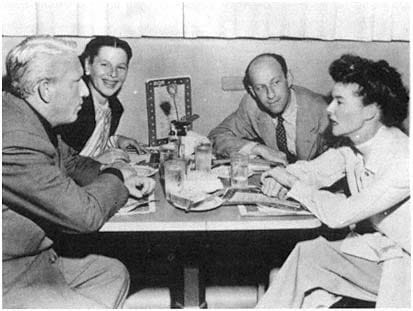
“We were all great pals”: MGM publicity photo, at the time of Pat and Mike, with
(from left) Spencer Tracy, Ruth Gordon, Garson Kanin, and Katharine Hepburn.
(Photo: British Film Institute)
ON WHY HE WENT INTO DIRECTING
I just wanted to be a director. Something has to be remembered here, and that is that the director occupies the important creative position in Hollywood, even today. I deplore it, I think it’s a fake, I think it’s a mistake, I think it’s terribly unfair. You can imagine how I feel when I pick up, say, the New Yorker magazine and in the front are all the listings of the revival pictures. Adam’s Rib is always listed — they’re crazy about Adam’s Rib and Pat and Mike . And they always refer to it as “George Cukor’s Adam’s Rib.” “George Cukor’s Pat and Mike.” It’s always the director who has that possessive on a picture.
Quickly in Hollywood I got the idea that the director is the kingpin, and that was the thing to be. The directors were the royalty and everyone else was small fry. That still obtains, I’m sorry to say.
ON COLLABORATION
I always worked with the writers. From the very beginning, from the first picture with Dalton Trumbo. I worked with him daily, I made a lot of suggestions and cuts, I had a lot of ideas, and we had a lot of quarrels; but they were professional quarrels, not personal ones.
It was the same when my wife and I were writing films together. In real life we never quarreled at all. But when we were writing together, we quarreled incessantly. It’s part and parcel of the profession, which is why I don’t collaborate, because I don’t have the energy or the time or the patience to go through quarrels, disagreements, fights, and compromises. I could never be induced to collaborate again.