How They Write A Script: Richard Matheson
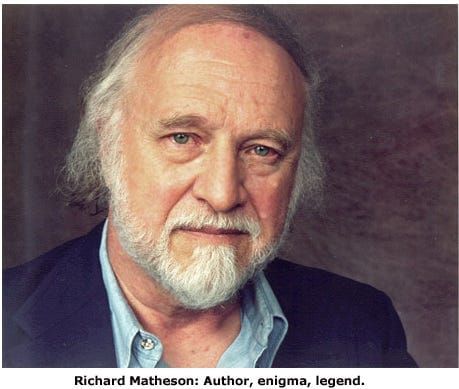
“Richard Matheson’s fan club is a big one, and his name is familiar to horror, science fiction, and fantasy fans around the world.
In Hollywood permanently since the late 1950s, Matheson is responsible for classic science fantasy films (The Incredible Shrinking Man, based on his own first novel), vintage television episodes (fourteen of the best, early Twilight Zone segments; plus noteworthy contributions to Alfred Hitchcock Presents, Star Trek, and Night Gallery ); a slew of stylish Edgar Allan Poe adaptations for the producer-director Roger Corman in the 1960s (including House of Usher, The Pit and the Pendulum, Tales of Terror, and The Raven ); and landmark telefilms (Steven Spielberg’s breakthrough made-for-TV feature Duel; The Night Stalker about a vampire in Las Vegas, which won the Writers Guild Award for Best Television Script; and The Morning After with Dick Van Dyke as an alcoholic corporate executive).
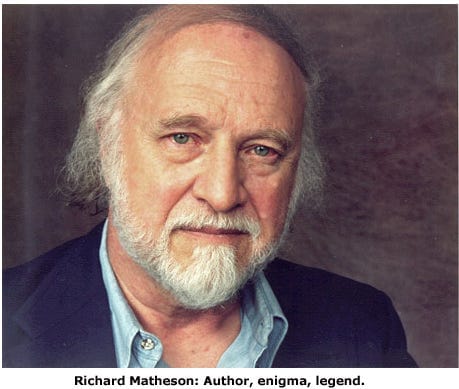
Scriptwriting has fueled and financed his fiction writing and vice versa. While maintaining his Hollywood footing, Matheson has continued to write an impressive number of short stories and novels. Many have been adapted for the big or the small screen, sometimes by Matheson himself, sometimes not. Horror was a longtime specialty, and two of Matheson’s scariest books have had a long life in print. I Am Legend (New York: Walker, 1970), about the sole survivor of a global plague, has been filmed twice, as The Last Man on Earth and The Omega Man. His haunted-house novel, Hell House (New York: Viking, 1971), is one of the all-time spookiest. Somewhat watered-down but still terrifying, it became the 1973 film The Legend of Hell House.”
That’s how the introduction to the interview with writer Richard Matheson begins in “Backstory 3: Interviews with Screenwriters of the 60s,” one of a 4-part series edited by Patrick McGilligan.
Matheson’s writing credits include The Incredible Shrinking Man, House of Usher, Master of the World, Pit and the Pendulum, Duel, and dozens of TV series.
ON HOW HE BECAME INTERESTED IN WRITING
I read a lot; my sister read a lot. I was taken to the library when I was very young, and I became an omnivorous reader. My sister, again, was a great moviegoer who took us to the movies a lot, living in Flatbush, where there were, like, ten theaters within walking distance. I went to the movies constantly. I always went to the Saturday matinees, and you’d go whenever else you could. If you were staying home, sick from school, and you could get away with it, you’d sneak over to the movies.
I read a lot of fantasy when I was a kid. Science fiction, I never read until I sold a story which they told me was science fiction.
I always liked movies. Whether, in my teen years, I ever gave credence to the idea that I could actually write them, I don’t know. But I corresponded with people like [the producer] Val Lewton when I was a teenager. I remember writing to him and telling him that I had figured out two of his secrets for scaring people: one was that you lead the viewer’s eye to one side of the screen and then have something jump out from the other side; the other was an extended period of silence, suddenly broken by anything — like a horse nickering in the stable — that would make you jump out of your skin. He wrote back to me that he and his editors, Robert Wise and Mark Robson, were delighted I had been able to figure this out.
ON HOW HE ENDED UP MOVING TO LOS ANGELES
I really was drawn toward films. After I got out of college, even more so. I told you I had had frostbitten feet — a romanticized description of what they call trench foot, where your feet get wet and cold — that’s how I got discharged from the Army. And my feet got very cold in Brooklyn, where I lived, especially during the winter when it was extremely cold.
I probably used the climate as an excuse to myself. I lived on East Seventh Street in Brooklyn with my mother and I remember walking down the street one day and the wind was so cold and so loud I was screaming into it and I couldn’t hear my own voice. That was the day I decided I was going to go to California. It seems remarkable to me now, that I would have the chutzpah just to leave.
My agent had a writer out here, William Campbell Gault, who met me at the bus station and let me stay at his house for a few days. And he introduced me to other writers, including a group called the Fictioneers. Mostly western, detective, and pulp writers. There was William R. Cox, Les Savage, Bill Gault — a whole pile of them. Hank Kuttner was the only one in the group writing science fiction and fantasy. I don’t think [Ray] Bradbury ever went to that particular group. It was a social club. We would meet for dinner and talk.
ON HOW HE PERCEIVES HIMSELF AS A WRITER
When I went to college and took writing courses, they would always talk about the distinctions between the pulp writer and the slick writer and the art writer. I came to realize that was ridiculous. There are only interesting stories and dull stories, no matter where they’re printed.
I never wrote like a pulp writer. Once in a while, you get inspired, like I did when I wrote a story called “Madhouse” — ten thousand words — and I rattled it all off in one sitting. But that’s a rarity. It’s much better to be a professional and a craftsman, and to rework things.
To this day, I’ve never written to the market. I’ve always written just what interested me and pleased me. As the perfect proof of that, just at the time when the horror novel was really starting to go crazy, I gave it up after I wrote Hell House. I had lost interest in it. I still have no interest in it. Now, it’s like an industry, for Chrisakes.
ON HOW HE WROTE “THE INCREDIBLE SHRINKING MAN”
Then, in 1954, we went back east because we were running out of money — my wife and I and our daughter and son — and I went to work for my brother again. He had his own business by then.
That was when I wrote The Shrinking Man. My agent, Al Manuel, sold it to Universal. They just wanted to buy the book. I recognized that this was my chance — now or never — to write the screenplay. They probably figured, “Let him have his ten weeks; then, we’ll have it rewritten . . . “ At the time, I was still living on Long Island.
I took to it like a duck to water. I’ve always written visually when I write novels or short stories. I can see it as I write it; therefore, the reader can see it, and therefore, my prose transposes pretty easily to films. If you write that way, to me, it’s just a question of learning the technique of film writing, which isn’t that complicated. It will take you about maybe a week to learn it. I over-learned it. I wrote intricate camera descriptions, which was perhaps ridiculous. But I’ve always written detailed shooting scripts. To a lot of writers, it’s a mistake. They always say, “Why bother? The director will change it.” I do it anyway. It works out — sometimes.
In Duel, Spielberg shot my script. He embellished it, obviously, and made it marvelously interesting, but it was my script, my through-line, and many of my shots.
I didn’t really appreciate it for a long time. Actually, it wasn’t until my son Richard became a professional writer that he pointed out how unusual it was for its time. The ending alone was unusual for its time.
In writing the script, I wanted to follow the structure of the book — which was sort of like Last Year at Marienbad [1962] — where you plunge right into the story and then have flashbacks. I had actually written the book manuscript the other way around, starting from when the main character was big. But by the time he got to be small, maybe one hundred pages had gone by, and I thought, “Geez, this is real boring.” So I restructured it. I did the same thing with I Am Legend. I restructured that book too, so that you were just plunged into the story, and the flashbacks brought you up to date.
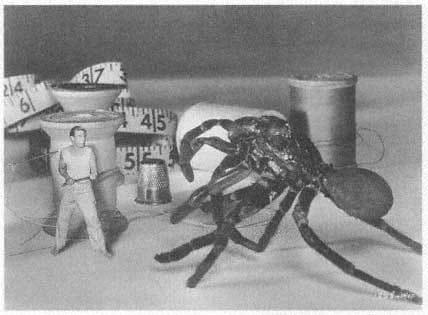
In The Shrinking Man, the first moment is the spider chasing him through the cellar, instead of telling the whole continuity of how it happened; then, I could pick specific points along the way to fill in the story… They [Universal] didn’t do it that way. It’s a straight continuity.
ON WRITING FOR THE TV SERIES “THE TWILIGHT ZONE”
Whenever I see one of my scripts for that show, it’s always my dialogue — word for word. Respecting writers as he did, Rod [Serling] let you do your own thing. It was really a nice experience. That was the first time I worked in television. I didn’t know how nice it was. We would have three-day rehearsals, for God’s sake, where we sat around tables with actors and directors, and discussed the show. That’s still pretty unheard of in television.
Yet, I have to say, I have really gotten more satisfaction out of other things on television. I’ve had more things on television that I felt good about than I ever had with films.
People always ask me why The Twilight Zone is still alive, and I always say, “Because the stories are so interesting.” That’s what I do. I tell an interesting story. I think that’s why I’m still around.
I had never done a television script. Ordinarily, they would ask for an outline, or so I was told. But the first show I did, the idea I presented to them was so vivid that they just said, “Yes, do it.”
I just said, “A World War I airplane pilot goes through a fog, lands, and he’s in a modern SAC base.” They said, “Yeah, do it,” because the image was so vivid. Then I had to figure out the story.
ON HIS ADAPTATIONS OF EDGAR ALLEN POE STORIES
Of the ones I wrote, the first one. Although the later ones — Masque of the Red Death, Tomb of Ligea — may have gotten closer to Poe. All of them, I think, were more like Lovecraft stories presented as Poe pictures.
Probably the best of mine was the House of Usher. Pure Poe-try, should I say? The second one, Pit and the Pendulum, that’s just a little short story which I had to make a whole picture out of. I had this idea for a mystery-suspense film, something I had never used before, and I just thrust it into that mold.
The Comedy of Terrors, which isn’t Poe, [Jacques] Touneur directed, and I think it’s very funny. I am proud of that picture and of the fact that I got AIP [American International Pictures] to hire Tourner.
Earlier on, I had asked for Tourner on one of my Twilight Zones. I think I’ve told this story before. They said, “Well, he’s a movie director. I don’t think he can handle this time schedule . . . “ As I recall, he did the shortest shooting schedule of anyone — twenty-eight hours. He had this book with every shot in it and detailed notes. He knew exactly what he was doing every inch of the way. He was so organized.
After a while, I couldn’t take the AIP things seriously anymore. That oh-my-God-she-isn’t-dead-she’s-been-buried-alive sort of thing. How long can you be serious about that? The Raven was just an out-and-out comedy.
ON THE FILM BUSINESS
Actually, I don’t feel the same way about films that I used to. No, I don’t mean films; I mean the film business. I still love films. It’s a wonderful medium of expression; nothing like it. But the business . . . I just haven’t been able to beat it. I should have gone into production, directing, some inside job. I had an agent once who said that if I went into film production only to protect my scripts, I’d be making a bad mistake. I can’t think of any other reason to go into film production, at least for me.
But I didn’t do that — my own failing — I’m a loner who likes to sit in a quiet, isolated room and write. The hurly-burly of the business would have been too much for me. When I first started in it, I was only twenty-nine years old, and I was popping Valiums like candy then.
Anyway, it was my own fault. I can’t blame the business for being what it is. And there’s always something new and hopeful that you’re working on. Even as I say this, a script I just finished — on Nikola Tesla — shows great promise of turning out well because of the director, Walter Murch, and the people involved in the production.
ON THE IMPORTANCE OF A STORY IDEA
They always say you should be able to tell any good story in two or three lines — or even one sentence. You couldn’t categorize my work that way completely. And you can’t say, “This is a story about Lawrence of Arabia . . . “; that’s such an expansive character. But give me virtually any film or story, and I can probably reduce it to two or three lines. And I hope my films fit into that category.
When I was writing short stories, some of my ideas would come from other books because I read omnivorously. Someone would mention something in a short story, totally overlooking what they had said, and I would pounce on it like a tiger. For example, there’s a section in Wild Talents, one of Charles Fort’s books, [New York: Garland, 1975], where, in several paragraphs, he describes, literally, a sequence that I made a whole short story out of. I couldn’t believe when I wrote it that nobody ever latched on to the connection. He said in future times, psychic girls would fight wars; they will visualize terrible things happening to soldiers. And I got a great story out of that.
Most of my ideas have come from films. When I lived in Brooklyn, I went to see a Dracula film and the idea came to me: If one vampire was scary, what if the whole world was full of vampires? That became I Am Legend.
Another time, I went to see a comedy with Ray Milland and Aldo Ray [Let’s Do It Again, 1953]; and Ray Milland was leaving an apartment and he put on Aldo Ray’s hat and it came down way over his ears. At that second, I thought, “What if a guy put his own hat on and that happened?” That’s where I got the idea for Shrinking Man.
And most of the ideas come from bad movies. Because if they’re good movies, you’re absorbed and not distracted. If it’s a bad movie, if you’re a movie buff, you stay and watch anyway. But as you’re sitting there, you drift off. Something will happen [on the screen] . . . and it will spin off [in your mind] into something else.
When you’re reading a story, I think, if the story is really boring you, you will stop reading it. You have to concentrate or stop. In a movie, you don’t have to concentrate. You can just sit there. Things will come into your eyes but not really into your brain. And you drift off in a different direction . . .
ON HOW HE’D LIKE TO BE REMEMBERED
Through the years, I have been able to get more and more into character, but I never went into stories based on characters. I went into stories based on a story idea. Then I put characters in the story that I hoped would be believable and realistic in real life and maybe move you. But I’m a storyteller. The story is the thing. They can put that on my tombstone: Storyteller.