Interview — George Lucas
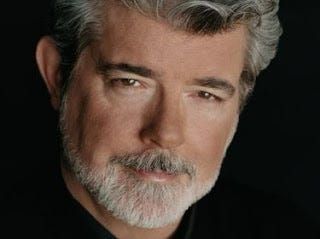
I just finished reading the book “What Happens Next” by screenwriter Marc Norman and it’s a hugely entertaining and informative book. I was particularly taken by the section wherein Norman spotlights three directors — Francis Ford Coppola, Steven Spielberg, and George Lucas — and details the hardest single part of their creative process: Writing.
The genesis of what came to be known as Star Wars is particularly noteworthy and I plan to post something on that later this week. But as much flack as Lucas may have taken re his writing of Star Wars: Episode I — The Phantom Menace, Star Wars: Episode II — Attack of the Clones, and Star Wars: Episode III — Revenge of the Sith, let’s not forget how wonderful the original Star Wars was (with a major uncredited assist from Willard Huyck and his writing partner and wife Gloria Katz). Nor this little gem:
American Graffiti (1973) was nominated for 5 Academy Awards including Best Writing.
In this May 2005 interview in Wired, Lucas talks about his legacy as a filmmaker. Here’s an interesting excerpt:
Give me an example of what you mean by a folk artifact.
Fahrenheit 9/11. People went nuts. The folk aspects of that film were George Bush or Iraq or 9/11 or — intense emotional issues that made people put up their blinders and say, “I have an opinion about this, and I’m not going to accept anything else.” If you could look at these issues more open-mindedly — at what’s going on with the human mind behind all this, on all sides — you could have a more interesting conversation, without people screaming, plugging their ears, and walking out of the room like kids do.
And you do that by —
By making the film “about” something other than what it’s really about. Which is what mythology is, and what storytelling has always been about. Art is about communicating with people emotionally without the intellectual artifacts of the current situation, and dealing with very emotional issues.
Life and death.
Life and death, or “I really want to kill my father and have sex with my mother.” It’s hard to talk about that kind of thing in a family situation without somebody getting upset. But in art, you can deal with those issues. You begin to realize that other people have had the same experience or go down those same paths deep in their minds. Most stories are really told for adolescents, which is why Star Wars was aimed at adolescents. Societies have a whole series of stories to bring adolescents into adulthood by saying, “Don’t worry, everybody thinks that way. You’re just part of the community. We don’t quite talk about it, but if you act on some of your notions, here’s what will happen: Zeus will reach down and smash you flat like a bug or the entire Greek army will come and crush your city and burn everybody inside of it, including your heroes.” These lessons are continually handed down from generation to generation. I love history, so I create an environment — in the past, present, or future — that allows me to tell the story, but in a way that’s not incendiary.
And so I ask you: What is George Lucas’ greatest legacy as a filmmaker?
And also this: Which is your favorite Star Wars movie?