Interview (Part 2): Elizabeth Oyebode (2016 Nicholl Winner)
My 6-part chat with the writer of the winning script “Tween the Ropes”
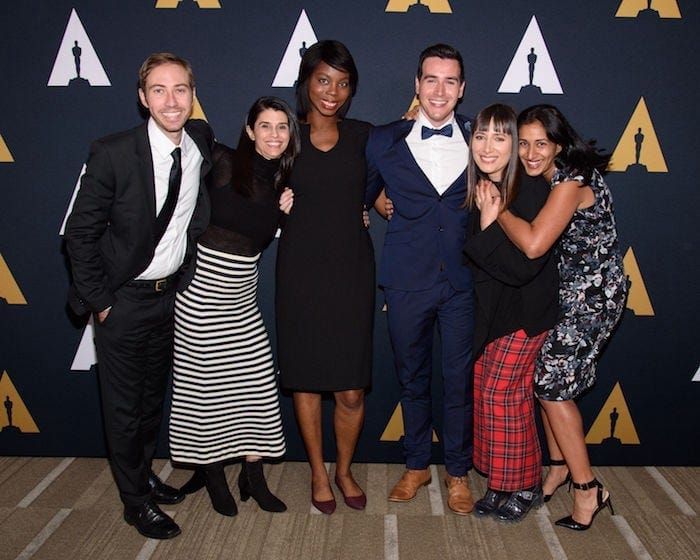
My 6-part chat with the writer of the winning script “Tween the Ropes”
Elizabeth Oyebode wrote the original screenplay “Tween the Ropes” which won a 2016 Nicholl Fellowship in Screenwriting. Recently I had the opportunity to chat with Elizabeth about her background, her award-winning script, the craft of screenwriting, and what winning the Nicholl has meant to her.
Today in Part 2 of a 6 part series to run each day through Saturday, Elizabeth and I delve into her script “Tween the Ropes”.
Scott: How did you make that transition into screenwriting?
Elizabeth: After college ‑‑ I think I told you this before ‑‑ I became a stand‑up comedian in the Washington, DC area and I loved it, but a lot of my bits weren’t really bits. They were stories. They were much more expansive. A few people commented that I should perform a one‑woman show just because my sets were almost like an episode of TV.
That’s when I started thinking differently about it. I was trying to write this one‑woman show. Then I just started thinking about plays. Then I saw a book about screenwriting, opened it up, and…
Scott: Here we are.
Elizabeth: Yep.
Scott: Once you discovered the screenwriting, that was it?
Elizabeth: Absolutely it. Then I read as many scripts as possible from the library and online. And I read Syd Field, Chris Vogler, Joseph Campbell. I really loved understanding the psychology behind it.
Scott: Read some books, and then reading scripts and writing pages, that was pretty much your education?
Elizabeth: Yes. I entered the occasional competition for feedback but, for the most part, it was reading and writing. Your blog is such a great repository of information as well.
Scott: Let’s talk about the script “Tween the Ropes,” a compelling drama that won the 2016 Nicholl Fellowship in Screenwriting.
Here’s a plot summary: “A brainy, young double dutcher contends with the hardships of her life in inner-city Baltimore.” The final words in the script, at least the version I’ve read is a card. It says, “For a real Nidi,” the name of the story’s protagonist. Is this story based on an actual person you know or an amalgamation of characters?
Elizabeth: It’s inspired by a person I knew and several I have read about.
Scott: Nidi Toth, a 10‑year‑old girl, how would you describe her as a character?
Elizabeth: She’s intelligent, resourceful, and determined but also wary of external conflict. I think, for her, there’s this pride of being a rock for her family and her brother in particular. But, at the same time, when she’s outside of her home, she becomes much more like a leaf and subject to the whims of her outer environment.
Scott: She’s growing up in an impoverished neighborhood. There’s the threat of violence all around. You have to live with that, literally. In the apartment complex she’s in, I remember there’s a scene where she’s talking early on to someone about how you’ve got to stay away from the windows. It’s that kind of an environment.
There is that dualistic thing where with her family, she applies one mask. That kind of, as you said, rock, but when she’s outside and in the world with the vicissitudes of life out there, it’s interesting you say she’s more like a leaf.
Elizabeth: It’s a tough environment in which to grow up. It’s one that I wanted to explore from the point of view of a character who gets left in the background often in films.
I wanted to have an audience see the world through her eyes and to feel what she feels on a daily basis, see what her highs and lows might be like, rather than just seeing her as this, maybe, cliché ‑‑ a little black girl jumping double dutch. I wanted them to see her as a three‑dimensional, complicated human being with hopes and dreams, but also these realities and worries.
Scott: Let’s look at the family unit, and then we’ll expand out and consider the surrogate family, which she has at school with the double dutch thing. She has a younger brother, Wayne, who’s seven. They have an interesting relationship.
Generally speaking, Nidi acts much like a mother in protecting him and making sure he has something to eat, but there other times where he jumps to her defense. Could you maybe talk a bit about that sibling relationship between the two of them?
Elizabeth: It’s an interesting symbiosis. They have just each other to depend on for much of the script. Even though Nidi is a bit worried about her brother’s intellectual capabilities, she relies on him for emotional support and, to a certain extent, to keep her grounded and focused on getting through the day.
For Wayne, I think she serves more as a mother figure, a stalwart support system where, without her in his existence, I’m not sure that he’d be able to make it on his own. There’s a connection that keeps them wanting to fight for and be there for one another. They’re always thinking of each other.
Scott: They’ve been forced to by virtue of not only their local environment, but specifically the relationship that they have with their mother and father. Mom is 26. She’s known as Mom‑mom. How would you describe her as a character?
Elizabeth: Mom-mom is physically present for them, but she’s also rather neglectful and unwilling to listen to their needs or their interests. I think some of what she brings to the table as a mother is a consequence of her getting pregnant at such an early age. As a result, she often uses humor to mask a feeling of helplessness and uncertainty.
Also, she knows what it looks like to have one’s hopes dashed and she prefers to be the one to shut Nidi and Wayne down almost out of a desire to protect them. So she’s flawed but not a lost cause.
Scott: And she works a lot.
Elizabeth: Yes, very hard‑working. She’s the resident manager and handles all the maintenance for the building. She has another job working at a fast food restaurant. That’s true.
I think that added dimension of her working so much highlights that though she can’t be a wholly positive figure, she can contribute in the way she knows best. In this case, it’s either financially or just by feeling like, “I go to work. I do my job. Therefore, I’m a good mother.” The emotional component doesn’t really factor in.
Tomorrow in Part 3, Elizabeth and I discuss some of the themes weaving through her script “Tween the Ropes” and how she chose the sport of double dutch jump-roping.
For Part 1 of the interview, go here.