Interview (Part 5): Michele Atkins (2016 Nicholl Winner)
A 6-part chat with the writer of the winning script “Talking About the Sky”.
A 6-part chat with the writer of the winning script “Talking About the Sky”.
Michele Atkins wrote the original screenplay “Talking About the Sky” which won a 2016 Nicholl Fellowship in Screenwriting. Recently I had the opportunity to chat with Michele about her background, her award-winning script, the craft of screenwriting, and what winning the Nicholl has meant to her.
Today in Part 5, Michele answers some of my craft questions:
Scott: Let’s jump in to some of those talent‑related questions about craft. In your Nicholl acceptance speech, you mentioned writer’s groups and teachers. You had mentioned it earlier here too. How important have they been for you in learning the craft and then in writing the script?
Michele: The writer’s groups were terrific. I met a man named Howard Casner. He has a blog and he does script notes. He ran a writer’s group in Hollywood that I went to for a couple of years. It’s defunct now.
I still have a relationship with him. I get notes from him. What Stephen King would call your ideal reader, that person who likes the same films that I like and the same projects that I like, he likes.
This is someone that I have a relationship with now that I can notes from and show my work to. As well as other folks in the classes and the groups that I read their scripts and they read my scripts.
There is also a producer named Andy Fraser who gives me awesome notes. He was interested in my projects when no one else really cared. It takes time to read and give notes. I was fortunate that Andy gave me his time.
You have to give to get. You have to read and give notes and spend some time with other people’s work. Those writing groups taught me that that you just don’t go in and show your work and never show up again.
It’s something that week after week you go to and you read other people’s work, and you try to be helpful to them as well. Not only that but, learn how to give notes that are constructive and not overly critical, so that the person receiving the notes can actually hear them.
Scott: I always tell my students when we do workshops it’s really valuable for you to provide feedback to other people on their work because you’re developing your own critical analytical skills.
Michele: Absolutely. No, I agree with that.
Scott: Let’s talk a little bit about because I’d the rest to hear you path in terms of we’re doing commercials. Is there a cross‑pollination for you from working in the storytelling world of commercials and screenwriting? Have you found some cross‑pollination there?
Michele: I wanted to get better, and I wanted to work on my directing. I’m very familiar with the commercial world, so I ended up getting a project through Levi’s. They did this contest with AFI.
I did a short film for Levi’s that essentially I won money to do a short film for them. It was shown at AFI fest 2012. It was more about commercial advertising type of a short than the actual film narrative short.
After that, I ended up getting that spot got some press. I ended up being in this commercial magazine called Shoot Magazine, up‑and‑coming director to watch.
I got signed shortly after that. Every time I go out, and I shoot and I direct a commercial, I’m just working on my craft and to be a better feature director. I would like to direct TALKING ABOUT THE SKY.
Scott: Is that your goal with the Nicholl script?
Michele: Yes, it is my goal.
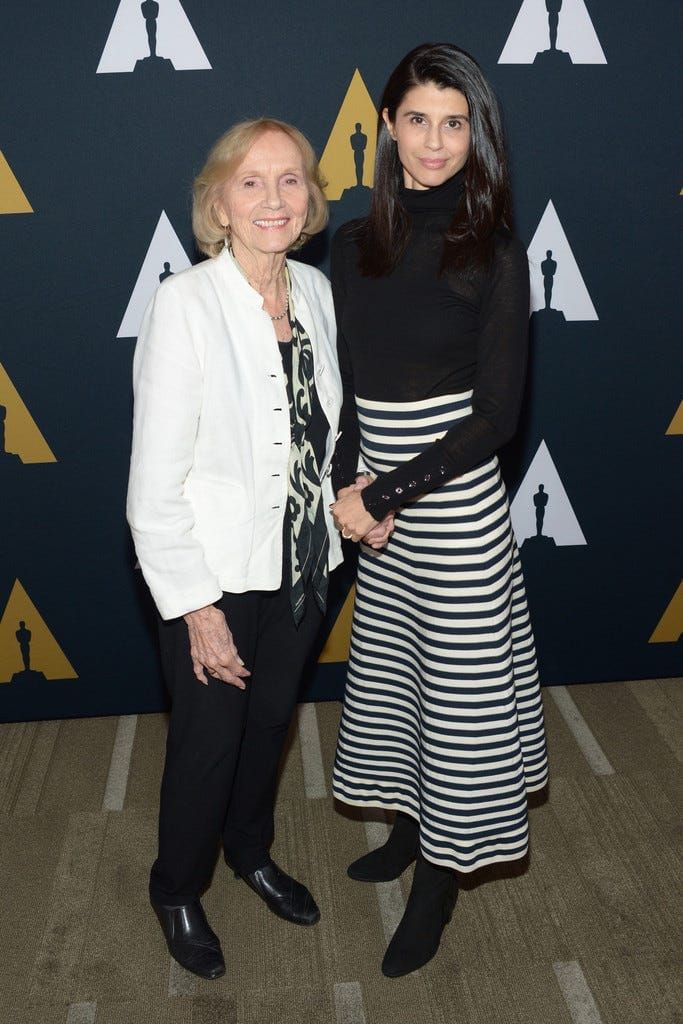
Scott: Eva Marie Saint, who you mentioned, was your champion in terms of the script and introduced you at the award ceremony had an interesting comment.
She said, “When reading a script, you hope to find truth, reality, well‑defined characters, and a good story. I found all of the above in talking about the sky.” What do you think when you hear that comment?
Michele: Wow, it was something. I felt really lucky that that script got to her, that she was able to read it, that the Nicholl committee read it, and that they liked it as much as I did. I’m glad the script spoke to them. You never know what the ultimate end is going to be for anything. Eva is a class act and I am trying to find the right words to describe the thrill it was to have her like my writing, but there aren’t good enough ones! If you look at her career it is amazing and not many people have the talent and successes she has. It is remarkable.
When I wrote that script, and was driving for rideshare I was making the transition from producing commercials to directing commercials. I put myself on a strict schedule every day.
This is how long I’m going to drive. I’m going to come home and write.
I was excited every day to get home and be able to write. At the end of the day to find out a good outcome happened to something that I put an immense amount of work into is very pleasing.
Scott: One thing that jumped out to me was the idea of well‑defined character. Maybe you could drill down to that a little bit because the characters in your script are very strong. How do you go about developing characters?
Michele: I have a picture in my head, or it’s something that I see on the street, or just a little snippet, a little slice of life.
I’m one of those people watchers that when you go to the airport, or you’re taking a train, or you are waiting for a coffee. I like to watch people and how they interact.
I start off with something like that, and then you start painting layers.
At first, you have a little sketch and an outline, and then you pick up something else, a certain speech pattern or word that somebody repeats over and over again. You think, that would be good for my character.
A lot of times when I was driving around or even now I have my phone, and I will dictate notes into the notes app or the voice app.
I’ll run dialogue back and forth, or I’ll hear something, a response, or a certain way a voice sounds. I’ll put it into my phone as notes for a certain character, and then I’ll go back and see how it works.
The going back to your script over and over again creating layer after layer after layer really enriches your characters.
I know some people suggest you do that character outlines in the back story, and I did do that a lot of times in the treatment. For instance, I just wrote a treatment for a script that I’m working on now and it was 50 pages, which is far too long for a treatment.
A lot of it is dialogue and a lot of it is history that I very well may not put in the screenplay.
Scott: Reminds me of that Tarantino quote. He said, “The audience doesn’t need to know everything about the characters, but they need to know that I know everything about the characters.”
Michele: That makes a lot of sense.
Tomorrow in Part 6, Michele provides some advice to aspiring screenwriters.
For Part 1 of the interview, go here.
Part 2, here.
Part 3, here.
Part 4, here.
For Michele’s commercial reel, go here.
For my interviews with 24 other Nicholl Fellowships in Screenwriting winners, go here.