Interview (Written): Eric Heisserer (“Lights Out”)
A Creative Screenwriting interview with Eric Heisserer, screenwriter of the recent horror movie hit Lights Out:
What’s the first step in taking a short and turning it into a feature length movie?
The first step was to get the treatment or outline down that gave us the skeletal structure for a feature film and let us know where the scary is, and also where the real heart is.
Something that David and I agreed on was that we wanted to be able to root for all these characters. We weren’t in the business of making the kind of movie where you’re essentially rooting for the monster and all the characters are either disposable or just jerks [laughs]. We wanted the audience to cheer when one of our characters managed to escape or survive an encounter with evil, versus having them cheer when a character dies!
So we started with the idea that we’d make something with some heart and then figure out where we wanted to put in our scares. David and I sat down and ran through a whole laundry list of scares that either tied-in with the dark or the thematic core of the movie, Diana. She represents mental illness and clinical depression, and how keeping that in the dark or keeping that as unspoken within a family can fracture a family dynamic and can even cause harm.
So with that in mind, we went down a list. He did a lot of the heavy lifting because heck, he’s going to direct and it’s my job to get him the script which he’ll be excited about shooting. But there are a handful of my ideas that managed to make it into the film and I’m especially proud of those.
Those are the core ingredients that we started with: a laundry list of scares, the heart (because we wanted to have the positive characters that we wanted to root for) and a theme of depression.
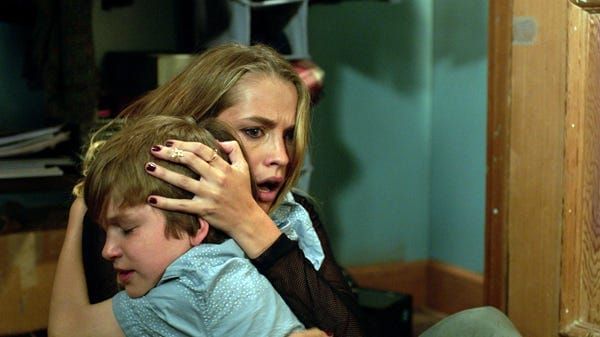
A scene from the movie Lights Out
As also producer, was rewriting different for you?
It went hand in hand. Once we were in production I joked that I fired the writer and now it’s just a matter of producing the best film possible. Having both hats allowed me to be side by side with David. I would say that something might have read well on the page but now that we’re hearing it out of the actor’s mouth, it’s a little bit clunky or it doesn’t fit the style of the behavior that I’ve started to see in this person or this cast member, so why don’t we change it up, toss this out and come up with some alternates?
He’d send me in there and we would have a small discussion with Teresa [Palmer] or Alex [DiPersia] or Maria or even Gabriel [Bateman] and that’s how it worked.
That’s how it should work, I think.
I both wrote and directed the last movie I worked on, and having been in the director’s chair, I had a lot of set experience. I also knew the kind of decisions that would be assaulting David on a daily basis and my responsibility there was to try and mitigate some of that and be a sort of offensive linebacker for him and handle some of those decisions.
There were plenty of times where I found myself writing copy for props or for computer monitors or TV screens, or I would end up writing additional dialogue for someone who was going to be a background player so it wouldn’t fall on his shoulders.
For the rest of the interview, go here.
Twitter: @CreativeScreen, @HIGHzurrer.