“Perfectly Happy” [cont’d]: “The Descendants”
Remember this post from the other day about Hollywood movie producer Lindsay Doran:
After reading the book “Flourish,” by Martin E. P. Seligman, a catalyst of the positive-psychology movement, she began rewatching films through the lens of what Dr. Seligman identifies as the five essential elements of well-being: positive emotions, engagement, relationships, meaning and accomplishment. (He refers to these elements collectively as perma.)
The results surprised her. And they inspired a stealth campaign to reverse the Hollywood superstitions that a “movie is only art if it ends badly, and that you’ll only win an Academy Award if you write or direct a movie about misery or play someone miserable,” as she put it. During the past six months, at a symposium and in a series of presentations to filmmakers, she has strongly advocated the concept of cinematic Zoloft.
Followed by this one:
Ms. Doran’s second “aha!” moment came when she consulted a veteran market researcher who oversees hundreds of previews annually. “I listed the five elements of well-being, and he said, ‘I can already tell you one thing: Audiences don’t care about accomplishments.’ ” She was thunderstruck. Wasn’t the Hollywood ending about accomplishment?
No, he said, adding: “Audiences don’t care about an accomplishment unless it’s shared with someone else. What makes an audience happy is not the moment of victory but the moment afterwards when the winners shares that victory with someone they love.” So she mentally rewound the concluding scenes of these “accomplishment” films. Ms. Grey leaps into the arms of Patrick Swayze at the end of “Dirty Dancing,” and after that she reconciles with her father. Jaden Smith performs that impossible kick at the end of “The Karate Kid,” but afterward makes peace with his opponent and shares the moment with his mother and trainer. Colin Firth conquers his stammer at the end of “The King’s Speech,” and then shares his victory with his wife, daughters and the crowds cheering outside the palace. The film closes with a title card that reads that the king and his speech therapist remained friends for the rest of their lives.
And how I cited Homeward Bound: The Incredible Journey as the paradigmatic Hollywood ending — “Give ’em what they expect, then give ’em what they want” — and Toy Story 3 as a more nuanced example of a bittersweet ending that works so beautifully because of how it resolves the many layers of characters relationships?
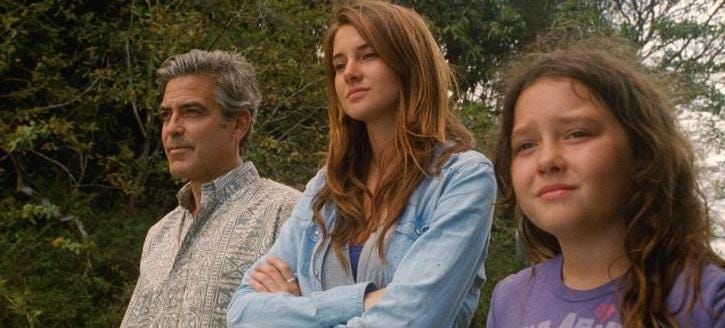
Here’s another one to add to the list: The Descendants. If you’ve seen the movie, hit the link. If you haven’t and don’t want to know the ending, please skip this post.
The Plotline of The Descendants — dealing with the impending and eventual death of Elizabeth King, the wife of the story’s Protagonist Matt King (George Clooney) who suffered a boating accident and is in a coma, is an unusual one because it’s a pretty passive affair. Certainly Elizabeth’s medical condition is the cause of everything else that goes on in the story, but the actual trajectory of the disposition of her character is one of a general decline, then death.
In that regard, what does Matt “accomplish?” He says good-bye to his wife, first in the hospital room — “My love, my friend, my pain, good-bye, good-bye, good-bye” — then in the boat with his daughters Alexandra (Shailene Woodley) and Scottie (Amara Miller) where they pour Elizabeth’s ashes into the ocean and place their leis upon the water’s surface. In its own way, as sad as that moment is, it symbolizes a victory for the Kings in that they have not only survived the ordeal of losing a wife and mother, they have used the experiences of the last few weeks to start to move together as a family.
But per this idea posited in the article, it’s not enough to just to show the accomplishment of saying good-bye, there needs to be a celebration. And sure enough, there is in the Denouement.
It’s a simple scene, beginning with Scottie sprawled on one side of a couch wrapped in a comforter watching “March of the Penguins” on TV off-screen. Matt walks up carrying two bowls of ice cream. He hands one to Scottie, settles onto the couch, pulls a part of the comforter over his legs. They eat ice cream, watching the documentary. Then Alexandra appears in the background. She stops for a moment mid-distance, as if deciding what to do in that moment. Then she moves forward and plops down onto the couch on the other side of Matt, now flanked by both of his daughters. Matt scoots over to allow Alexandra room, then pulls the comforter onto her legs. She takes his bowl of ice cream which he gives up willingly. After a beat, he snags Scottie’s bowl and eats a spoonful of her dessert.
And that’s the final image: Matt and his two daughters, hunkered under a comforter, eating ice cream, watching a documentary about penguins, sharing ice cream, sharing space… together.
It is a pitch perfect celebration, sublime in its quietude and import: The three of them are doing precisely what they need to do which is spend family time together. One of the persistent accusations hurled at Matt throughout the story was that he never spent enough time with his wife and children, one that he never attempts to refute. He knows he failed on that front. The feeling of this denouement is not like this is Matt consciously trying to make it up to the girls by carving out time from his life to be with them. Rather it has the sense that this is where he wants to be. With his daughters. With his family.
Thus at the heart of this resolution and why it feels so satisfying as a viewer is the fact it is about these characters and their relationships. They are not perfect, far from it. The family is not healed, perhaps never will be completely. But they have survived. They have reoriented their world views. And most importantly they have found each other.
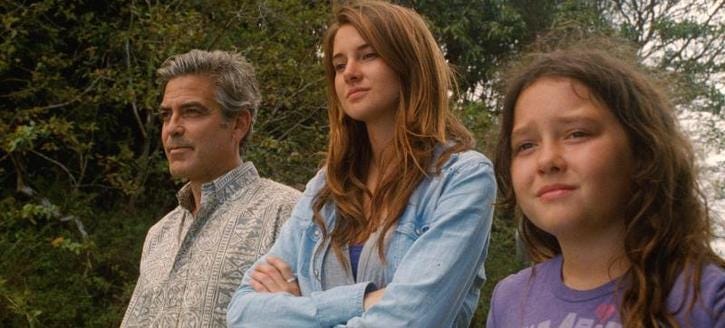
Note: I have not been able to find a photo online of that ending shot on the couch. If anyone can source that, please post the URL in comments. For now, this image of the three together drives home the point.
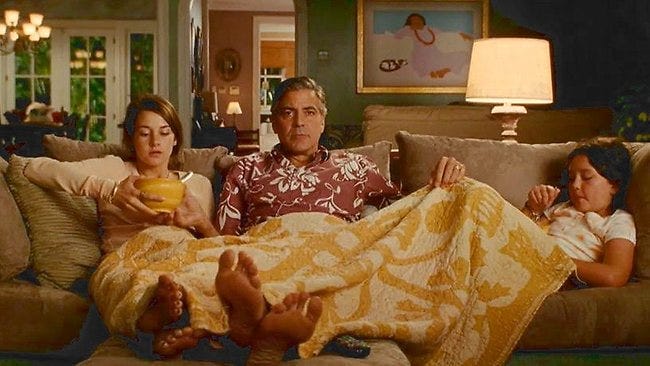
UPDATE: Thanks to Walter Purvis who found the photo!
UPDATE #2: Thanks to @LaFamiliaFilm who found another photo!
Comment Archive