Profile: Christopher Nolan (Part 1)
Trevor Hogg is back with another profile at FlickeringMyth.com, this one on writer-director Christopher Nolan. Here’s an excerpt:
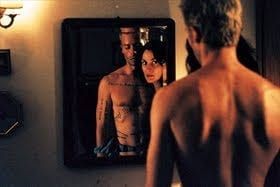
“The structure of Memento is weirdly less self-conscious than it was with Following,” observed Christopher Nolan when discussing his sophomore effort released in 2000 about a man (Guy Pearce) suffering from short-term memory lost who attempts to avenge the murder of his wife (Jorja Fox). “In Following, the relationship between the subject matter and the narrative divides. It’s a bit harder for people to figure out, it’s a little more subtle. Memento is very clear to most people, even if they hate it. It’s like we try to put them in his head and that’s why the story is told backwards.” The director had a certain viewpoint in mind when positioning his camera. “What we tried to do with Memento was simply block the film from the character’s point of view as much as possible. He walks into a room and you’re looking over his shoulder, exploring the room as he does.”
“It’s been a weird organic process, because my brother told me the concept when he was writing the story,” explained Christopher Nolan, who frequently collaborates with his younger sibling Jonathan. “He told me it while we were driving from Chicago to L.A., across country.” The Nolans chose to explore the concept using two different mediums. “We had decided that in our own ways we were going to try and tell the story in the first person; me in film and him in a short story…I was going for something that lived in its own shape which was slightly built from the standard linear experience.” Two years later as Christopher Nolan completed the movie, Jonathan wrote the final draft of his short story titled Memento Mori. Though both versions maintain key elements such as the main character leaving notes to himself as well as having tattoos containing information about the murderer, they significantly diverge from one another in their conclusion. Unlike the film, there is no ambiguity in the short story as to whether the right perpetrator is killed.
Contemplating what makes him and his brother artistically different, Jonathan Nolan remarked, “I’ve always suspected that it has something to do with the fact that he’s left-handed and I’m right-handed, because he is somehow able to look at my ideas and flip them around in a way that’s just a bit more twisted and interesting. It’s great to be able to work with him that way.” When writing the screenplay for the picture which features Carrie-Anne Moss and Joe Pantoliano of The Matrix (1999) as well as Callum Keith Rennie (Hard Core Logo), Christopher Nolan found inspiration in literature. “Certain books had a big influence on me, particularly Graham Swift’s Waterland. It’s a really fantastic novel that I read years and years ago where he has this incredibly complex juggling of parallel timelines.”
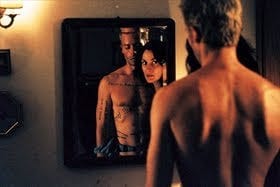
“The weird thing is you go through these tortuous creative machinations and then you look back at the original script and it’s pretty close to what’s on the screen,” confided the London-native who pointed out one particular difference. “There is probably more voice over in this film than there was in the script. I kept missing it when it wasn’t there for twenty minutes because you just needed to keep drawing people into his mind.” The first person perspective left audience members as perplexed as the main character. “I find it quite satisfying that people will come out of this film arguing about who are the good guys, and who the bad guy is. Not because there isn’t one but because we are using an unreliable narrator.”
Here’s the latest trailer for Nolan’s upcoming movie Inception:
The movie debuts July 14th.
Next week, part 2 of Trevor’s profile of Christopher Nolan.