Profile: Danny Boyle (Part 1)
Our friend Trevor Hogg is back at FlickeringMyth with the first installment of a profile on Danny Boyle. An excerpt:
“I come from a very ordinary, working class family in Manchester,” explained British filmmaker Danny Boyle. “It was a very strict Catholic family. I was an altar boy for eight years. I am supposed to be a priest; it was my mother’s fondest wish that I would become one.” The religious aspirations of the teenager were called into question by a man of the cloth. “I was going to transfer to a seminary near Wigan, but this priest, Father Conway, took me aside and said, ‘I don’t think you should go.’ Whether he was saving me from the priesthood or the priesthood from me, I don’t know. But quite soon after, I started to do drama. And there’s a real connection. All these directors — Martin Scorsese [The Departed], John Woo [Face/Off], [and] M. Night Shyamalan [The Sixth Sense] — they were all meant to be priests. There’s something very theatrical about it.”
Stepping into the theatre for the first time, the eighteen year old discovered his new vocation — a career in the arts. Boyle joined the Joint Stock Theatre Company dropping out of the University of Wales; he thrived in the new environment and eventually moved to the Royal Court Theatre Company based in London. The rising theatrical talent was made the Artistic Director from 1982 to 1985; he oversaw productions of Howard Benton’s The Genius and Edward Bond’s Saved, the latter resulting in his winning a coveted Time Out Award. Boyle, who was promoted to Deputy Directory in 1985, did not work exclusively for the theatrical organization; he also directed other stage productions such as The Pretenders and The Last Days of Don Juan for the Royal Shakespeare Company. Looking to expand his career horizons into the realm of television, Danny Boyle applied for the drama producer’s job with BBC Northern Ireland during the late 1980s. “Supposedly I was the only applicant from outside the region and they weren’t going to appoint inside the region for their own reasons — political, religious — so they appointed me,” recalled the Manchester native who transitioned from producing to directing for the acclaimed detective series Inspector Morse (ITV, 1987–2000) and the period miniseries Mr. Wroe’s Virgins (BBC, 1993).
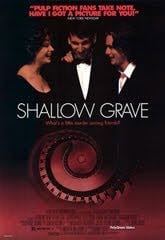
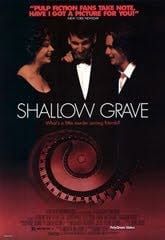
Teaming with the grandson of screenwriter Emeric Pressburger (The Red Shoes), producer Andrew Macdonald (The Last King of Scotland), and doctor-turned-writer John Hodge, Danny Boyle made his theatrical film debut with Shallow Grave (1994). Three friends turn fatally against one another when they discover that their dead flatmate has left behind a suitcase filled with money. Cast in the dark thriller are Kerry Fox (Bright Star), Christopher Eccleston (The Others), Ewan McGregor (Big Fish), Ken Stott (Charlie Wilson’s War), Keith Allen (The Good Night), and Colin McCredie (Taggart). “I was very lucky to get a really tight, 90-minute script,” stated the rookie director. “Because you kind of don’t know what you’re doing on your first movie and there’s something wonderful about that. You can never get back to that innocence. It’s a good thing to start with a thriller, because you’re not going to have a lot of money and thrillers don’t depend on a lot of money. I say sort of semi-controversially or provocatively, your first film is your best film, always, because it has that innocence about it, about not knowing what you’re doing.” Completing the $2.5 million production required some drastic measures. “We were literally selling furniture to pay for the film stock by the end.” Reflecting on the picture which grossed $3 million in the United States, Danny Boyle said, “It was very much like the film Wall Street [1987] and Gordon Gekko’s ‘Greed is good’ speech; Shallow Grave was very much influenced by that cynical self-interest.” Shallow Grave was lauded with the Alexander Korda Award for Best British Film at the BAFTAs; Best British Actor (Ewan McGregor), Best British Film, Best Director at the Empire Awards; and the ALFS Award for British Newcomer of the Year (Danny Boyle) at the London Critics Circle Film Awards. Roger Ebert of the Chicago Sun-Times wrote, “All of the materials are in place for a film that might have pleased [George] Orwell. But somehow they never come together. One of the problems, I think is that all three conspirators are so unpleasant.”
For more of the profile, go here.