Profile: Darren Aronofsky, Part 1
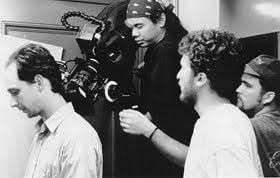
Our friend Trevor Hogg is back at FlickeringMyth with the first installment in a 2-part profile of Darren Aronofsky. An excerpt:
“Pi [1998] has a young math genius named Max Cohen for the main character,” explained Darren Aronofsky who recruited Sean Gullette once again for the leading role. “He lives in a gloomy apartment in Chinatown, isolated from other humans… [Max] is obsessed with the idea that everything in the world, ultimately can be represented and understood through numbers.” This mathematical obsession leads to Max being pursued by two ruthless organizations: a Wall Street company seeking to dominate the world financial market and a Kabbalah sect seeking to unlock the secrets of their sacred texts. “A film made for $60,000, the only way you can get it done is with a tremendous amount of favours,” observed Aronofsky who collected $100 donations from family and friends. “Every single filmmaker on the film from the P.A. [production assistant] to me to Sean to the producer to the first A.C. [assistant cameraman] were all equal profit sharers in the film. There’s a pool of 50% of the film which all of us shared equally. That’s the way to do it. That’s how we got their passion.” With the fundraising campaign falling short, a cash infusion by executive producer Randy Simon allowed the principle photography to commence; the project, which involved eight months of acting rehearsals, and took three years to make.
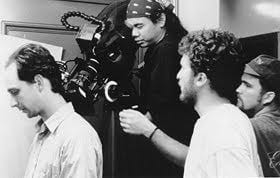
“I don’t really think that Pi is a math movie,” observed Darren Aronofsky. “The hardest math problem in the film is forty-one plus three, and we give you the answer five seconds later. It’s more the hokey-pokey magic tricks of math that we wanted to show off.” The director added, “It preserves the tradition of [Rod] Serling and Phillip K. Dick in that it works the lines separating paranoia, insanity and genius.” Aronofsky also sought to craft an entertaining piece of cinema. “We wanted to make a roller-coaster ride for ninety minutes, where audiences would be just strapped in and stay glued to their seats… If we accomplished the thriller goal, I knew we could push the themes a bit and push the style.” Cast in the picture are Mark Margolis (Gone Baby Gone), Ben Shenkman (Blue Valentine), Pamela Hart (Next Stop Wonderland), Stephen Pearlman (The Horse Whisperer), Samia Shoaib (The Next Big Thing), Ajay Naidu (Office Space), Kristyn Mae-Anne Lao, Lauren Fox (Revolution Summer), and Clint Mansell. “We really tried to exploit our limitations throughout making Pi, meaning that anytime we had something that we weren’t sure we could do, we would figure out what we could do and did it the best we could. We knew we couldn’t pull off colour. First we could only afford 16mm. And the way 16mm colour looks blown up, I’d never be happy with that, no matter whose process we used. We decided on black and white, but the problem with a black and white negative was we didn’t want the movie to look like Clerks [1994] — all grey. Then we decided to look into [black and white] reversal film, which is beautiful film stock, but extremely challenging to do.”
“We walked into the festival with no buzz,” recollected Darren Aronofsky regarding Pi being accepted as an official entry at the Sundance Film Festival. “At our first screening, we had a standing ovation.” A distribution deal was signed with Live Entertainment [later Artisan] causing entertainment industry publication Variety to print the headline Pi = $1 million. Grossing $3 million domestically, the science fiction thriller won the Directing Award — Dramatic, and a nomination for the Grand Jury Prize — Dramatic, at Sundance; it also received a Special Recognition Award for “excellence in filmmaking” from the National Board of Review, and the Open Palm Award at the Gotham Awards. The Independent Spirit Awards lauded the film with Best First Screenplay and nominations for Best Cinematography and Best First Picture. Questioned about how the Jewish community reacted to the story, Darren Aronofsky replied, “When we showed it at the Museum of Modern of Art [as part of the program of] New Directors, New Films, it was a very Jewish audience and they actually cheered throughout the film.”
For more, go here.
Comment Archive