Profile: Darren Aronofsky, Part 2
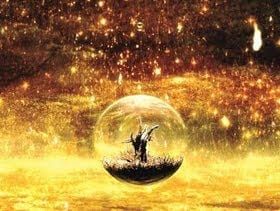
Our friend Trevor Hogg is back at FlickeringMyth with the second installment in a 2-part profile of Darren Aronofsky. An excerpt:
“I walked out of The Matrix [1999] and I was thinking, ‘What kind of science fiction movie can people make now?’,” marveled Brooklyn born filmmaker Darren Aronofsky. “The Wachowski Brothers took all the great sci-fi ideas of the twentieth century and rolled them into a delicious pop culture sandwich that everyone on the planet devoured.” The solution arrived in the form of a college buddy who had left neuroscience to become a writer. “I remember Darren saying, ‘How cool would it be to cut from a battle scene in some historical period to a man traveling alone in space for an unknown reason?’,” remarked Ari Handel who co-wrote the script for The Fountain (2006). “To convince Warner Bros. to give us the big budget to make this very experimental film, we knew we needed real stars.” Brad Pitt (Fight Club) and Cate Blanchett (Robin Hood) were originally signed to be the leads in the initial $75 million production that was to feature three stories: a present day scientist and his cancer-stricken wife, a conquistador and his queen, and a space traveler who meditates on his past love. Elaborate sets were built including a ten story pyramid on the Gold Coast of Australia. The production started to unravel when Brad Pitt and the studio demanded extensive script revisions. Matters got worse when the science fiction fantasy lost the financial backing of Village Roadshow and New Regency. In 2002, the troubled cinematic endeavor collapsed when seven weeks before principle photography was to begin Pitt left. “After working together for two and half years, Brad had lost trust in me and faith in the project,” admitted Aronofsky who suffered a near mental breakdown.
Escaping to India and China for a self-imposed month long exile, the filmmaker returned to New York where he sat for months playing Xbox snowboarding games. Looking at the series of research books for the movie, the director came to a final conclusion. “I could feel that The Fountain was not out of my blood,” confessed Darren Aronofsky. “And then I remembered I don’t have to write for the studio or Brad Pitt or any other movie star. I decided to start acting like an independent filmmaker again.” Realizing he would have to significantly scale back his vision in order to secure the necessary financing, Aronofsky hired Kent Williams to create a graphic novel based on the original screenplay which was published by DC Comics in 2005. “If that many people had tried to shut me down, I would have believed them and given up,” confessed actress Rachel Weisz (The Constant Gardener) who was recruited to play the female lead in the revised version. “But Darren has a kind of tenacity that I’ve never come across before — tenacity or madness. So The Fountain didn’t have Brad Pitt anymore, for however many gazillions he cost. Writing a cheaper version of the movie let Darren take a more indie route to getting it made.” Selected to replace Brad Pitt was an actor whom Darren Aronofsky saw performing in the Broadway musical The Boy from Oz, Hugh Jackman (X-Men).
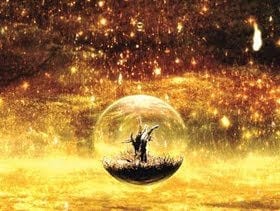
“The whole approach of my team was to take old-school techniques and street technology and figure out how to do something fresh and original with them,” stated the director. “No matter how good CGI looks at first, it dates quickly. But 2001 [1968] holds up. So I set the ridiculous goal of making a film that would reinvent space without using CGI.” Warner Bros., which was anxious to recoup its initial $20 million investment, was skeptical about choosing practical effects over computer generated ones. “The studio gave Darren a hard time,” stated Peter Parks, a marine biologist and photographer who, along with his son, runs a special effects company. “Nobody believed he could make this film without CGI. The studio thought he was crazy. He had to fly that reel across the Atlantic five or six times.” To create the nebula scenes, a device used by the Parks called a microzoom optical bench, that has ability to magnify a microliter of water up to 500,000 times, was deployed. “When these images are projected on a big screen, you feel like you’re looking at infinity. That’s because the same forces are at work in the water — gravitational effects, settlement, refractive indices — are happening in outer space.” Peter Parks believed Aronofsky made the right decision. “The CGI guys have ultimate control over everything they do. They can repeat shots over and over and get everything to end up exactly where they want it. But they’re forever seeking the ability to randomize, so that they’re not limited by their imaginations. I’m incapable of faithfully repeating anything, but I can go on producing chaos until the cows come home.”