Profile: Francis Ford Coppola (Part 2)
Our friend Trevor Hogg is back at FlickeringMyth with the second installment in a 5-part profile of Francis Ford Coppola. An excerpt:
“There had been a movie a year or so before The Godfather [1972] based on the novel called the The Brotherhood [1968], starring Kirk Douglas [Paths of Glory],” remembered American director Francis Ford Coppola. “It was a big studio production which was sort of about the Mafia. It was not successful. When The Godfather proposition came out, a lot of people thought, ‘That won’t work.’” Financially broke and faced with being evicted from the offices of his production company American Zoetrope, the filmmaker was approached by Paramount Pictures to helm the cinematic adaptation of the tale authored by Mario Puzo. “I thought, when I read the book, that the story of the brothers and the father and the Mafia was interesting. But it was also a book a about this girl who has extremely large genitalia. She has an operation, and the doctor who fixes her body is the first to sleep with her.” Much to the disbelief of his colleague George Lucas (Star Wars), Coppola chose to turn down the potentially lucrative project. At the goading of Lucas to find something he liked in the novel, the director went to the public library to do some research on the Mafia. “When I read those books, I turned around my attitude,” recalled Francis Ford Coppola. “I was fascinated by the whole idea that there were these various families who had divided up New York and they ran them like businesses.” The Detroit native set about revisiting the source material aided by new points of reference. “When I read it [again], instead of just reading it, I underlined everything and made notes as to everything I thought…I cut it up, with all my notes on it, and I put it in a big loose-leaf binder. I began to diagram the story and write down the theme for each scene.” He added, “I broke down each sequence, I made a little synopsis as to what happened, I wrote a paragraph as to what the time period, the 1940s, was like. Then I put in images and the tone for each scene.”
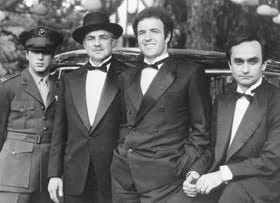
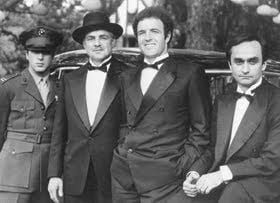
“The original script was set all in contemporary time. It had hippies in it,” revealed Francis Ford Coppola who fought against the cost-saving measure of transferring the period drama to the present day. “One of the reasons it was so important to me to get Paramount to agree to set the movie in the forties instead of the seventies was that so much of the story connects with what was going on in America during that period.” The director decided to emphasize the Shakespearean elements found in the book which evolves around a man in search of a successor. “He’s got one son who’s tough and a Mafia guy. He’s got one son who’s sort of a little light-headed. He’s got a third son, his youngest son…who is a war hero whom he wants to go into politics rather than become dirty.” Coppola clashed with the Hollywood studio over the casting wish list for the proposed $2 million production (rising to a final tally of $6.2 million) which would have seen Robert Redford (The Sting) play Michael Corleone, the third son who assumes control of the family business. “I worked with a wonderful casting person named Fred Roos [Five Easy Pieces]. We worked together and we started to figure out, what if [Al] Pacino plays this part? I got all of the other actors [Robert Duvall, Diane Keaton, and James Caan] to come up to San Franciscio…My wife cut their hair and got some clothes. We shot on 16mm film a whole bunch of tests of scenes.” The Paramount executives were not impressed with the footage resulting in a very intensive casting search. “We had to test every young actor for every part,” groaned the filmmaker. “We tested Martin Sheen [The Departed] as Michael. Dean Stockwell [Compulsion] as Michael. Ryan O’Neal [Barry Lyndon] as Michael. There were hundreds of tests and we spend hundreds of thousands of dollars on them. But then, we went back to my $500 worth of tests.” Chosen to play the patriarchal title character was Marlon Brando (A Dry White Season). “I thought it would be an interesting contrast to play him as a gentle man, unlike Al Capone who beat up people with baseball bats,” stated Brando on how he approached his signature role of Don Corleone. “I saw him a man of substance, tradition, dignity, refinement, a man of unerring instinct who just happened to live in a violent world and who had to protect himself and his family in this environment.”
“The first shot we did was the scene where Michael [Pacino] and Kay [Keaton] come out of Best’s department store,” stated Francis Ford Coppola who used a variety of locations while conducting the principle photography in New York. “I honestly did feel from the second week that this was a remarkable movie being made, but the number of people seeing the dailies began to shrink. You can always tell when a studio is giving up on a picture — you look around the room and there’s nobody there.” The production was in constant turmoil as the film fell behind schedule at the cost of $40,000 a day and making matters worse, the director had to deal with a disgruntled movie crew. Cinematographer Gordon Willis when asked to remark about the freewheeling filmmaking style employed by Coppola replied, “I like to lay a thing out and make it work, with discipline. Francis’ attitude is more like, ‘I’ll set my clothes on fire — if I can make it to the other side of the room, it’ll be spectacular.’” In a counter move designed to starve off his being replaced by the studio, Francis Ford Coppola fired the discontents on his production staff. “When you make a movie, there isn’t a human being on that set that doesn’t think they can make it better than you,” observed Coppola whose job was saved by the performance of Al Pacino in the pivotal restaurant assassination scene.
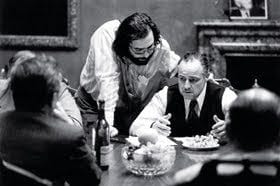
“I liked the idea of starting the movie…with, ‘I believe in America,’ because it’s what the whole movie is about,” reflected Francis Ford Coppola. “It’s saying that our country should be our family in a way, that it should afford us the protection and the honour that, in a strange way, this Mafia family does.” The cinematic theme resonated with movie audiences whose overwhelming enthusiasm resulted in the picture grossing $1 million dollars a day for an initial release total of $86 million. At the Academy Awards The Godfather won for Best Picture, Best Actor (Marlon Brando), and Best Adapted Screenplay while contending for Best Supporting Actor (James Caan, Robert Duvall, and Al Pacino), Best Costume Design, Best Director, Best Editing and Best Sound. The BAFTAs presented the period crime drama with the Anthony Asquith Award for Film Music along with nominations for Best Actor (Marlon Brando), Best Costume Design, Best Supporting Actor (Robert Duvall), and Most Promising Newcomer to a Leading Film Role (Al Pacino). The Golden Globes lauded the movie with Best Director, Best Picture — Drama, Best Actor — Drama (Marlon Brando), Best Original Score, and Best Screenplay as well as nominating it for Best Actor — Drama (Al Pacino) and Best Supporting Actor (James Caan). The Godfather received a Directors Guild of American Award, a nomination from the American Cinema Editors for Best Edited Feature Film, and the Writers Guild of America Award for Best Adapted Screenplay — Drama. In 1990 the Mafia saga was inducted into the National Film Registry.
“Everyone advised me not to invest my own money,” lamented Francis Ford Coppola of his decision not to finance George Lucas’ sophomore effort about a group of high school students on the eve of their graduation. “I turned the film over to Universal and lost the chance to earn enough money to set up my own studio. That movie could have brought me over $20 million. After that I decided to finance all of my Zoetrope films myself.” American Graffiti (1973) grossed $115 million at the domestic box office; it won Best Picture — Musical or Comedy at the Golden Globes while receiving Oscar nominations for Best Picture, Best Director, Best Supporting Actress (Candy Williams), Best Editing, and Best Original Screenplay.