Profile: Francis Ford Coppola (Part 5)
Our friend Trevor Hogg is back at FlickeringMyth with the final installment in a 5-part profile of Francis Ford Coppola. An excerpt:
Shot over a course of eighty-six days, Youth Without Youth (2007) is a cinematic adaptation of the novella by Mircea Eliade. Struck by lightning, a timid seventy year old academic (Tim Roth) finds himself growing younger in 1938 Romania. “My and Tim’s interpretation was that he was this gentle, older professor who had never even had the courage to take the woman he loved because he was so bookish and sweet,” revealed filmmaker Francis Ford Coppola. “I made the style very deliberately classical; it allowed me to do what I’ve always wanted to do [which] is to make a movie without any [camera] movement.”
Chosen to be the romantic love interest in the $19 million production was Alexandra Maria Lara (Control). “I thought Alexandra was an actress who had a wonderful ability to [let you] know what she’s feeling just by looking at her face, and that’s a big thing in a movie.” Other performers in the picture include Bruno Ganz (Downfall), André Hennicke (Pandorum), Marcel Iures (Mission: Impossible), Andrian Pintea (Vlad) and Alexandra Pirici (The Wind in the Willows). “I tried to make a movie you don’t have to think about and you can enjoy it as a work,” stated Coppola. “But later on if you want to see it again or you want to think about it, you’ll get more.” Youth Without Youth grossed $3 million worldwide and earned a Independent Spirit Awards nomination for Best Cinematography.
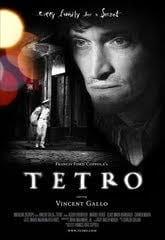
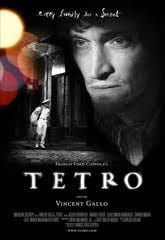
Tetro (2009) marked the first time since The Conversation (1974) that Francis Ford Coppola had written an original screenplay. While on a stopover in Argentina, Bennie (Alden Ehrenreich) seeks out his older brother Tetro (Vincent Gallo) whom he has not seen for years. “I knew Argentina had a great cultural, artistic, literary, musical, and cinema tradition,” said the director who conducted the principle photography in Buenos Aires. “I like those kinds of atmospheres very much because you usually find creative people to work with.” Life was not so easy for Coppola in the South American country as rumours circulated that the production had been shut down temporarily by a labour dispute. The picture was shot in the same way as Rumble Fish (1983) which made use of black and white images combine with the occasional use of colour.
“I know choosing Vincent Gallo to star in my film will raise a few eyebrows, but I’m betting that seeing him in the role will open some eyes,” remarked Coppola who also decided to change the gender of Tetro’s mentor and literary critic; the role initially intended for Javier Bardem (No Country for Old Men) was filled by Carmen Maura (Volver). “As I read and reread [the script], I felt that the interaction between the two characters would be far more intriguing if they were of the opposite sex.” As for casting Alden Ehrenrich, the moviemaker said, “As of the moment he read the Catcher in the Rye paragraph [for me], I felt he was the right one.” The $15 million dollar project which earned $3 million worldwide stars Maribel Verdú (Pan’s Labyrinth), Silvia Pérez (Encarnacion), Rodrigo De la Serna (The Tango Singer) and Erica Rivas (Night Runner). “I’m not trying to return to form,” declared the Detroit native. “I am trying to follow my heart and do more personal films.” Todd McCarthy of Variety wrote when “Coppola finds creative nirvana, he frequently has trouble delivering the full goods.” “A complex mediation on family dynamics, Tetro’s arresting visuals and emotional core compensate for its uneven narrative.” was the consensus from the movie review website Rotten Tomatoes. The movie received nominations from the Cinema Writers Circle Awards and Goya Awards for Best Actress (Maribel Verdú).
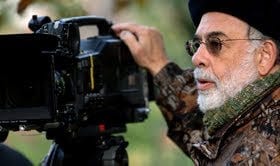
“Obviously to write stories and scripts that are not of an immediate commercial nature, you need to make them less expensively,” observed Francis Ford Coppola who has found financial stability with his profitable and successful California winery. “I finally accepted that the bigger the budget, the stupider the movie had to be…The smaller the budget, the more ambitious you can be.” The director is not impressed with the current Hollywood studio mentality. “The film industry doesn’t even want to finance drama now; they want to make films about superheroes…It has to be a product more like Coca-Cola, something that everyone is familiar with.” Coppola has no interest in giving up his independence. “People like myself, who decide that it’s necessary to work within a system in order to be able either to change it or eventually go off on their own to subsidize the kind of work they believe in, inevitably become changed by the process, if they go along with it.” The movemaker added, “I dream of being part of a really scintillating world cinema; it would be nice for movies to again become special events…If I ever got the money that, say George Lucas got from Star Wars [1977], I’d put every penny into changing the rules.”
For more, go here.
For Part 1, go here.
For Part 2, go here.
For Part 3, go here.
For Part 4, go here.
Comment Archive