Profile: Hayao Miyazaki (Part 2)
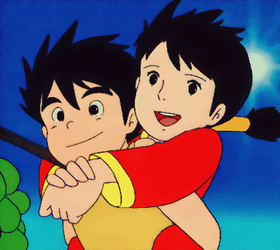
From our friend Trevor Hogg at FlickeringMyth.com, a profile on the legendary writer-director-animator Hayao Miyazaki. Here is an excerpt from Part 2:
“I was frankly in a dilemma after my work on From the Apennines to the Andes [1976] ended,” stated Japanese anime artist Hayao Miyazaki who found himself at a career crossroad. “I really thought I could never do any work that involved just layouts. But then I was asked if I’d like to try directing. Even today I don’t like being pegged as just a “director” or as someone who does scene designs or screen layouts. Rather than being seen solely as directing, if it’s something that I like to work on, I’d actually like to be thought of as an animator.”
Aided by the talents of his long-time collaborator Isao Takahata and their mentor Yasuo Ôtsuka, Miyazaki adapted Alexander Key’s The Incredible Tide into an animated television program known as Mira shônen Konan (Conan, the Boy in Future, 1978). “I still think of this series as basically a love story between Conan and Lana,” reflected the man who designed, storyboarded and directed nearly all of the twenty-six episodes, “but without depicting this part of the story properly, Conan and Lana would never have amounted to anything more than two people with crushes on each other. I realized what was missing, but I didn’t know what to do about it. I had accepted the original idea of a post-Armageddon setting for an adventure story, but I did feel constrained by the burden of the heavy ending.”
Further revisions were made out of necessity. “You have a weird society where people dream of riding bicycles through desolate scenes of dark oceans, gray skies, and craggy boulders and rocks — it’s a bleak mental landscape,” explained Hayao Miyazaki. “And you have this weird society called High Harbour. I don’t think a boy like Conan would have ever been born in a world like that. Nature recovers and forgives humans, and even though “forgives” is a strange way to put it, I do think that nature creates the foundation for all life to exist, so that humans [who are also animals] can go on living. Conversely, in creating the setting for a character like Conan, I think it would have been better to have nature having already made its comeback. I have been told, however, that the idea that nature can recover by itself may be a very Japanese one.” There was another major reason to diverge from the pessimistic tone of the original story. “Even if someone’s lost all hope for the future, I still think it’s incredibly stupid to go around stressing this to children.”
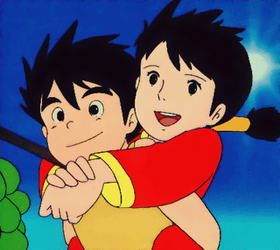
“I can’t do the work unless I have an emotional investment in it,” admitted the animator. “I tend to pour myself into the characters. And when I do so, I start to emphasize with the characters.” Hayao Miyazaki had a particular concept he wanted to explore. “I wanted to have a young protagonist who takes over from the failed generation of older guys.” When it came to deciding upon the age of the title character, the creator of science fiction fantasy series reasoned, “It seems to me that most boys are about eleven when they start imagining themselves as the heroes in stories where they have the traditional roles like saving princesses, etc., so that’s why I made Conan eleven.” The title character is grounded in reality. “Conan is not a superman. He’s an ordinary kid who mainly thinks about having fun in his life. But humans are complex characters. And one fact about Conan is that the conditions in which he lives amplify certain aspects of his personality. He doesn’t go looking for adventure, he just does his best to stay alive.” Miyazaki added, “He comes to embody the vitality, resolute spirit, and understanding of others that his world needs. I personally like the idea that it is because of Conan’s silent influence that Jimsy becomes happier, that Dyce tries to become more normal, and that Monsley is transformed.”
Next week: Part 3