Profile: Hayao Miyazaki (Part 4)
From our friend Trevor Hogg at FlickeringMyth.com, a profile on the legendary writer-director-animator Hayao Miyazaki. Today an excerpt from Part 4:
“I certainly do not make animated films just so they will be popular with children,” stated Studio Ghibli co-founder Hayao Miyazaki. “I try to create what I wanted to see as a child or what I believe my children want to see. We have all heard folktales. You can tell when you read them that they are a kind of encouragement; they assure us that somehow things will turn out alright. Even if something terrible happens, someone will come and save us — Cinderella and Snow White are good examples.” Revisiting the fairy tale of Beauty and the Beast, the Japanese filmmaker wrote in a planning memo dated April 19, 1995, “Mononoke-hime [Princess Mononoke, 1997] does not purport to solve the problems of the entire world. The battle between rampaging forest gods and humanity cannot end well; there can be no happy ending. Yet, even amid the hatred and slaughter, there are things worthy of life. It is possible for wonderful encounters to occur and for beautiful things to exist.”
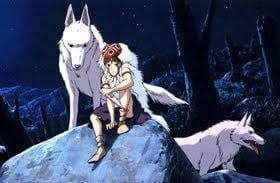
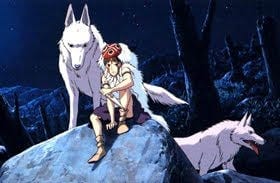
Miyazaki had a particular era and goal in mind when developing the project; he wanted to “depict the unchanging nature of humans by overlapping the turmoil of the Muromachi period [1336 to 1573] — just as the medieval framework collapsed — with the upheavals of our era as we head into the twenty-first century. This is a vivid period of action-adventure woven from two threads — a vertical thread of the struggle of humans and spirits over a beast god [boar god], and a horizontal thread of the meeting between a girl [Princess Mononoke who is raised by wolves and is a fierce fighter who despises humans], and a boy [Ashitaka, who has a death curse placed upon him]. This meeting is the key to their liberation.” When describing the central characters, the Tokyo-native, remarked, “The pivotal figure in the story, the Great Forest Spirit, is an entirely imaginary creature with a face of a human, the body of a beast, and horns made of trees. The boy protagonist is a descendent of the Emishi, who disappeared in ancient times after being decimated by the Yamoto regime; the girl looks not unlike a type of clay figure of the Jômon period.”
Desiring to break free of the clichés and biases associated with period dramas, the anime artist placed the castles, towns, and farm villages with rice paddies in the background. Hayao Miyazaki was attracted to the Muromachi era because, “It was a period of mobility, when the distinction between warriors and peasants was less entrenched, and — the paintings show women as craftspersons — society was more broadminded and free.” The animator was inspired by the villains featured in Victorian-age novels. “The evil characters that appear in them are truly dashing. They are lighthearted, generous, and good-looking — the epitome of cool everyone idealizes in our modern society.” Miyazaki added, “I’m frankly so sick of stories where the most negative characters appear with scary faces.”