Profile: Martin Scorcese (Part 5)
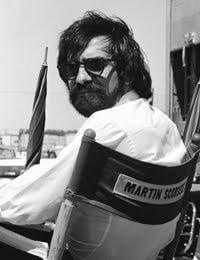
Our friend Trevor Hogg has another profile at Flickering Myth, this one on Martin Scorcese.
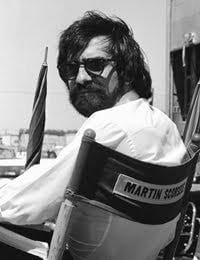
Noted as one of America’s most distinctive directors, Scorcese also has 14 film writing credits including Mean Streets, Goodfellas, and Age of Innocence. Here is an excerpt from the Part 5 finale of the profile:
“I didn’t think of it as Hong Kong. I reacted to what Bill Monahan put together in the script; I liked the idea,” explained American filmmaker Martin Scorsese when discussing The Departed (2006). “Taking from the Hong Kong trilogy of Andrew Lau‘s film [Infernal Affairs], that’s the device, the concept of the two informers. [I am] totally, whether I like it or not, drawn to stories that have to do with trust and betrayal. I found that I kept being drawn back to the script and to the project. It became something else.” Questioned about his shift from portraying Italian criminals to those of Irish heritage, the director observed, “The differences between different ethnic groups as gangsters, that’s purely technical.” Cast in the plot-twisting thriller are Leonardo DiCaprio (The Beach), Matt Damon (The Bourne Supremacy), Jack Nicholson (One Flew Over the Cuckoo’s Nest), Alec Baldwin (Beetlejuice), Mark Wahlberg (Boogie Nights), Martin Sheen (Badlands), Ray Winstone (Edge of Darkness), and Vera Farmiga (Source Code). “It’s really rare in a film of this budget to have characters this interesting,” stated Matt Damon of the $90 million production in which he portrays a gangster mole planted in the Boston police force. Leonardo DiCaprio, who plays the undercover police officer, is in agreement with his co-star. “These characters are two sides of the same coin in a lot of ways,” stated DiCaprio. “They come from different backgrounds but they each could have easily made choices the other character made, depending on the circumstances.” The frequent Scorsese collaborator added, “I think the working experience was interesting because it was almost like we were shooting two entirely different films.”
“We shot in an armory in Brooklyn. That’s where there was space,” revealed Martin Scorsese. “I think it was an issue of a very good shooting deal in New York as oppose to Boston.” Leonardo DiCaprio was impressed with those helping behind the scenes. “We had a great technical advisor name Tom Duffy who knew the entire history of Boston and what the streets were like; he was there throughout the entire filmmaking process. The police gave us unbelievable advice. Matt actually went on a raid at a crackhouse.” The frontline knowledge is not something Matt Damon is going to forget. “The ride-along was a great experience,” said Damon. “I was lot closer to the action than I was comfortable with, I’ll tell you that. We did the whole deep breathing, the little huddle before we went in. They gave me a bulletproof vest and put me at the end of the line of people who went crashing through the door.”
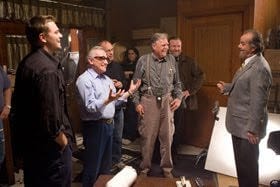
Working with three-time Oscar-winner Jack Nicholson left a lasting impression on Leonardo DiCaprio. “He had a short run; he filmed his scenes and then he left. But those were some of the most intense moments of the film.” DiCaprio went on to give an example, “We did the [table] scene one way, and I remember Jack [telling] Marty he didn’t feel that [his portrayal of Costello] was intimidating enough…I came in the next day and the prop guy told me, be careful, he’s got a fire extinguisher, a gun, some matches, and a bottle of whiskey. Some things are in the film that he did that day and some things aren’t.” Matt Damon is quick to point out that, “None of the violence in this film is gratuitous and the characters pay a price for their violence. That’s a good message to send out to people — that there’s a price to pay.” Acknowledging that there is usually a body count associated with his movies, Scorsese remarked, “The thing that gets me going is a sense of energy that can be misdirected into violence.”
For Part 1, go here.
For Part 2, go here.
For Part 3, go here.
For Part 4, go here.
For the rest of Part 5, go here.