Profile: Steven Spielberg (Part 2)
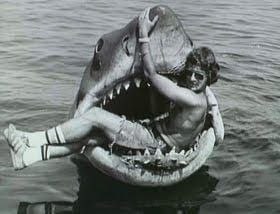
Our friend Trevor Hogg is back at FlickeringMyth with another profile, this one on Steven Spielberg. Here is an excerpt from Part 2:
With the theme of his TV thriller Duel in mind, Spielberg shifted the roadside action to a waterside resort town for his next picture. “What really attracted me to the Jaws [1975] project was in the novel,” revealed the director of the best seller written by Peter Benchley, “the last 120 pages, when they go out to hunt, a sea hunt for the great white shark…The extended drama between these three people who are against each other, and then finally join forces to fight the shark.” An agreement was reached with producer Richard Zanuck. “I said I’d like to do the picture if I could change the first two acts…and then be very true to the book for the last third.” Zanuck agreed and Steven Spielberg went about revising the story so as to make the characters Sheriff Martin Brody (Roy Scheider) and Matt Hooper (Richard Dreyfuss) more sympathetic. “I took the Mafia out of it, I took, not the sex out but the affair [between Brody’s wife and Hooper] because there really is no time for a romantic ichthyologist to show up in town.” The third member of the trio was the wily veteran shark hunter. “My first choice to play [Sam] Quint was Lee Marvin [The Dirty Dozen] but Lee Marvin wasn’t interested. My second choice was Sterling Hayden [Dr. Strangelove], whom I thought would make an amazing Quint. He couldn’t do it either…Then [the producers] Dick Zanuck and David Brown suggested Robert Shaw [A Man for All Seasons].”
“My agent took me over to be introduced to him [Steven Spielberg], and he was having a conversation with a writer named Tracey Keenan Wynn [The Longest Yard],” recalled Roy Scheider (All That Jazz). “And as I approached him, I heard a conversation that went something like this, ‘We’re going to have to make this giant shark come out of the water, and land on a boat, and crack the boat in half!’ And I remember saying to my agent as we walked away, ‘Those guys, they’ve got to be kidding — a giant shark that cracks a boat in half!’ I thought they were loony.” Scheider was not alone in his assessment of the project. “He [Steven Spielberg] told me this movie he wanted to make, and it was really a total shocker,” stated Richard Dreyfuss (The Goodbye Girl), “as a tale, it was a great, exciting story. And I said, ‘Well, this sounds like it’s going to be a great movie. I’d rather watch this movie than shoot it, because it’s going to be a bitch to shoot!’” As it turned out Dreyfuss was right as the mechanical monster kept on malfunctioning, forcing the director to shoot more from the point of view of the aquatic killer. “Whenever you were on the island,” remembered the Oscar-winning actor, “you could hear the radio mikes, and they were always saying, ‘The shark is not working, the shark is not working.’”
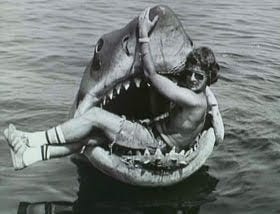
Jaws Steven Spielberg“It’s really a movie about our fear of the water,” observed Steven Spielberg. “When you’re out swimming and turn to tread water, half of your body is under the surface and you can’t keep tabs on what’s happening down there around your feet.” Making the principle photography a complicated endeavor was the decision to film in a real setting. “I wouldn’t want to do it in a tank because it wouldn’t be believable, especially today when pictures like The French Connection [1971] and Midnight Cowboy [1969] are shot in a documentary style, on location.” To effectively portray the live action, the filmmaker had a specific place in mind. “The real attraction of Martha’s Vineyard was the fact that it was the only place on the East Coast where I could go twelve miles out to sea and still have a sandy bottom only thirty feet below the surface of the water, where the mechanical shark could function.” There was a significant creative reason for selecting the location. “It was very important that, no matter where my cameras turned, I didn’t want to see land. My fear was the minute the audience saw land they’d say, ‘Look, it is getting pretty intense out there, just turn the boat around and go toward that land we keep seeing in your movie!’”
Other major complications arose during the production of the picture. “It’s the first movie that I had not prepared because I had no time,” stated Steven Spielberg. “The studio wanted to begin with this picture quickly because of the intended Actors Guild strike; they got the film going at least two months prematurely. Suddenly I found myself in Martha’s Vineyard looking at locations and rewriting the script every night with Howard Sackler [The Great White Hope] and then Carl Gottlieb [The Jerk].” There was no relief from the rushed atmosphere for the twenty-nine year old filmmaker. “I couldn’t rehearse with the actors and we had to make their performances come together virtually twenty-four hours before we began shooting or during Take 3 an idea would pop into my head, so we’d get into a huddle, break, and re-shoot it. I didn’t have Robert Shaw until we were almost shooting…We were casting as we went along, Roy was the first person cast in the picture and Roy only had a three week headstart.” Reflecting on his sophomore effort, Spielberg said, ““When I first heard the word Jaws I just thought of a period of my life when I was much younger than I am right now, and I think because I was younger, I was more courageous…or I was more stupid. I’m not sure which. So when I think of Jaws, I think about courage and stupidity. And I think both of these things exist underwater.”
Credited with being the original summer blockbuster, Jaws become the first picture to gross over $100 million in U.S. box office receipts; it went on to achieve a worldwide total of $471 million. Not only audience members were impressed as the seafaring thriller won Academy Awards for Best Editing, Best Original Score, and Best Sound while receiving a nomination for Best Picture. At the BAFTAs, Jaws was lauded with the Anthony Asquith Award for Music and contended for Best Actor (Richard Dreyfuss), Best Director, Best Film, Best Editing, Best Screenplay, and Best Soundtrack. The Golden Globes awarded the movie with Best Original Score, while handing out nominations for Best Director, Best Picture, and Best Screenplay. The Writers Guild of America nominated the $7 million production for Best Adapted Screenplay — Drama and Spielberg received a Directors Guild of America nomination.
“Finding a story that will hold my interest for the nine months it takes to make a motion picture from start to finish, that’s my biggest problem,” confessed Steven Spielberg who also admitted, “The conception of the story is the most exciting part of making a picture for me. The second most exciting part is assembling the film. The most nerve-wracking part of the movie, the process that I most dislike, is the actual shooting and directing of the picture.”