Profile: Steven Spielberg (Part 4)
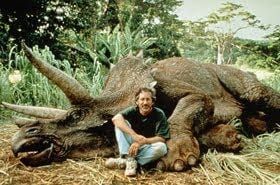
Our friend Trevor Hogg is back at FlickeringMyth with another profile, this one on Steven Spielberg. Here is an excerpt from Part 4:
Cinematically adapting a book by novelist Michael Crichton (The Great Train Robbery) about genetically-recreated dinosaurs running amok on a commercial animal reserve resulted in a movie that pushed the boundaries of computer technology and practical effects. “Our job was to create the most realistic dinosaurs that anyone has ever seen,” said makeup effects wizard Stan Winston of his work on Jurassic Park (1993). “We did an enormous amount of research. We maintained a legitimacy to all of the available knowledge when it came to what dinosaurs looked like and how they lived. We had to take that reality and make it as interesting, as dramatic, as beautiful, and as spectacular as you have ever seen.” Depicting a sense of realism was no easy task for Winston and his team. “We attacked our sculptures in a much more technically engineered way. Instead of just sculpting free-hand, we took our fifth-scale sculptures and sliced them into pies, so to speak, so we had a sculpture put together like the hull of an airplane; then we blew those slices up five times, recreated those hull pieces, and put the armature back together so that we had an armature that was very close to the finished structure of the character. Then it was a matter of detailing: putting on the skin and doing the final sculpting on an armature that gave us the shape.”
“We had four or five months of tests to see if we could make a computer create an image that looked like lizard skin and not like plastic,” stated Dennis Muren, the effects supervisor for Industrial Light & Magic. “Then we had to get the motions right.” The work was not entirely seamless. “In some cases you could see when we cut from a walking CG [computer graphic] element to someone in a suit, to a hydraulic puppet,” admitted special effects supervisor Michael Lantieri. Part of the problem with the believability factor was the setting of the story. “Although terrible things were happening in Jurassic,” explained production designer Rick Carter, “I don’t think you ever felt the terror very deeply, because everything had this Hollywood veneer which is how the theme park presented itself.”
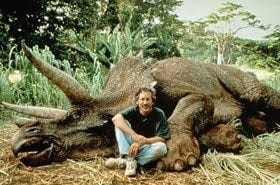
Michael Crichton maintained a pragmatic view about what got translated from the printed page to big screen. “You never get to have things exactly as you want them,” reflected the best-selling author, “and you are always struggling with other people — which is easier than struggling with yourself, but not necessarily more fun. The finished project is never entirely yours, even if you are the director and writer. After so many years doing collaborative work, I’ve gotten used to the way it goes. And sometimes it is incredible fun. So you take the good with the bad.” Explaining the world of Jurassic Park in a way that moviegoers could comprehend without being bored was a major priority for Steven Spielberg. “People don’t know a lot about paleontology,” remarked the director. “They know next to nothing about genetic engineering, so all of the exposition was enthralling. You learned something. I even did some of it in animation, like one of those Frank Baxter films — Our Mr. Sun [1956] or Gateways to the Mind [1958] — that I saw as a kid.” David Koepp (Stir of Echoes), who co-wrote the screenplay with Crichton, was under no disillusions as to what theatre audiences would be expecting. “In writing Jurassic Park, I threw out a lot of detail about the characters because whenever they started talking about their personal lives, you couldn’t care less. You wanted them to shut up and go stand on a hill where you could go see the dinosaurs.” Even with the dinosaurs garnering the cinematic spotlight in the $63 million science fiction-adventure, the performances of actors Sam Neill (Little Fish), Laura Dern (Rambling Rose), Richard Attenborough (The Great Escape), Samuel L. Jackson (The Negotiator), Joseph Mazzello (The Social Network), Ariana Richards (Angus), and Jeff Goldblum did not go by entirely unnoticed. “No one recognized me after I made The Adventures of Buckaroo Banzai [1994] and The Fly [1986],” recalled Goldblum. “But after Jurassic Park they would stop me and talk about those films. It’s like Jurassic Park jogged their memories.”
Jurassic Park tallied $915 million in worldwide box office receipts and won Oscars for Best Sound Effects Editing, Best Visual Effects and Best Sound. At the BAFTAs the picture was presented with the award for Best Visual Effects and received a nomination for Best Sound; in Japan, the Mainichi Film Concours lauded it with the Reader’s Choice Award for Best Foreign Language Film. The MTV Awards nominated Jurassic Park for Best Action Sequence, Best Movie and Best Villain; while the Young Artists Awards handed out trophies for Best Young Supporting Actor in a Motion Picture (Joseph Mazzello), Best Young Actress in a Motion Picture (Ariana Richards), and Outstanding Family Motion Picture — Action/Adventure.
For the rest, go here.
Go here for Part 1.
Go here for Part 2.
Go here for Part 3.