Profile: The Coen Brothers (Part 1)
Trevor Hogg is back with another great profile on FlickeringMyth.com: The Coen Brothers. An excerpt:
Using a Super 8 camera, Joel and his younger brother Ethan were inspired to remake the Hollywood movies being broadcasted on television; their naivety about motion picture production did not hinder their innovative spirit when shooting a new version of The Naked Prey (1966). “We had very weird special effects in that film,” reminisced Joel Coen of the childhood project entitled Zeimers in Zambia. “We actually had a parachute drop — a shot of an airplane going overhead, then a miniature, then cut to a close-up of the guy against the white sheet as it hit the ground.” Their enthusiasm for the craft of filmmaking led the brotherly duo to venture into the realm of scriptwriting. “The first one was called Coast to Coast,” stated Joel. “We never really did anything with it. It was sort of a screwball-comedy.” The unproduced tale was a product of the brothers’ surrealist sense of humour; it dealt with Chinese communists creating twenty-eight clones of the legendary physicist Albert Einstein.
After their post-secondary studies, the two siblings from Minneapolis, Minnesota reunited in New York; they renewed their creative partnership which proved to be so intuitive that upon meeting the brothers, an interviewer wittingly remarked that the Coens were “joined at the quip”.
While Ethan Coen earned money as a part-time typist, his older sibling immersed himself in the movie industry. “I was an assistant editor on a few low-budget horror films, like Fear No Evil [1981],” recalled Joel. “There was another one which I actually got fired from called Nightmare [1981], which had a small release here in New York, and The Evil Dead [1981].” The latter film would solidify an ongoing artistic relationship between the Coens and cult-horror maestro Sam Raimi (Darkman) who hired them to write a script for him called The XYZ Murders.
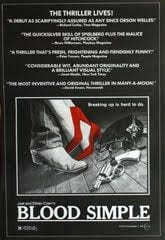
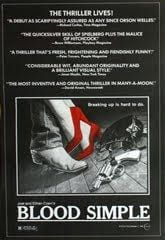
Indulging in their appreciation for the film noir genre, Joel and Ethan began to construct what would become their feature length debut. “You can’t get any more independent than Blood Simple,” declared Joel. “We did it entirely outside of Hollywood.” The director of the picture went on to say, “The main consideration from the start was that we wanted to be left alone, without anyone telling us what to do. The way we financed the movie gave us that right.”
In regards to the literary influences for the murderous tale about a sleazy private investigator (M. Emmet Walsh) hired by a cuckolded husband (Dan Hedaya) to follow his adulteress wife (Frances McDormand), Ethan said, “[James M.] Cain is more to the point for this story, than [Raymond] Chandler or [Dashiell] Hammett. They wrote mysteries, whodunits.” The writer-producer explained further, “Cain usually dealt with three great themes: opera, the Greek diner business, and the insurance business.” Completing his brother’s answer, Joel replied, “Which we felt were the three greatest themes of twentieth century literature.”
Shooting the picture in Texas had an aesthetic appeal for the moviemaking brothers. “Your classic film noir has a real urban feel and we wanted something different,” stated Ethan. There was another major decision revealed director Barry Sonnenfeld (Men in Black), who served as the cinematographer for the film, “I think we were afraid that to shoot the film in black and white would make it look too “independent”, too low-budget.” Sonnenfeld’s remark caused to Ethan to deadpan, “We wanted to trick people into thinking we’d made a real movie.”
Tomorrow a link to Part 2 of the profile.
Comment Archive