Profile: The Coen Brothers (Part 2)
Here is Part 2 of Trevor Hogg’s profile at FlickeringMyth.com on the Coen Brothers. An excerpt:
Midway through the writing of the script for Miller’s Crossing, Joel and Ethan Coen attempted to break their creative impasse by composing another story about a playwright suffering from writers’ block. Motivated by their desire to work again with actor John Turturro (Quiz Show) and to shoot a movie in a huge neglected hotel, the two brothers completed the screenplay for Barton Fink (1991) in three weeks.
Revealing the person who helped to inspire the title role played by Turturro, Joel stated, “The character had a little of the same background as a writer like Clifford Odets [Waiting for Lefty], though the resemblance stops there. Both wrote the same type of plays on proletarian heroes, but their personalities are very different. Odets was much more open to the external world, a very sociable guy even in Hollywood which isn’t the case with Barton Fink!.” A famous author served as the model for the Southern alcoholic writer W.P. Mayhew. “It’s obvious that we chose John Mahoney [Moonstruck] for that part because of his resemblance to [William] Faulkner,” remarked Ethan, “but it was also because we were very keen to work with him.” As for the similarities between the fictional character and the real life personality, Joel observed, “It’s obvious Faulkner had the same disdain as Mayhew for Hollywood, but his alcoholism didn’t paralyze him and he continued to be productive.” For the part of producer Jack Lipnick (Michael Lerner), the Coens turned their attention towards a couple of studio legends. “The incident with the uniform, for instance, came from the life of Jack Warner, who enrolled in the army and asked his wardrobe department to make a uniform,” said Joel. “Lipnick also has the vulgar side of Harry Cohn.”
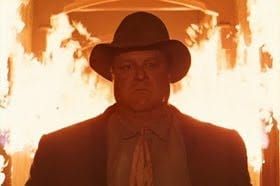
“We wanted the start of the movie to have a certain rhythm and to take the audience on a kind of journey,” stated Joel. “When Barton awoke and discovered the corpse near him, we wanted it to be a surprise without clashing with what had gone on before.” The director of the picture went on to say, “You don’t know who killed Audrey Taylor [Judy Davis]. We didn’t exclude the possibility it was him, though he proclaims his innocence repeatedly. It’s one of the classic conventions of crime movies to create false trails for the audience as long as possible. With that said, we wanted to remain ambiguous until the end. But what’s suggested is that the crime has been committed by Charlie [John Goodman], the neighbour in the room next door.”
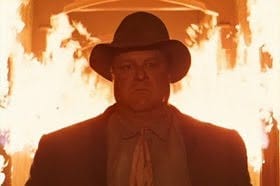
John Goodman (The Babe) was the first choice of the Coens to play insurance salesman Charlie Meadows. “The role was written for the actor, and we were obviously conscious of that warm, affable image the audience feels comfortable with,” explained Ethan. “We exploited that expectation in order to finally turn it around. Yet, as soon as he presents himself, there’s something menacing, disquieting about him.” The choice of the principal filming location was critical in establishing the right tone. “We wanted an art-deco style and a place that was falling to pieces, having known better days,” stated Joel. “The hotel had to be organically connected with the movie — it had to be the externalization of the character played by John Goodman. Sweat falls from his brow like wallpaper falls from the walls. At the end, when Goodman says he’s a prisoner of his own mental state, that it’s like a hell, the hotel has already taken on an infernal appearance.”
Next week: Part 3.
Comment Archive