Profile: Walter Murch (Part 3)
Our friend Trevor Hogg is back at FlickeringMyth with another profile, this one on famed film editor and sound engineer Walter Murch. Attentive readers know that I am fascinated about the relationship of editing and screenwriting, and in particular Murch’s ideas, as evidenced by previous posts here and here. How we, as writers, ‘cut’ shots, scenes, and transitions in script form can be a critical component in how the narrative flows, pace, visuality, and so forth.
Here are some excerpts from the third part of the profile on Walter Murch:
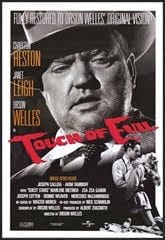
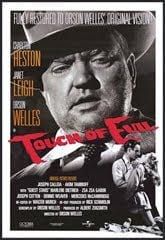
An unexpected phone call from Rick Schmidlin, led to Walter Murch reading the complete fifty-eight page memo written by Orson Welles (Citizen Kane) outlining the required revisions for the crime thriller Touch of Evil (1958). “The memo is inspiring for its raison d’être — which was to lay out the things Welles felt were wrong with the studio version of the film, and what he felt could be done to correct it, within its own terms,” said an impressed Murch. “It worked out to contain approximately fifty practical suggestions, beginning right away with the removal of Henry Mancini’s opening music.” Schmidlin had convinced Universal Studios to reassemble the picture according to Orson Welles’ specifications; impressed with Murch’s work on The Conversation, he wanted him to spearhead the 1998 project. “In the end, we were able to accommodate all fifty changes, even though all we had was the original negative and the magnetic soundtrack. No outtakes had been saved, of course, though they were available when Welles wrote his memo. What helped immeasurably were some of the new digital techniques — unimaginable when the film was originally shot.”
The modern computer technology was put to good use with the famous opening camera tracking shot that follows a vehicle traveling into Mexico with a clock bomb that explodes in real time. “We were able to remove the titles, since we luckily discovered a “textless background” in one of the cans of negative. This was then digitally rewoven into the fabric of the film, so you can’t tell where the transition takes place.” The music soundtrack was changed from bongos and brass to “overlapping fragments of source music” alternating and interweaving between Afro-Cuban and rock and roll music throughout the film as the action repeatedly goes back and forth across the American-Mexican border. “The moments when the car with the bomb approaches the camera are much tenser now than they were in the earlier version. The bomb car also has a musical signature, a certain song on its radio that helps to identify it and tell you it’s getting closer even when you haven’t seen it yet.” Contemplating the differences between the two pictures, Murch observed, “What’s nice about the new version of the film is that the opening shot now acts as a prelude to the events that follow. It settles you into your chair and presents you, in miniature, with all the themes and ideas that the following piece of cinema is about to investigate.”
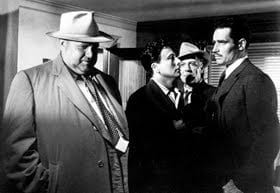
Asked to explain the classic film, Walter Murch replied, “Touch of Evil is, in a way, an investigation of the idea of ‘borderness’. What is a border? What are our expectations of the people who live there? Welles plays tricks and upsets those expectations. In an earlier, non-Welles draft of the screenplay, the American detective was a Texas Ranger. He was upright and his Mexican counterpart was the corrupt, slothful, lecherous cliché. Instead, it’s the American detective, Quinlan — Welles — who is corrupt, overfed, shabbily dressed, reactionary and racist. By contrast, Vargas, the Mexican narcotics investigator played by Charlton Heston, is square, liberal, uptight, moralistic, and a workaholic unable to consummate his honeymoon with Susie, the luscious Janet Leigh, because of his commitment to solving the crime.”
Walter Murch has a deep appreciation for the innovative techniques employed in the movie by the legendary Hollywood filmmaker such as filming with a handheld camera (a French Camérette) and shooting on real locations at night. “In the denouement of Touch of Evil, Welles worked out something that’s very close to my heart because it’s so similar to the beginning of The Conversation — namely, to make the resolution of the story depend on different shadings and perspectives of sound. Quinlan and Menzies are walking through this maze of oil derricks at night, and unknown to Quinlan, Menzies is wired for sound with a radio mic hidden under his jacket. Some distance away, Vargas is following them with a radio receiver, picking up their conversation, hoping that Quinlan will incriminate himself. When you’re close to Quinlan and Menzies, they sound normal. When you’re with Vargas and his tape recorder, they sound distorted, like voices over a telephone. And when you’re far away from both the hunter and the hunted, you hear the voices in a sort of echoey field of sound. It’s all very dynamic with no musical accompaniment. This attention to detail pays off fantastically well when Quinlan and Menzies walk over a bridge and Vargas is forced to go under one of the archways of the bridge to stay close to them. And now Quinlan’s recorded voice, heard over the tape recorder, echoes within the archway. Quinlan suddenly stops, suspicious — he hears his own voice with the wrong echo on it. And he begins to work out what’s happening — that his buddy Menzies is carrying a hidden microphone and his enemy Vargas must be under the bridge with a recorder. So that echo — that particular quality of sound — causes the plot to unravel; Quinlan accuses Menzies, there is a struggle, Menzies is shot, then Quinlan goes after Vargas, and then is shot himself by the dying Menzies. Welles hung the whole ending of the film on the ability of the people in it, and the audience, to understand a subtle nuance with the sound. That it’s the wrong echo. It’s fantastic!”
Assessing the extensive corrections requested by Orson Welles, Walter Murch said, “When I started working on the project, I never expected that we could do everything he wanted. In my experience even if you have all the necessary resources, you’re lucky if seventy-five percent of the ideas pan out — a good rate of success for anybody’s notes about a film. But in this case every single one made the film better. Although there were some notes that mystified me, initially. It was only after I’d completed the work, and seen them within the context of the whole film that I realized what Welles was after.” Orson Welles had a great appreciation for the craft of film editing. “He once said in an interview in Cahiers du Cinéma, ‘For my style, for my vision of cinema, editing is not simply one aspect; it’s the aspect’,” recalled Walter Murch. “The only time one is able to exercise control over the film is in the editing. The images themselves are not sufficient. They’re very important but they’re only images. What’s essential is the duration of each image and that which follows each image; the whole eloquence of cinema is that it’s achieved in the editing room.”
For Part 1 of the Murch profile, go here.
For Part 2, go here.