Reader Question: How can you tell if a scene is necessary or unnecessary?
You can figure this out by asking one simple question.
In response to a previous post, Manwhit asked:
thanks for the question/response. im having the same problem. any suggestions on non-formatting cuts. i.e. how can you tell what is important and what isn’t storywise scene by scene?
Manwhit, you are referring to this post about how to cut 10 pages from a script and not affect the substance of the story.
This other question you raise is much more to the substance of the story — how to determine what is important and necessary from scene to scene.
There is a question you can ask as you approach writing each scene that should help you know if the scene is necessary or not. That question is:
What is the point of the scene?
It’s the first rule of scene-writing: Every scene must have a point to justify its existence, every scene must have a function in relation to the story. If your scene doesn’t have a point or you just can’t figure it out, then you’ve got a problem.
A scene is a building block, a piece of a larger structure. If a screenplay is the foundation of a movie, then every piece or building block within that foundation has to serve a purpose. And that purpose, the very reason for that scene / building block to exist in the first place is its point.
So how to determine the point of the scene? Let’s consider the two realms of the screenplay universe: The External World, what I call the Plotline, and the Internal World, what I call the Themeline.
The External World / Plotline is where your reader can hear and see what Characters say and do — through dialogue and action.
The Internal World / Themeline is where your reader can interpret and sense what Characters mean and feel — through subtext and intention.
Notice that Subtext is tied to Dialogue. And Intention is tied to Action.
In relation to the Plotline, a scene will have a structural goal.
In relation to the Themeline, a scene will have an emotional goal.
These two goals are part of a whole. When something happens in the Plotline, that incident has an impact on characters. So the structural goal can be understood this way:
“Actions shape attitudes.”
Likewise, when a shift in a character’s thoughts or emotions occurs in the Themeline, that has an effect, too. So the emotional goal can be understood this way:
“Attitudes shape actions.”
As a writer, your primary challenge in figuring out the point of a scene is to determine what key event occurs in the scene (structural goal) that impacts a character’s psychological change (emotional goal) and/or what attitudinal shift (emotional goal) impacts a character’s actions (structural goal).
For example, take this scene from the movie The Silence of the Lambs:
EXT. SIDEWALK OF THE FUNERAL HOME — POTTER, WEST VA. — DAY
SOUND of organ music, as Clarice, carrying her fingerprint
kit, mounts some steps to the sidewalk. She stops, seeing -
COUNTRY PEOPLE
in their somber best, filing into the mortuary for a service.
The music — “Shall We Gather At The River?” — is issuing
from the open double doors. Several of the mourners glance
over at her curiously.
ANGLE ON CLARICE
staring back at the mourners, hearing the music, as a sense
memory is triggered in her…
IN FLASHBACK — LOW ANGLE, MOVING
as we approach, down the aisle of a country chapel, an open
wooden coffin. Sad country faces turn, looking at us from
the flanking pews. The b.g. organ hymn is “Shall We
Gather…?”
THE SAD, 10 YEAR-OLD CLARICE
in her best dress, is reluctantly approaching the casket.
Her hands are held by the plump hands of unseen matrons.
CHILD’S POV
on the looming coffin… closer and closer… until finally
she can see, lying inside it… her dead father, arms folded,
his marshal’s badge still pinned to his lapel.
CRAWFORD (V.O.)
Starling…?
NEW ANGLE (PRESENT DAY)
as the grownup Clarice turns towards the impatient Crawford.
Like her, he carries a large case.
CRAWFORD
We’re around back.
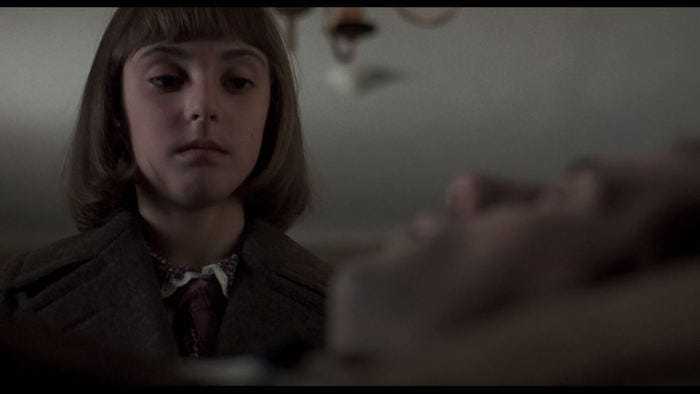
What is the point of this scene:
Structural Goal: For Clarice to relive the painful memory of her father’s funeral.
Emotional Goal: To lay the groundwork for Lecter’s continuing psychological ‘work’ with her.
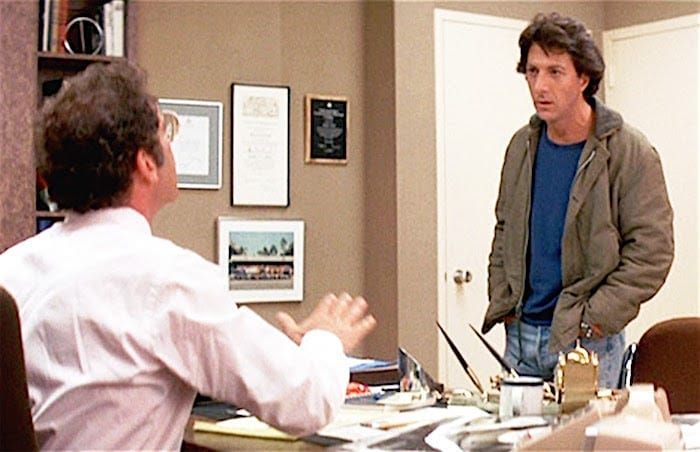
Or this scene from Tootsie:
INT. CORRIDOR
Michael striding down miles of carpeting, into George’s
office.
SECRETARY
(jumping up)
Michael, he’s tied up now.
I swear.
He strides past into:
INT. GEORGE GREY’S OFFICE
George Grey is around 50, impeccably dressed, talking
on the phone. As Michael enters:
GEORGE
(into phone)
Hold on a second.
(pushes hold)
Michael, can you wait outside,
please? I’m talking to the
Coast.
MICHAEL
This is a coast, too, George.
New York is a coast!
GEORGE
Wait a minute.
(releases “hold;”
then, into phone)
Sy, listen —
(beat)
Sy?
(into intercom)
Margret, get him back, will you?
I cut myself off.
MICHAEL
Terry Bishop is doing “Iceman
Cometh.” Why didn’t you send
me up for that, George? You’re
my agent too.
GEORGE
Stuart Pressman wanted a name.
MICHAEL
Terry Bishop is a name?
GEORGE
No. Michael Dorsey is a name.
Whey you want to send a steak
back, Michael Dorsey is a name.
Excuse me. Why do you make me
say things like that? That was a
rotten thing to say. Let me start
again. Terry Bishop is on a
“soap.” Millions of people watch him.
He’s known.
MICHAEL
And that qualifies him to ruin
“Iceman Cometh?”
GEORGE
Look, I can’t have this conversation.
MICHAEL
I can act circles around that guy.
I’ve played that part!
GEORGE
If Stuart Pressman wants a name,
that’s his affair. I know this will
disgust you, but a lot of people are
in this business to make money.
MICHAEL
Don’t make me sound like some
flake, George, I want to make
money, too.
GEORGE
Oh, really? The Harlem Theatre
for the Blind? Strindberg in the
park? The People’s Workshop in
Syracuse?
MICHAEL
I did eight plays in nine months in
Syracuse! And I got great reviews
from New York critics! Not that
that’s why I did it!
GEORGE
— No, of course not. God forbid
you should lose your standing as an
underground cult failure.
MICHAEL
Do you think I’m a failure,
George?
GEORGE
I will not get sucked into this discussion!
I am too old, too smart, and too successful!
MICHAEL
(goes close to desk)
I sent you Jeff’s play to read, it’s got a
great part for me in it. Did you read it?
GEORGE
Where do you come off sending me your
roommate’s play that you want to star in?
I’m your agent, not your mother. I’m not
supposed to produce your roommate’s
play so you can star in it. I’m supposed to
field offers.
MICHAEL
Who told you that? The agent-fairy?
That was a significant play!
GEORGE
Nobody wants to do that play!
MICHAEL
Why?
GEORGE
Because it’s a downer! No one is going
to produce a play about a couple who move
back to Love Canal!
MICHAEL
But that actually happened!
GEORGE
Who gives a shit! Nobody wants to pay
$20 to watch people living next to chemical
wastes! They can see that in New Jersey!
MICHAEL
Ok, ok, I don’t want to argue about this
now, I’ll raise the money myself! I’ll do
anything! Send me up for cat commercials,
dog commercials, voice-overs, anything!
GEORGE
But I can’t send you.
MICHAEL
Why?
GEORGE
Michael, no one wants to work with you.
MICHAEL
That’s not true! I bust my ass to get a
part right!
GEORGE
Yes, but you bust everyone else’s ass
too. A guy’s got four weeks to put on
a play — he doesn’t want to argue about
whether Tolstoy can walk if he’s dying.
MICHAEL
The guy was an idiot. That was 2 years
ago.
GEORGE
They can’t all be idiots. That’s the last
time you worked! You argue with everyone.
You’ve got one of the worst reputations in
town. Nobody will touch you.
MICHAEL
Wait a minute…what are you saying? That
nobody in New York will work with me?
GEORGE
No. That’s too limiting. How about no one
in Hollywood will work with you either. I
can’t even send you up for a commercial.
You played a tomato for 30 seconds and they
went a half day over because you wouldn’t
sit down!
MICHAEL
It wasn’t logical.
GEORGE
You were a tomato! A tomato doesn’t have
logic! A tomato can’t move!
MICHAEL
That’s what I said! So if a tomato can’t move,
how can it sit down?! I was a great tomato!
I was a stand-up tomato!
GEORGE
Michael … Michael … you’re a brilliant actor.
But there’s nothing I can do for you. I think
you ought to get some therapy.
MICHAEL
(quietly determined)
— George, I’m going to raise $8,000 and I’m
going to do Jeff’s play.
GEORGE
(shaking his head)
Michael, you haven’t been listening. You’re not
going to raise .25 cents
(slowly)
No one will hire you.
MICHAEL
Oh yeah?
EXT. MADISON AVE. — LONG LENS — DAY
Teaming with people, coming and going. The focus gradually
forces us to noticed one woman moving towards us unsteadily
on high heels. She is Michael.
What is the point of the scene?
Structural Goal: To clearly demonstrate to Michael that no one will hire him.
Emotional Goal: Michael decides to become Dorothy Michaels.
So, Manwhit, my advice to you is as you prep every scene, ask yourself the question:
What is the point of this scene?
If it doesn’t do something to advance matters in both the Plotline and the Themeline, then it could be that you have an unnecessary scene.
Furthermore if you can’t figure out what a scene’s structural goal and emotional goal is, you likely have more work to do in prepping to write it.
GITS readers, how about you? How can you tell if a scene is important enough to keep — or unimportant enough to jettison?
Comment Archive