Rise of the international movie marketplace
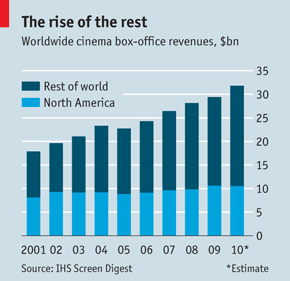
I missed this article in the Economist from back in February, but not Annika W who forwarded it to me. Really drives home how important the international market has become as far as Hollywood movies are concerned. Just look at this chart:
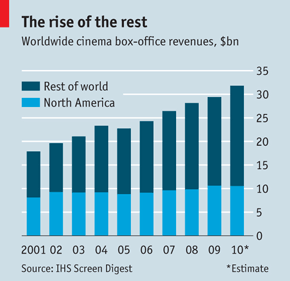
Here is the main point of the article:
Hollywood has always been an international business, but it is becoming dramatically more so. In the past decade total box-office spending has risen by about one-third in North America while more than doubling elsewhere (see chart). Thanks to Harry Potter, Sherlock Holmes and “Inception”, Warner Bros made $2.93 billion outside North America last year, smashing the studio’s previous record of $2.24 billion. Falling DVD sales in America, by far the world’s biggest home-entertainment market, mean Hollywood is even more dependent on foreign punters.
The rising foreign tide has lifted films that were virtually written off in America, such as “Prince of Persia” and “The Chronicles of Narnia: the Voyage of the Dawn Treader”. Despite starring the popular Jack Black, “Gulliver’s Travels” had a disappointing run in North America, taking $42m at the box office so far. But strong turnout in Russia and South Korea helped it reach almost $150m in sales elsewhere. As a result, it should turn a profit, says John Davis, the film’s producer.
The growth of the international box office is partly a result of the dollar’s weakness. It was also helped by “Avatar”, an eco-fantasy that made a startling $2 billion outside North America. But three things are particularly important: a cinema boom in the emerging world, a concerted effort by the major studios to make films that might play well outside America and a global marketing push to make sure they do.
The piece has several bits of information [which I’ve bolded] that should be of particular interest to the screenwriting community:
The success of a film outside America is not purely a marketing matter. As foreign box-office sales have become more important, the people who manage international distribution have become more influential, weighing in on “green-light” decisions about which films are made. The studios are careful to seed films with actors, locations and, occasionally, languages that are well-known in target countries. Sony cites the foreign success of “The Green Hornet” (Taiwanese hero, Austrian-German villain) and “Resident Evil: Afterlife” (Japanese location) as evidence of that strategy.
I’m not saying that when Christopher Nolan sat down to write Inception, the first thing that sprang to his mind was, “Hey, the movie business is an increasingly international phenomenon. I need to make sure to craft characters from all parts of the world to help drive foreign sales.” But he did end up with this:
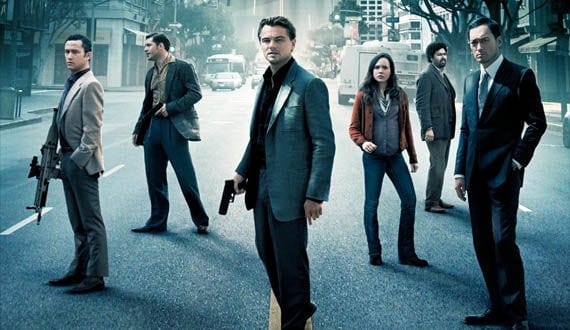
Two Americans [Cobb, Arthur], another American studying in Paris [Ariadne], a businessman from Asia [Saito], an Englishman [Eames], and a chemist from the Middle East [Yusef], the latter two of whom happen to be in Mombasa in Africa. Not exactly sure where Mal is from, but if it’s South America, then you basically have all the continents covered with the exception of Australia.
There’s more:
Big noisy spectacle travels best. Jason Statham, the close-cropped star of many a mindlessly violent film, is a particular Russian favourite. Films based on well-known literature (including cartoon books) and myths may also fare well. Films that trade on contemporary American cultural references are about as popular abroad as an oil slick on a NASCAR track. (Note to our non-American readers: NASCAR is an American sport involving fast cars.) Comedy travels badly, too: Will Ferrell and Adam Sandler provoke guffaws at home but incomprehension abroad. As the market swings away from America, funny films are less likely to find financing or broad distribution anywhere. “You won’t see us doing a lot of comedies,” says Brad Grey, head of Paramount Pictures.
The article notes how several big spectacle movies fared poorly in the U.S., but made lots of money internationally including Prince of Persia, The Chronicles of Narnia: the Voyage of the Dawn Treader and Gulliver’s Travels.
The point about “well-known literature” and “myths” may help to explain why spec scripts like “Cristo”, “Arthur & Lancelot”, and “Voices from the Dead” have sold this year.
And comedy? After many years of being the most popular spec script genre by sales, look at the trendline for the genre for the last three years:
2008: 35
2009: 26
2010: 16
Do you think the growing influence of the international market has anything to do with that?
The importance of the international market isn’t a new reality, but it is a growing one, and a screenwriter would be smart to consider the ramifications on the stories they choose to write, the characters they choose to inhabit, and the way the choose to write them.
For the rest of the article, go here.
Comment Archive