Go Into The Story Interview (Part 5): Omar Al Dakheel and Elie El Choufany
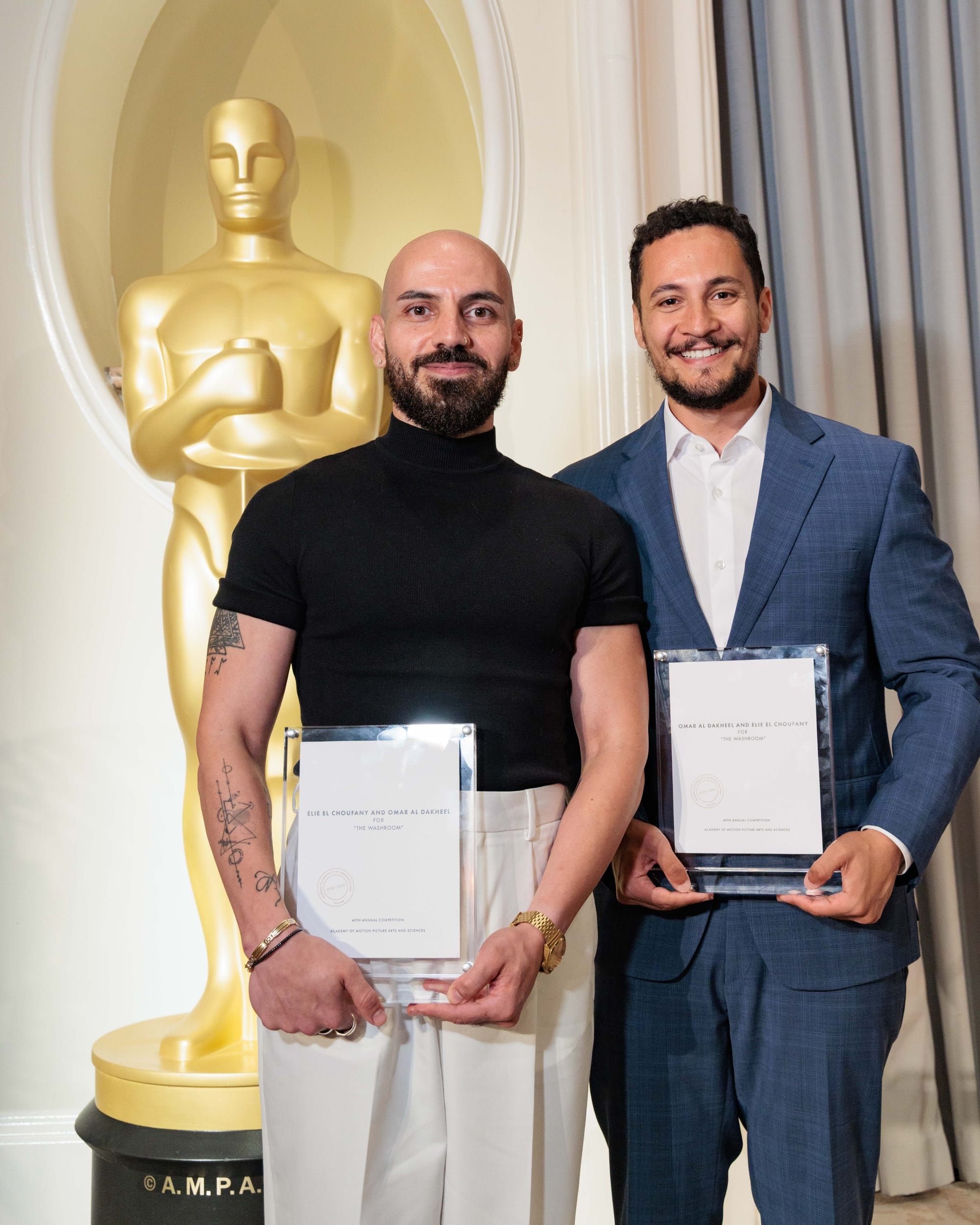
Omar Al Dakheel and Elie El Choufany wrote the original screenplay The Washroom which won a 2025-2026 Nicholl Fellowship in Screenwriting. I had an hour-long conversation with the pair exploring their creative backgrounds, analyzing their Nicholl-winning screenplay, and a discussion of key aspects of the screenwriting craft.
Today in Part 5, Elie and Omar share what their Nicholl experience has been like.
Scott: You had a lot of subplots at work there in Act Two. You've got the mosque and the cemetery. You got the mosque and the women's section. You got the Waleed and Hassan relationship. You got Noor, a woman who actually has feelings for Waleed. You’ve got a storyline involving the town’s mayor. A guy Christopher trying to scam some of the mosque’s property. How did you figure out all those subplots and wrangle the story structure?
Elie: We had a really strong understanding that what we wanted was a, a story about a community that's, that we explore through Waleed's eyes. So that we wanted to make sure that we make space for the community to live and act to. In terms of actually tracking we basically wrote down a version of the story from each character. And choice because, consequence, cause. Choice, cause, consequence, cause. And we were able to move Waleed through each of their narratives without breaking flow. It took a couple of tries to get it there. The tricky thing to do is when you see the story through each character's eyes, you're like, "Oh, but this is also important, and this is also important," and we had to kill a bunch of darlings and scenes that we loved to ultimately bring it to the bare bones and only to keep what is in service to Waleed's narrative. But while paying keeping the weight of each character's arc.
Omar: Also, if you notice, like it's always, like the POV of Waleed. We want to show just enough of the other characters to know that they have their own storylines. Like the mayor has an election to go through, Christopher’s expanding his farm, the women fixing their section at the mosque, too. We didn't want any of them to feel like caricatures.
But Waleed is leading a community, so by default he's constantly putting out fires. That allows us to glimpse all these other people's stories while remaining firmly in his point of view.
Scott: I think the script’s ending lands just right. It’s one of those stories where the ending really is the beginning of the Protagonist’s new life.
Elie: One of the things I love about film is when the movie ends and you leave the theater, wanting to talk about, “Oh, what's gonna happen? Where is he gonna go?” Oh, and having opinions about it, because it's not really close-ended. It doesn't give you a definitive answer as to- ... what's going to happen. And it opens up room for conversation.
That's really one of the best experiences about leaving a theater and watching a movie is having conversations about it, and I think that and, we again fought really hard to keep that end open because we had a lot of notes from different people being like, "Oh, but give us something," and we were always sure that it was going to be that.
Scott: Open-ended. Do you have an idea where Waleed is five years, ten years from now, or have you thought about that at all?
Omar: We thought about it, but we don't have to talk about it. Sequel.
Scott: Sequel. There you go. Thinking with your producer’s cap on! It’s an excellent script and I look forward to watching the movie in a theater. Congratulations. Let’s talk about your Nicholl experience. What was that process like?
Omar: This year it was different. It used to be it used to be an open submission and you submit, and then it goes through, I think, three rounds of readers. But this year the Academy decided that they have Academy partners that you have to go through their partners.
So for us, we went through Urbanworld, which was a fantastic screenplay contest that that we were a part of before. And what happens is that each one of these partners can submit one script from previous alumni and so we honestly, we didn't think much of it. Months later, "Oh, congratulation, you were selected, Urbanworld will submit your script to the Academy." Then we got an email about what was it? I forgot. Anyway we got an email about to make sure some sort of just like information about the script. And we're like, "Okay that's interesting. Maybe that means we're officially in the running."
And then the last thing is when they called us and they were like, "Okay, you got it," and then we couldn't believe it. Honestly, it felt like a shot in the dark because it is the most competitive screenplay contest in the world.
Elie: And I think they opened it to all branches of the Academy.
Omar: The first time they’ve done that. Not just the Writers Branch at the Academy, it's all nineteen branches. And it was the highest number of readers this time from previous years. So it was really incredible. It was surreal meeting everybody at the ceremony.
Scott: How was your Nicholl week in Hollywood?
Elie: It was really good, and really insightful to see what all the other winners wrote about, what kind of stories they're telling, where, what, how they brought their lived experience into their scripts, and it was really great to connect. And now, we have built relationship with all of them. Hoping to keep pushing each other to write and develop our stories.
Omar: It's also good to learn about the Academy, too. It's not just like people think of the Academy, the Oscars. There's a lot of things. We went to the archive, we went to the museum, we went to the library. It's like the resources and all the people that work there, it is really incredible to see that and this, big organization and the work that it does. To become a small part of that through the Nicholl Fellowship was incredible.
Elie: And then one of the most surreal moments was seeing our script in the library. because they add script to the library, and that was a real moment for us.
Tomorrow in Part 6, Omar and Elie answer some questions about their approach to the craft of screenwriting
For Part 1 of the interview, go here.
Part 2, here.
Part 3, here.
Part 4, here.
I have interviewed every Nicholl winner since 2012. You may read those interviews here: LINK.