Screenwriting Lesson: “Inception” (Part 2 — Exposition as Revelation)
Handling exposition — the conveying of setting, information, data, and backstory — is a tricky business. If one of the first rules of writing a screenplay is “Don’t bore the reader,” exposition can present significant challenges because often it is anything but entertaining. Nothing can bog down a script quicker and cause a reader’s interest to wane than an exposition scene.
And yet here is Inception, a story filled with exposition: Dream states, Cobb and Mal’s backstory, stealing information from a target’s subconscious, dream within a dream, the idea of inception, Cobol Engineering, Cobb’s desire to go home to his children, Cobb’s legal issues with the United States, Cobb and Miles, “dream-share,” creating the architecture of a dream state, the relative passage of time in dream states, the suspicious subconscious, totems, the importance of mazes in dream states, the target Robert Fischer, the complicated relationship with his father and the family business, Fischer’s right-hand man Browning, drugs to induce heavy dream states, Mal as a wild card, the planted idea — “My father doesn’t want me to be him,” photos of Fischer’s past with his father, the pinwheel, the twelve hour plane flight from Sydney to Los Angeles, securing the 747, the instability of working with three layers of concurrent dream states, relative time experience in each level of dream state, the “kick,” how Cobb is keeping Mal alive, Mal’s death, Maurice Fischer’s death and upcoming funeral, Fischer had an extractor train his mind to defend itself, Limbo, the bitter details of the death of Fischer’s mother and young Fischer’s experience of it, what happens if Saito dies when they are in a dream state, the complex revelation of what happened with Cobb and Mal, and on and on and on.
There are many tricks of the trade to help handle exposition in a movie. One of the most effective ones is to approach the exposition as revelation. “Something revealed or disclosed, especially a striking disclosure in a dramatic or surprising way, as of something not before realized.” When exposition comes off like that, it doesn’t feel so much like mere information; it feels like entertainment.
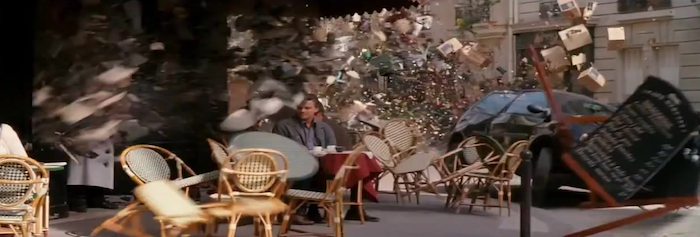
One notable example of exposition as revelation in the movie Inception is the way Nolan handles the basic information of how a dream state operates. Seated at an outdoor café, Cobb provides important details to Ariadne [P. 31–32]:
COBB
Our dreams feel real while we’re in them.
It’s only when we wake up we realize
things were strange,
Ariadne gestures around them-
ARIADNE
But all the textures of real life- the stone,
the fabric. cars… people… your mind can’t
create all this.
COBB
It does. Every time you dream. Let me ask
you a question: You never remember the
beginning of your dreams, do you? You just
turn up in the middle of what’s going on.
ARIADNE
I guess.
COBB
So… how did we end up at this restaurant?
ARIADNE
We came here from…
Ariadne trails off, confused.
COBB
How did we get here? Where are we?
Ariadne THINKS, unable to remember. A FAINT RUMBLE begins.
ARIADNE
Oh my God. We’re dreaming.
Cobb nods. The RUMBLE is BUILDING.
COBB
Stay calm. We’re actually asleep in
the workshop. This is your first
lesson in shared dreaming,
remember?
Ariadne looks around, mind REELING. Cobb BRACES-
The restaurant VIOLENTLY FRAGMENTS, EXPLODING AND IMPLODING
PARTICLES OF FURNITURE, WALLS, PEOPLE FLYING AROUND-
Ariadne WONDERS at the MAYHEM WHIRLING around them- Cobb
SHIELDS his head against the debris. She sees him-
ARIADNE
(shouting over noise)
If it’s just a dream, why are you covering your-
Ariadne is WIPED FROM HER SEAT BY A MASSIVE BLAST and we-
CUT TO:
INT. WORKSHOP — DAY
Ariadne JOLTS awake.
COBB (O.S.)
Because it’s never just a dream.
Ariadne turns to Cobb’s voice. They are both sitting in the lawn chairs.
In a classic case of ‘show it, don’t just say it,’ Nolan uses the power of the visual to transform all that exposition in the scene — when you dream, your mind “creates and perceives a world simultaneously,” how our “dreams feel real while we’re in them,” how when you dream, your mind creates all the “textures of real life,” how you “never remember the beginning of your dreams” — into a giant, memorable piece of entertainment, and ending — literally — with a climactic bang, all of it approaching exposition as revelation. Here is the scene in the movie:
Takeaway: Any time you have a scene which features a significant amount of exposition, especially if it tends to drag down the story’s energy, consider how you can approach it as revelation, both in terms of the nature of the actual content itself and in the way you convey the information through visuals.