Screenwriting Lessons: “True Grit” — Part 4: Voice-Over Narration
Five-part series exploring lessons from the Coen brothers screenplay.
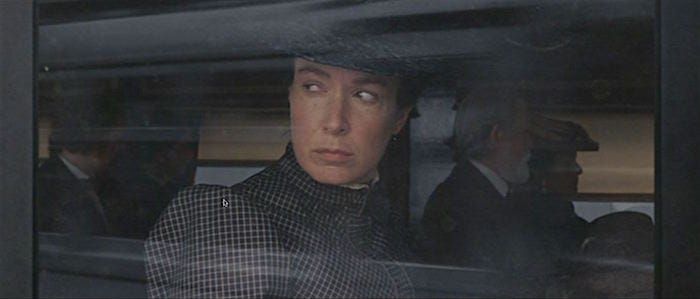
Five-part series exploring lessons from the Coen brothers screenplay.
You may have heard there is a negative perception in Hollywood development circles about the use of voice-over narration. That attitude is perhaps best articulated by the character of Robert McKee in the 2002 movie Adaptation (screenplay by Charlie Kaufman & Donald Kaufman, based on “The Orchid Thief” by Susan Orlean). Sitting in a seminar led by the famous screenwriting guru McKee, the story’s Protagonist (Charlie) ponders his horrific case of writer’s block [P. 86, Scene 183, Draft: November 21, 2000]:
KAUFMAN (V.O.)
It is my weakness, my ultimate lack of
conviction that brings me here. Easy
answers. Rules to short-cut yourself to
success. And here I am, because my jaunt
into the abyss brought me nothing. Well,
isn’t that the risk one takes for
attempting something new. I should leave
here right now. I’ll start over —
(starts to rise)
I need to face this project head on and —
MCKEE
… and God help you if you use voice-over
in your work, my friends
Kaufman looks up, startled. McKee seems to [be] watching him.
MCKEE (CONT’D)
God help you! It’s flaccid, sloppy
writing. Any idiot can write voice-over
narration to explain the thoughts of a
character. You must present the internal
conflicts of your character in action.
Kaufman looks around at people scribbling in notebooks. “Flaccid…” writes the guy on one side of him. “Any idiot…” writes the guy on the other side.
And there it is: The basis of the prejudice against voice-over narration in full bloom. The “thoughts of a character” must be presented through “your character in action.” Voice-over narration represents “flaccid, sloppy writing.”
Then how to explain Double Indemnity (1944), Sunset Blvd. (1950), To Kill a Mockingbird (1962), A Clockwork Orange (1962), Apocalypse Now (1979), Stand by Me (1986), The Shawshank Redemption (1994), Forrest Gump (1994), The Usual Suspects (1995), Election (1999), American Beauty (1999), and dozens of other movies whose screenplays were nominated for Academy Awards, each featuring voice-over narration?
The simple fact is for some stories, voice-over narration is a good, perhaps even best choice available to a screenwriter. Such is the case of True Grit. Screenwriters Ethan and Joel Coen use the narrative technique in a specific way: At the beginning [P. 1–2] and the end [P. 115–118] of the screenplay. This is what is commonly referred to as ‘bookends, something we also see in movies like To Kill a Mockingbird and American Beauty.
Here is entirety of the voice-over narration in True Grit as voiced by Mattie’s character when she is an adult. First from the screenplay’s beginning:
People do not give it credence that a young girl could leave home
and go off in the wintertime to avenge her father’s blood, but it did
happen…
While visualizing the murder of her father:
I was just fourteen years of age when a coward by the name of Tom
Chaney shot my father down in Fort Smith, Arkansas, and robbed him
of his life and his horse and two California gold pieces that he carried
in his trouser band… Papa was a Cumberland Presbyterian and a
Mason. He’d hired Chaney — for paid wages, not on shares — when
Chaney was “down on his luck.” If Papa had a failing it was his kindly
disposition; I did not get my mean streak from him… He had taken
Chaney up to Fort Smith to help lead back a string of mustang ponies
he’d just bought from a stock trader named Stonehill. In town, Chaney
had fallen to drink and cards, and lost all his money. He got it into his
head he’d been cheated and went back to the boarding house for his
Henry rifle. Papa remonstrated, and Chaney shot him in the breast…
Chaney fled. He could have taken the time to saddle the horse — or
hitched up three spans of mules to a Concord stagecoach and smoked
a pipe, as it seems that no one in that city was inclined to give chase.
Chaney had mistaken its citizens for men.
Then while showing young Mattie as she arrives by train in Fort Smith, Arkansas:
You might say, what business was it of my father’s to meddle? My
answer is this: he was trying to do that short devil a good turn. He was
his brother’s keeper. Does that answer your question?
The Coens use voice-over narration at the beginning for at least three reasons: (1) To frame the story; (2) To handle key exposition quickly and efficiently; (3) To give readers an immediate sense of Mattie’s voice and thereby her personality.
The screenplay returns to the use of present day voice-over narrative only at the very end. Here is all that text:
A quarter of a century is a long time… I had written a letter of thanks
to Marshal Cogburn, with an invitation to visit, along with the fifty
dollars I owed him. In his reply he promised he would try to call next
time he came to Fort Smith with prisoners. Brief though his note was,
it was rife with misspellings… The marshal did not visit, nor did he
communicate further. I had not been conscious during his leavetaking:
by the time Bagby rode us to Fort Smith my hand had turned black. I
was not awake when I lost the arm. I later learned that Mr. LeBoeuf
recovered fully. When the marshals found him he was searching the
pines below the rock ledge for Tom Chaney’s body. He found it and
took it back to San Saba for the reward. It was well earned…
Then we see Mattie as an adult — missing part of her arm — visiting a traveling “Wild West show” in Tennessee:
Little Frank had sent me the flier. He had chaffed me through the
years over the fact that I had not married, calling the marshal my
“secret sweetheart,” and he sent a note with the advertisement:
“Skill and dash — it’s not too late, Mattie!” Little Frank and Victoria
have always liked jokes and they are all right in their place. I have
never held it against either one of them for leaving me at home to
look after Mama, and they know it, for I have told them.
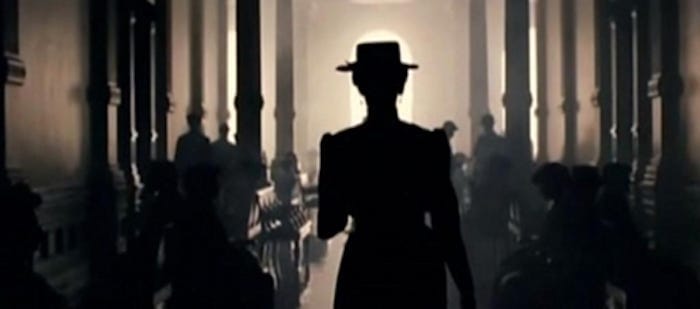
There she learns of Cogburn’s recent death:
I had the marshal’s body removed to Dardanelle. The railroads do
not like to carry disinterred bodies in the summertime, but I had my
way. . . . People love to talk. They love to slander you if you have
any substance. They said, Well, she hardly knew that man. . .
Then Mattie in a cemetery, standing before Cogburn’s headstone:
. . . It’s just like a cranky old maid to pull a stunt like that, burying
him in the family plot. They say I love nothing but money and the
Presbyterian Church and that is why I never married. It is true
that I love my church and my bank. I will tell you a secret. Those
same people talk mighty nice when they come in for a crop loan
or a mortgage extension. I care nothing for what they say. I would
have married a baboon if I had wanted and fetched it its newspaper
and slippers every morning but I never had time to fool with it.
And finally:
Anyway, a woman with brains and a frank tongue and one sleeve
pinned up and an invalid mother to care for is not widely sought
after. I never did see Mr. LeBoeuf again but if he is yet alive I
would be pleased to hear from him. I judge he would be in his
seventies now and nearer eighty than seventy. I expect some of
the starch has gone out of that cowlick. Time just gets away
from us.
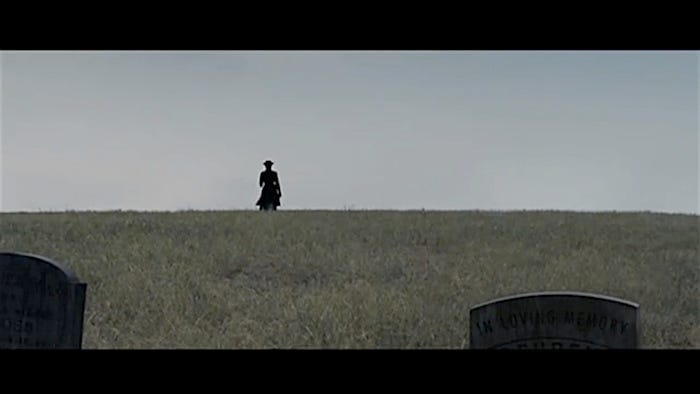
Here the Coens use voice-over narration for much the same reasons as in the screenplay’s beginning: To frame the story’s ending and to provide key exposition as neatly and efficiently as possible.
As with the beginning, the third reason is also tied to Mattie’s personality. As we see in the Denouement, she is still the fierce, independent woman she was as a 14 year-old. She might well have moved from her position of disconnect to the world — a smart, assertive, independent soul — to connection had it not been for the fact that her experiences on the trail with Cogburn and LeBouef were so profound, they became these sort of archetypal ideals no other humans could possibly match up to. Who could she possibly meet in life who could be as much of a wisdom figure (Mentor) as Cogburn and potential lover (Attractor) as LeBouef. For the rest of her life, Mattie need only look at her missing limb to be reminded every moment of every day of those seminal experiences with these two men, so deeply seared into her consciousness. She had found a connection, all right. It was, however, with these two powerful figures who dwarfed everything else that followed. And we can only learn the personal depth of those feelings through the use of voice-over narration.
Takeaway: Sometimes a story cries out for the use of voice-over narration and in such cases, you must override the supposed conventional wisdom and heed that call. But you must make doubly sure that you are not using this narrative technique as just an easy way out.
Tomorrow: Another screenwriting lesson from True Grit.