Screenwriting Lessons: “True Grit” — Part 3: Absent Nemesis
Five-part series exploring lessons from the Coen brothers screenplay.
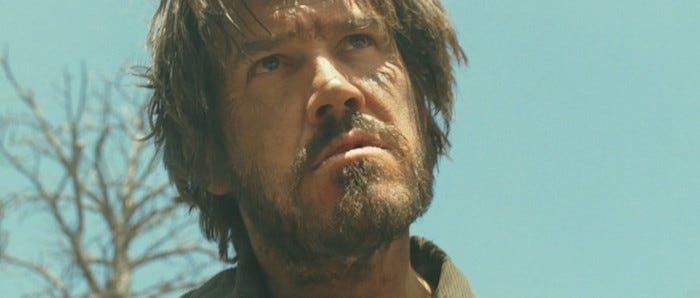
Five-part series exploring lessons from the Coen brothers screenplay.
True Grit is a chase story. That is the Protagonist (Mattie) and her companions (Cogburn and LeBouef) spend the bulk of the plot chasing the Nemesis (Tom Chaney) and his cohorts in crime. In this type of narrative approach, the Protagonist and Nemesis are separated most of the time. Logic dictates it: Once the Protagonist catches up to the Nemesis, unless there’s a plot twist, the story will have reached the Final Struggle and plunge toward its conclusion.
What this translates into is a void created by an absent Nemesis. They may loom as a threat, a shadow hanging over the Protagonist throughout, but with no direct contact for most of the story, opportunities for conflict between these two key characters are minimized, essentially forestalled until the Plotline’s end.
That is the case in True Grit. We are introduced to Tom Chaney and his murderous act which precipitates the story’s plot through Mattie’s beginning voice-over narration, then do not actually intersect with the character until the very end of Act Two.
If the basis of drama is conflict, and the most powerful conflict of a story is between a Protagonist and Nemesis, how can a writer handle a narrative with an absent Nemesis? In True Grit, the Coen brothers — adapting story elements already in place from the novel by Charles Portis — use a series of events to create persistent opposition which in effect functions as a substitute for the absence of Tom Chaney while on his trail. Here is a chronological list of those oppositional scenes:
- Undertaker office: Mattie disputes the fee for handling her father’s body and meets resistance in sending home Yarnell [P. 2–4]
- Outhouse: Mattie attempts to speak with Cogburn who is occupied with “prior business” and rebuffs her [P. 7–9]
- Stonehill’s office: Mattie engages in a lengthy negotiation with the flummoxed auctioneer about the dispensation of horses her father purchased [P. 10–14]
- Monarch Boarding House: Mattie shares a bed with a snoring Grandma Turner who hogs the blanket on a bitter cold night [P. 15–16]
- Outside courtroom: Mattie attempts to hire Cogburn to go after Chaney, but once again he rebuffs her [P. 23–25]
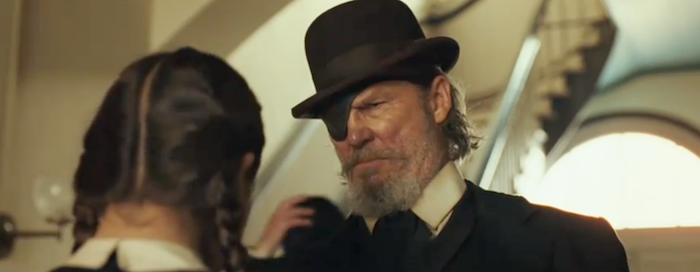
- Boarding house: Having developed a fever, Mattie awakens to see LeBouef is in her room and they have a contentious first meeting [P. 26–30]
- Stonehill’s office: A final bout between Mattie and the auctioneer as she procures her money from their deal [P. 32–34]
- Grocery store / back room: Mattie meets resistance from Cogburn as she finalizes a deal for both of them to pursue Chaney [P. 35–39]
- Grocery store: The next morning, Mattie returns only to learn that Cogburn has taken off without her [P. 39–40]
- River: Mattie rides her horse Little Blackie and catches up with Cogburn and LeBouef, who initially try to send her home and even whip her with a mesquite switch until they finally relent, allowing her to accompany them [P. 40–45]
- Camp [Night]: Cogburn goads LeBouef — the pair don’t get along — so that Mattie tries to smooth their ruffled feathers by telling a story [P. 45–48]
- Camp [Morning]: An argument over the business arrangement leads to an angry LeBouef heading off on his own [P. 48–52]
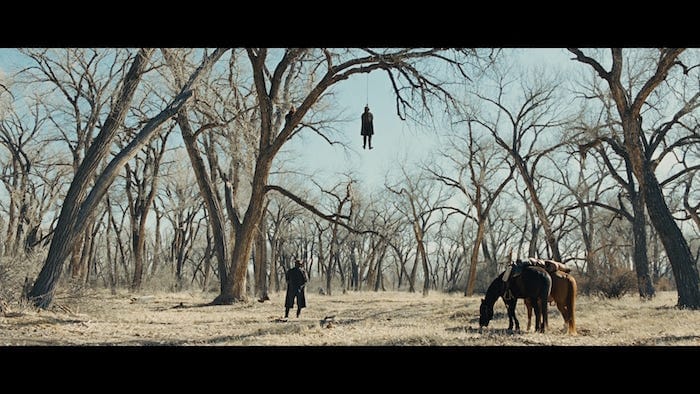
- Riding: Coming across a hanged man, Mattie has to scale a tall tree to cut the corpse loose, only to discover upon inspection it is not Chaney [P. 54–59]
- Cabin: The altercation and deaths of Quincy and Moon [P. 61–70]
- Riding: A drunk Cogburn and LeBouef get into an argument, leading to a shooting challenge [P. 71–75]
- Camp: Another dispute leads to Cogburn quitting the pursuit of Chaney and LeBouef departing the group [P. 83–86]
- River: Mattie finally intersects with Chaney who takes her hostage [P. 87–90]
Even in scenes which don’t direct opposition toward Mattie, there is conflict as in the courtroom where Cogburn’s testimony is called into dispute by the defense attorney [P. 16–23] and where Cogburn punishes two Indian youths for pestering a mule [P. 52–54].
Takeaway: If you have a story where the Protagonist and Nemesis do not come into contact often or until the plot’s end, look for opportunities to create opposition for your Protagonist through the impact of nature, circumstances or other characters in effect creating a surrogate antagonism dynamic.
Tomorrow: Another screenwriting lesson from True Grit.