Spoilers don’t spoil anything
So all of us who claim we despise movie trailers that give away too much of the plot? Evidently we’re lying. Or wrong. Or both. Jonah Lehrer at Wired explains a recent experiment:
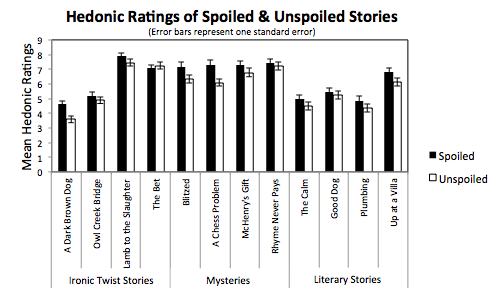
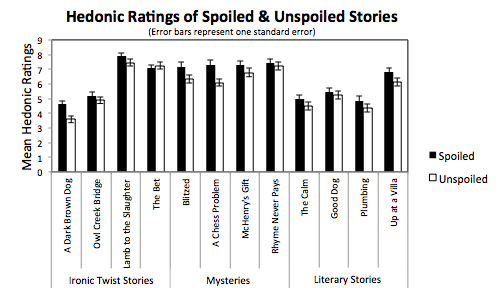
The experiment itself was simple: Nicholas Christenfeld and Jonathan Leavitt of UC San Diego gave several dozen undergraduates 12 different short stories. The stories came in three different flavors: ironic twist stories (such as Chekhov’s “The Bet”), straight up mysteries (“A Chess Problem” by Agatha Christie) and so-called “literary stories” by writers like Updike and Carver. Some subjects read the story as is, without a spoiler. Some read the story with a spoiler carefully embedded in the actual text, as if Chekhov himself had given away the end. And some read the story with a spoiler disclaimer in the preface.
Here are the results:
1.) In this age of information, we’ve become mildly obsessed with avoiding spoilers, staying away from social media lest we learn about the series finale of Lost or the surprising twist in the latest blockbuster. But this is a new habit.
— —
2.) Just because we know the end doesn’t mean there aren’t surprises.
— —
3.) Surprises are much more fun to plan than experience.
Agree? Disagree?
One upside to having so much information available nowadays: It is much easier to ‘see’ a movie without seeing a movie. I confess, given the zero sum nature of my life, when some movies are released, I determine I do not need to see this one or that one. However I do believe it’s important to track the plotlines of most films so I can keep them straight as reference points in potential conversations with producers and execs. So even though I complain about movie trailers like this: