“Taking Back the Knife: Girls Gone Gory”
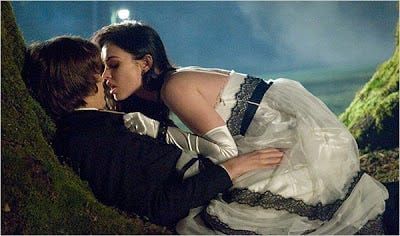
Good NY Times article today. Jumping off from the upcoming premiere of the “high school retro horror romp” Jennifer’s Body, written by Diablo Cody, the article explores women and horror movies — both as moviegoers and characters with horror films:
LONG before the first big-screen vivisection of a female breast, the novelist H. P. Lovecraft wrote that horror was “supposed to be against the world, against life, against civilization.” But the delight that the genre’s filmmakers, especially those behind the “Saw” franchise and its torture porn kin, take in depicting a steady stream of starlets being strung up, nailed down or splayed open, makes it clear that modern horror is against some more than others.
And yet recent box office receipts show that women have an even bigger appetite for these films than men. Theories straining to address this particular head scratcher have their work cut out for them: Are female fans of “Saw” ironists? Masochists? Or just dying to get closer to their dates?
“Jennifer’s Body” (out on Sept. 18), a high school retro-horror romp — written by Diablo Cody, directed by Karyn Kusama (“Girlfight”) and starring Megan Fox as a satanically possessed sex bomb who literally feeds on boys — offers another, more reassuring explanation for the draw: Audiences love a woman who can take back the knife.
We’ve discussed horror movies before here, noting the increase in its female audience. One explanation:
This basic appeal for female viewers was given a sophisticated reading by the film theorist Carol J. Clover in “Men, Women and Chain Saws” (1992), in which she refers to a lone young woman who either escapes or overthrows a killer as the “final girl.” More comfortable watching a woman in peril than a man, young, male audiences — initially slasher movies’ core viewers — get the best of both worlds, identifying first with the predator and then with the would-be prey. That women also identify with the scrappy heroine is something of a happy accident.
“The final girl.” So did horror movies evolve the archetype of the female from victim —
— to survivor?
More about Jennifer’s Body:
“Jennifer’s Body” was designed with both feminists and 15-year-old boys in mind, a seemingly eccentric blueprint that, as Ms. Kusama points out, is in line with the best movies of the slasher tradition. “It may be one of the best ways for a young male audience to experience a female story without feeling like they have been limited by a female perspective,” she said.
Here that perspective is doubled, with Jennifer and her innocuous shadow, Needy (Amanda Seyfried). The story of the girls’ tormented, toxic relationship is set off by various depictions of Ms. Fox — a combination of brain-locking beauty and recombinant evil — rummaging through some poor guy’s torso. Between Needy’s cautious yearning and Jennifer’s pure, trampling id, the film presents a portrait of female identity in flux.
And then there’s this admission by the studio exec who was responsible for acquiring Jennifer’s Body:
And so is Debbie Liebling, the former president for production at the recently dissolved Fox Atomic, a studio that was dedicated to low-budget, teen-oriented genre films like “Turistas.”
“I’m not sure what the attraction is, psychologically, for females,” she said in a recent interview. “I would love to know why girls are going to see ‘Saw,’ because I have no idea.” (Fox Atomic acquired “Jennifer’s Body,” which is now to be released by Fox.)
Even studio execs don’t know why women like horror movies. Maybe it’s as simple as this comment from Diablo Cody:
“Some of us just like that stuff,” she said. “We like suspense, we like to be scared, we like to have visceral reaction in the theater. Maybe I’m starved for adrenaline, but for me watching a horror movie is very pleasurable. So making one was kind of a dream.”
How about you? Why the growth in women fans for the horror genre?
Comment Archive