Tweetstorm: Eric Heisserer on Minimalist Screenwriting Style

“Find the most powerful word and use it.”
Back when Twitter was fun, screenwriters would sometimes string together a series of tweets - what came to be known as "tweetstorms." Advice, personal anecdotes, reflections on the craft. It was pretty awesome.
The only problem: Once the tweetstorm came ... it went.
So, I took to contacting the writers and asking if I could reprint their tweetstorm at Go Into The Story. That way, they'd at least be stored where folks could access them in the future.
Here's an example: In March 2014, Eric Heisserer (Arrival, A Nightmare on Elm Street, Final Destination 5, The Thing, Hours) posted several tweets about screenwriting style. Reprinted by permission.
All right my Twitter buddies, I wanna talk about a certain style of screenwriting. It will likely lead to today’s challenge.
I’ve seen a rise in a certain style of writing in the past few months. Half of the scripts I’ve seen use the “haiku” narrative style. By that I mean the extremely terse Walter Hill form of writing. Soft returns, loads of white space.
First off: Yay! Congrats to all of you swinging for this minimalist style. It’s incredibly hard to pull off. So let’s talk about pitfalls.
The Walter Hill minimalist style isn’t merely a matter of omission. You can’t simply cut out a ton of action and format the rest as a poem. Every choice must be a conscious one. We need to know who the characters are in a scene. What things look like. Details. Don’t be vague.
I’ve read scripts recently where the only description was character action, i.e. “Joe runs.” This is too minimal; non-cinematic.
Likewise, there should be reason why and when you choose a soft return. Usually that choice should be directorial in motive. Suggest a new shot with the new line. Or a movement within the shot to catch a detail. Make it a cinematic choice.
So the Tuesday Challenge is this: Try out the minimalist style for five pages with these constraints: 1) With each new location/room, pick three details in the location to describe at the head of the scene. Shine a light on three sensory tidbits (at least 2 visual). 2) When you introduce a character pick three words to describe them. Make 1 physical, 1 psychological, 1 metaphoric.
The Walter Hill style isn’t about omitting descriptive detail, but rather paring it down to poetics. Find the most powerful word and use it.
Do not write it like a kid in a dark room with a flashlight, waving it around and making light saber noises. Point it at the dead body.
Here is a page from the Walter Hill & David Giler draft of the script for Alien:
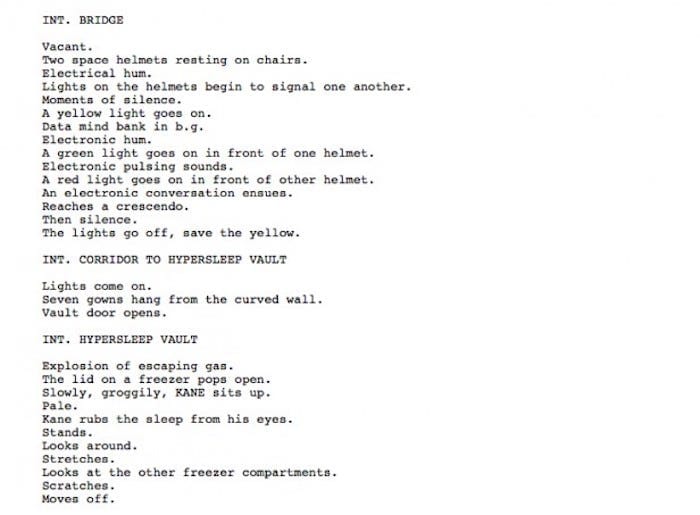
Notice while it is certainly minimalistic, it is also cinematic, as Eric said, “Pairing it down to poetics.”
I’ve posted several articles about the haiku-style of writing. Some links: here, here, here. And here are some excerpts from an interview with Hill.
Eric has put together a book that arose from his Twitter exchanges: “150 Screenwriting Challenges” which is available for Kindle here.
You may see all of the Screenwriting Tweetstorms archived on the site here.