What drives screenwriters crazy!
Press pieces like this: The 5 Secrets of Tom Hooper’s ‘King’s Speech’ Success:
So how did Hooper do it? What are the secrets of his success?
1. Fail as a Child Actor Directed by Roger Mortimer. His ex-Royal Shakespeare Company drama teacher when he was 10 to 12 taught him well. “I’m a failed actor,” confesses Hooper. “But I was a very strategic 11-year-old and I said, ‘Hold on, if I’m not getting the lead in a school of 300, I probably shouldn’t be an actor.’” So he “nicked” (stole) a book on filmmaking and became a director instead. And he never forgot the acting lessons Mortimer drummed into his Oxford-bound skull.
2. Listen to Helen Mirren, Don’t Be an Actor Manipulator Like Howard Hawks. Hawks once got a startled reaction he wanted from Rita Hayworth in Only Angels Have Wings by feeding her ego with compliments all morning, then having Cary Grant dump a pitcher of water on her head on camera. Mirren would not respond well to this technique. “Working with Helen Mirren, you don’t want to go, ‘Right, Helen, on this line you’ve gotta be here, because I’ve got this shot lined up.’” says Hooper. “She’ll just give you one of those looks that only Helen Mirren can give you and go, ‘Well, that’s great, but for these reasons I think my character would do this.’ I learned from her to love that moment of rehearsal — you’ve got your plan, but what does she bring to it?”
“So I became good in a very quickfooted way in reconsidering how I was gonna shoot to take advantage of the spontaneity of that rehearsal. In King’s Speech we had three weeks.”
3. Listen to Geoffrey Rush. Out of the rehearsal came a crucial King’s Speech montage of speech lessons. “That was Geoffrey Rush’s idea, because the risk was you’d have a film where these guys meet six times and he’s fine, you wouldn’t understand the frequency and intensity of the relationship.”
4. Listen to Geoffrey’s Body Talk. “Geoffrey was trained at Lecoq Mime School in Paris, and is consequently brilliant in the way he carries his body. His Exit the King on Broadway was a master class in physical acting. So I’d start out with a closeup and — oh God, he’s doing something amazing with his hand which I’m missing. Then we’d go a bit wider. Then I’d go, God, I love that, but I’m missing the silhouette his body’s making, so I’d go wider still, to explore his body language.”
“So it made me think about Colin’s body language. Was there a way he could create a silhouette specific to Bertie? Was there a way of deconstructing the confidence with which Colin naturally stands, ’cause he’s a big strapping lad of six foot three and, and, and, and [Hooper sometimes repeats words rapidly, a bit like stuttering] creating a sense of a man who folds into himself, crumples into himself? Who on a sofa will sit in the corner as if to use the arm of the sofa as a kind of friend, as a security blanket?”
“In some ways there’s this process of transference that goes on, where you see what one actor is bringing and could I bring the other into the language of the first so there’s an equilibrium going on in the style of both. And managing those exchanges of action, of, of, of their, of their, of their essences, is kind of very interesting.”
5. Be a Bit of an Actor Manipulator Like Howard Hawks. “The other thing I thought was really interesting on The King’s Speech was how placement of the camera affects the psychology of the actors. People said I shot with fisheye lenses, which is complete nonsense, but I definitely shot on wider lenses than is typical. The camera was maybe 18 inches from Colin’s face in the closeup on the very first day, a 10-minute scene where the characters first meet. I wanted the nervousness of the first day to percolate into his performances.”
“I thought, well, stammering is like living with performance pressure. So I want to do everything to rather counterintuitively increase the pressure on Colin. He’s about to shoot ten percent of the movie on the first day in the first scene. And I mean this was really rather ballsy, ’cause it could’ve backfired. But my instinct was that he could use that pressure, that sense of being hunted, and I think that’s what happened.”
“Then I turned around to Geoffrey, and he thought, Ah! I’ve gotta be more minimalist than I’ve ever been before because Tom’s shooting it so close. I could’ve been 12 feet away and just as close, but it’s the psychology of where you put the camera.”
“Actors are so highly attuned that just walking out onto the set they’ll start picking up all these clues. I was at the roundtable with Ethan Coen and he said to me, ‘I’ve never directed an actor in my life,’ and I thought, well — I wonder if that’s true. Because I’m sure if you walk into a Coen brothers setup, a good actor will immediately read so much from the locations, the art direction, where the camera’s placed, from the casting of the other person — that is all directing as well, just because it’s not saying, ‘Now do it this way, now do it that!’”
The bottom line on actors, which may earn Tom Hooper an Oscar or two: “Make them partners in the storytelling process.”
Not one word about screenwriter David Seidler. The person without whom the story as written would not exist. Go here and learn about how he had to wait 28 years for Queen Elizabeth to give him approval to go forward with the story. Go here to learn about how Seidler was drawn to the story in large part due to the fact that he had been a stutterer when he was a youth.
He writes The King’s Speech as a play. Then as a screenplay. His idea. His vision. His story.
Yet not one bloody word in the article above about Tom Hooper’s “secrets of his success.”
Movies are a director’s medium, fine. But when you don’t even mention the screenwriter, the words Hooper used to work with the actors in the film, that is just flat-out bull shit.
So from a parallel universe, here is an addition to the article:
6. Know when you’re dealing with a brilliant script. “Of course, it all starts with the written word,” Hooper said. “And what David [Seidler] did was remarkable. I often thought as I drove to the set every morning if it hadn’t been for his vision, his persistence, his creativity and that wonderful script which so captured the souls of these two remarkable characters and that story universe, I wouldn’t have this job. None of us would.”
“I mean when you’re dealing with a brilliant script like the one David wrote, it excites you as a director to see what you can do with it visually… and of course the chance to work with the actors and all that delicious dialogue. I was just so… I guess you could say inspired by the opportunity to work on such a project. But let’s just be clear… what you see in the movie, every last frame of it, it’s all there in the screenplay really. David created and captured the story. And I was fortunate enough to be able to translate that into onto the screen.”
In our dreams, right?
I know this won’t come anywhere near rectifying THR’s editorial choices in their article (I have to imagined that Hooper did acknowledge Seidler in the discussion), but here goes:
David Seidler’s IMDB page here.
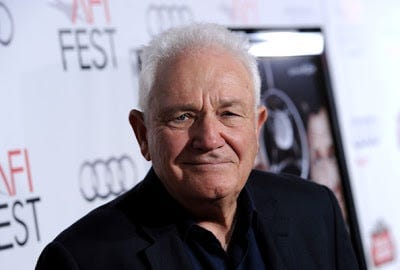
David Seidler’s Wikipedia page here.
Script Magazine podcast interview with David Seidler here.
LAT’s Q&A with David Seidler here.
David Seidler: Screenwriter, The King’s Speech.