“Why The Social Network shouldn’t work (and why it does)”

Found this interesting commentary on The Social Network from U.K-based writer Allen Palmer. Here is a list of reasons [conventional wisdom] why Palmer asserts TSN should not have worked:
“Your protagonist should be likable”
“Scenes shouldn’t be longer than 3 pages”
“Don’t use voiceover”
“Don’t use flashbacks”
“Your character should have an arc”
“You need to pose a dramatic question”
“You should like the protagonist and hate the antagonist”
“The climax should pit protagonist vs antagonist”
“Screenplays should be 110 pages”
Then reasons why the movie did in fact work:
“Drama is conflict”
“The audience must connect with your protagonist”
Why we connect to Mark Zuckerberg #1: Special powers
Why we connect to Mark Zuckerberg #2: Wit
Why we connect to Mark Zuckerberg #3: Chutzpah
Why we connect to Mark Zuckerberg #4: Empathy
It’s quite good analysis and you should read the entire post, but let me just excerpt Palmer’s comments re “Drama is conflict”:
The greatest rule of all. In my Introduction to Screenwriting course, I tell my students that if they only take one thing away from the weekend, let is be this. Drama is conflict. And while Sorkin might be willing to ignore some of the outlying territories in the nation of screenwriting rules, he bows down and prays at this particular altar. There is conflict at every turn:
- Mark Zuckerberg vs Erica
- Mark Zuckerberg vs the exclusive Harvard Final Clubs
- Mark Zuckerberg vs the Harvard Academic board
- Mark Zuckerberg vs the Winklevi
- Cameron Winklevoss vs Tyler Winklevoss & Divya
- The Winklevi vs Larry Summers
- Mark Zuckerberg vs Eduardo
- Eduardo vs Sean Parker
- Eduardo vs his psycho girlfriend
- Sean Parker vs the police
- Sean Parker vs Mark Zuckerberg
Conflict between us and them. Conflict within us. Conflict within them. Brilliant. And necessary. But still not sufficient. There is one more rule that Sorkin honours that allows him to get away with a 162 page doorstop about an unlikeable protagonist who doesn’t grow and betrays his best friend.
In real life, many if not most of us avoid conflict. But movies are not real life. In movies, we are drawn to conflict. For a whole host of reasons. It’s exciting. It’s creates energy. Its outcome is uncertain. It’s emotional. It’s raw. But most of all conflict is entertaining.
So if there’s one lesson above all you can take away from TSN, it’s this one: Conflict. Conflict. Conflict.
For everything Sorkin may have done to break the ‘rules,’ there’s one aspect of the movie where, at least according to my world-view, he followed one of the most innate aspects of storytelling: character archetypes. Specifically the five primary character types that exist in movie after movie after movie: Protagonist, Nemesis, Attractor, Mentor, Trickster.
Protagonist — Mark Zuckerberg
He’s the central character, the character through whose perspective the story is told, the character to whom all other major characters are connected. And while I would agree that he doesn’t go through any metamorphosis in the traditional sense of a Protagonist arc, the fact that he does not change is the character’s arc which is why that final scene — this young multibillionaire reduced to friending the Attractor (Erica), then hitting reload… reload… reload… is at the end of the day a tragedy, driven home by John Lennon belting out “Baby You’re a Rich Man” on the soundtrack.
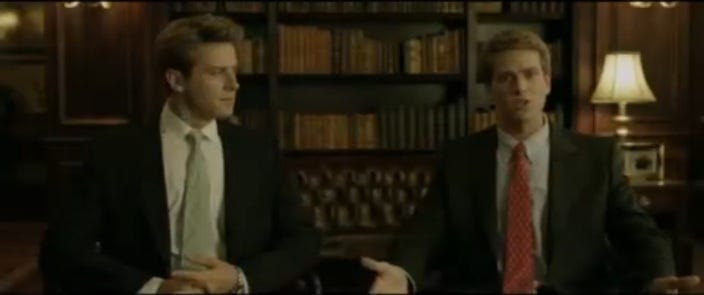
Nemesis — The Winkelvoss brothers
Once Facebook is created, what’s Zuckerberg’s goal in The Social Network? To defeat the brothers in the lawsuit brought against him. That provides the spine of the story’s Plotline — a clear adversarial relationship befitting a Protagonist-Nemesis dynamic.
Attractor — Erica
She’s only in the movie for four scenes, but they are critical ones: (1) The very first scene where she breaks up with him; (2) where she finds out Zuckerberg has blogged about her; (3) much later where Zuckerberg attempts to reach out to her and she rejects him [see below]; (4) the very last scene where he tries to friend her. If an Attractor is that character most connected to a Protagonist’s emotional development — or lack thereof as in the case of Zuckerberg’s character, it is Erica.
Mentor — Eduardo
He provides the logarithm at the beginning of the movie for Zuckerberg to come up with his first social network experiment. He provides funds for “The Facebook.” He provides ‘wisdom’ per his business training, albeit advice that proves to be rather ‘analog’ compared to the digital speed with which Facebook explodes. But mostly he is Zuckerberg’s friend. And Zuckerberg is complicit in screwing him. I think the implication is clear by the movie’s end that Zuckerberg regrets this choice, and learned a hard lesson in the process, befitting a Protagonist-Mentor connection.
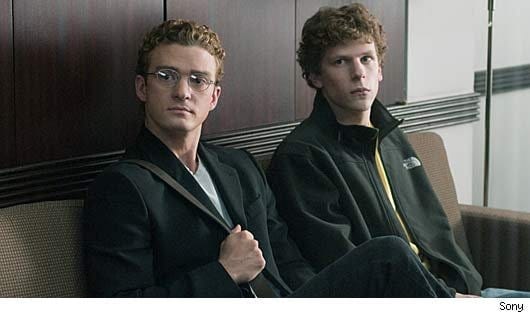
Trickster — Sean Parker
Sean is an ally — at first — echoing back precisely what Zuckerberg has said about The Facebook, how it needs to evolve and grow before trying to monetize it. Sean gets them important meetings with backers. Sean shows Zuckerberg how a young entrepreneur can act. But then Sean also is heavily involved in Eduardo getting screwed. And eventually gets busted almost costing Facebook dearly. Classic shapeshifter.
Terrific movie. And I think it’s pretty much a lock it wins Best Adapted Screenplay at the Academy Awards which will be interesting. Because then we’ll get to hear Sorkin’s acceptance speech. Coming from someone who wrote this:
Sorkin’s acceptance speech should be something to which we can all look forward.
Comment Archive