Interview (Part 4): Isaac Adamson
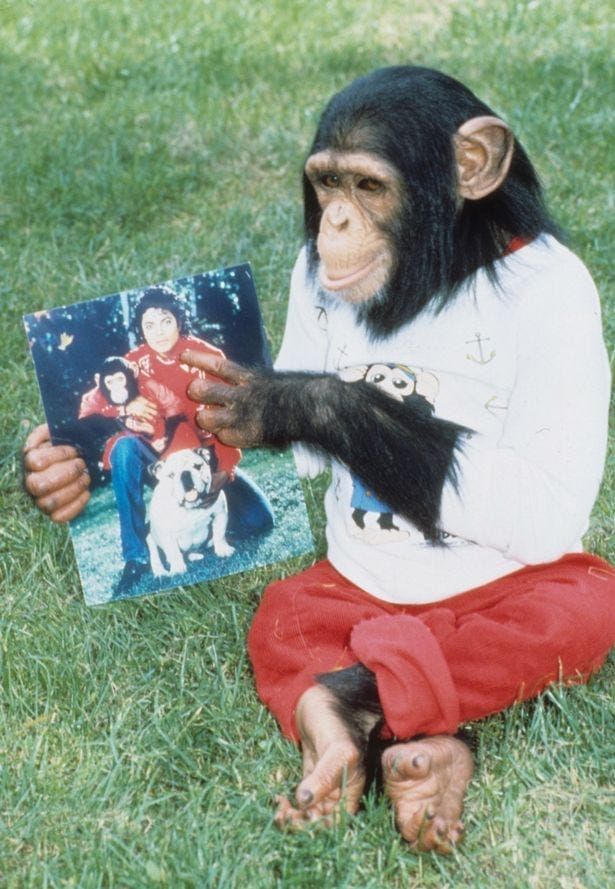
The top rated screenplay on the 2015 Black List is “Bubbles” and it was written by Isaac Adamson. It’s a terrific story, one of the most, if not the most unique ways to approach writing a biopic I have ever seen: The story is a snapshot of Michael Jackson’s life told from the perspective of his pet chimpanzee Bubbles. I would have been interested in interviewing Isaac simply based on the creative inspiration of that idea — I mean, who thinks like that — but when it hit #1 on the Black List charts last year, it was a no-brainer. I reached out to Isaac’s manager Lee Stobby and we finally arranged a time in Isaac’s busy schedule to spend an hour together over the phone, talking with Isaac from his home in Portland, Oregon.
Today in Part 4, Isaac and I discuss some themes at work in the script “Bubbles”:
Scott: I’d like to talk about some of the themes. We’ve already discussed, one, the hierarchical dynamic: Who’s the King? There’s another one, too, that’s played pretty strongly throughout, and that’s this idea of being in a cage.
There’s obviously the cage that Bubbles is in at the beginning in the prologue and then eventually winds back up in, but Michael Jackson himself essentially being in a cage as a kind of trapped public figure. Is that something you were going for?
Isaac: Absolutely. That was a theme that I wanted to run through the whole thing. This idea that Michael Jackson was caged by his own celebrity. Even in Neverland, he’s constructed what amounted to a cage for himself. He thought he was building a thing that would set him free, but that turned out not to be the case.
Scott: Kind of like Xanadu in Citizen Kane.
Isaac: Yeah.
Scott: Another thing, I think it’s Frank, one of Michael Jackson’s cadre of people who says on Page 83, this long and touching observant bit of business talking about Michael Jackson as a pop star in relation to the rest of the world.
He says, “You find the beast is bigger than you, stronger than you ever imagined. You discover the beast never sleeps, and the beast will trample you underfoot without a second thought.”
He’s literally talking about the public, and obviously it has some double meaning going on there.
Isaac: Yeah. It does. He is talking about the public but…I’m not sure how to answer that one.
Scott: Here’s a take on it that I had. Obviously, Bubbles is a beast, he’s an animal. He, through his actions to Michael Jackson later on in a horrifically violent way, exhibits that behavior. It’s almost a metaphor for what the public has done to Michael Jackson, whether he realizes it or not, through his own aberrant behavior.
Isaac: Totally. That speech is also there to kind of presage Bubbles’ later attack on Michael.
Bubbles pointing to a photograph of the King of Pop
Scott: You have that ticking clock, too, which the trainer says that as they get older, these chimpanzees become more in touch with their animalistic nature and you have to watch out for that. We see this instinct on Bubbles’ part, to become more and more in touch with his inner warrior.
Isaac: It’s just a natural part of, I would say human adolescence too, but chimp adolescence is that they get more aggressive. They get stronger, they get more unruly. They don’t like to wear clothes. [laughs] I don’t know if that’s true of adolescents humans, though maybe they wear less clothes.
Beyond a certain age, they’re too dangerous to handle and throughout the script, we see Bubbles fighting against this but ultimately being unable to stop his natural evolution into an adult chimpanzee. That was one of the central themes I was going for too, that ultimately Bubbles is punished for doing the one thing Michael Jackson can’t do, which is grow up.
Scott: I can totally see that. That leads right into this whole Jordan Chandler thing, the young boy that essentially led to the downfall of Michael Jackson in the public perception. There were the lawsuits and all that stuff where you get the sense that Michael Jackson’s trying to, setting aside whatever criminal activity may or may not have happened, trying to cling to his youth.
Isaac: It was definitely that. He was completely enamored of Peter Pan. If you look at the photographs of Neverland, there are Peter Pan statues and pictures and stuff like that everywhere. I know he was working with, I forget what director it was, but for a long time he was trying to get a film version of Peter Pan made where he would star as Peter Pan.
Even if you look at the shape of his nose as it evolves, he was going for that upturned classic Peter Pan nose at one point in his life.
Scott: The point you made that Bubbles does grow up and Michael Jackson resists that, and Bubbles of course in growing up is getting in touch with that inner animalistic side which exhibits itself in that assault on Michael Jackson, that’s an interesting point I hadn’t quite grabbed it, it makes a lot of sense.
I’ve read conflicting accounts on this: Did Michael Jackson ever go visit Bubbles again in Florida, or did he not?
Isaac: He never visited him in Florida that I’m aware of, but I read an interview with Bob Dunn, who was Bubbles’ trainer, that said that Michael would come visit Bubbles in Sylmar at this facility that Bob Dunn had. He visited there a few times with his kids, so that’s what that scene is based on. But once Bubbles went to Florida in 2005, Michael never came to visit him that I know of.
Scott: How soon in the process did you know that that end scene, where Michael does come for a visit and he brings the three kids, and there’s a touching moment there, how soon in the process did you know that that was going to be, essentially, the denouement of the story?
Isaac: That came pretty late. In my original thinking about it, there was going to be the attack and then the next thing we knew, there’s Bubbles in the ape sanctuary, thinking about Michael, still wondering about when he’ll return. But I realized that I needed something a little softer, and a little more emotional — a lot more emotional, actually — and also show some kind of healing that time has done.
I didn’t want to end with…have his last action with Michael be attacking him, because they had had this great friendship together and gone through this adventure together.
I just felt it needed a kind of grace note.
Scott: You have a great callback, that little finger‑to‑finger thing.
Isaac: That came pretty late, too. That was after the first draft, but before I’d shown it to anybody. I wanted them to have some kind of secret handshake that they could do, some kind of nonverbal way of communicating with each other.
I came up with the fingers touching, and I liked that a lot.
Scott: Then you went back to set it up?
Isaac: Exactly.
Tomorrow in Part 5, Isaac shares how he discovered “Bubbles” had been named the top-rated screenplay in the 2015 Black List and what that has meant to him as a screenwriter.
For Part 1 of the interview, go here.
Part 2, here.
Part 3, here.
Isaac is repped by CAA and Lee Stobby.
Twitter: @isaacadamson.