“All The Things That Are Wrong With Your Screenplay In One Handy Infographic”
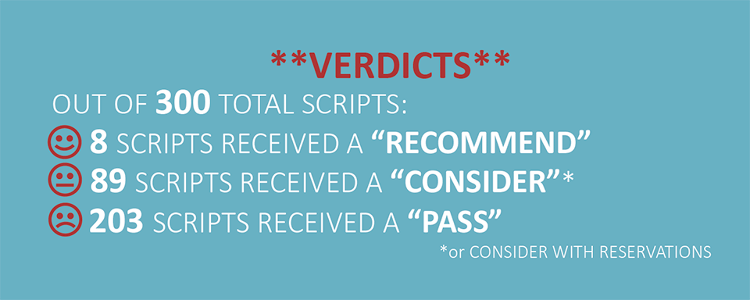
By now, you’ve probably seen this making its way around the web:
A professional scriptreader read 300 screenplays for five different studios, all the while tracking the many recurring problems. The infographic he made with the collected data offers a glimpse at where screenwriting goes wrong.
There are 14 slides to the infographic, some with numbers like these:
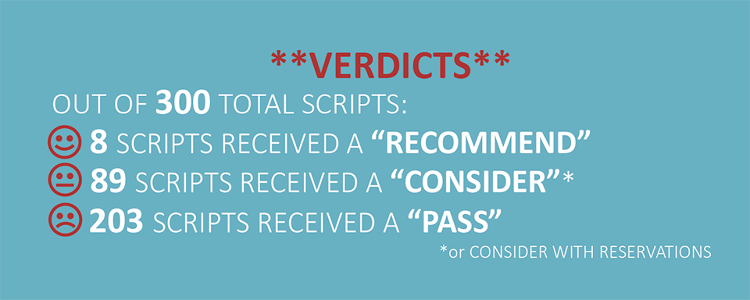
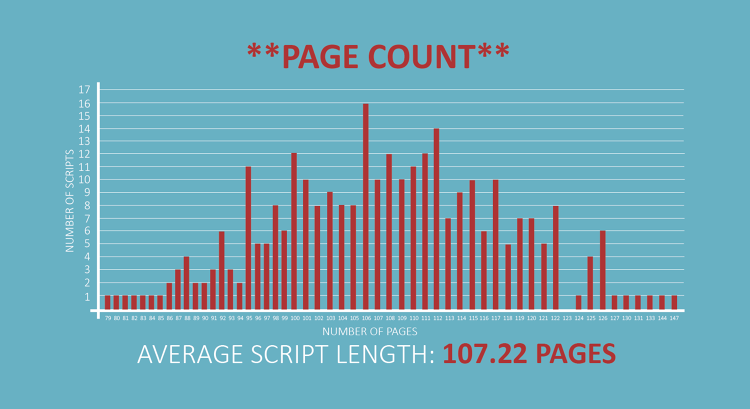
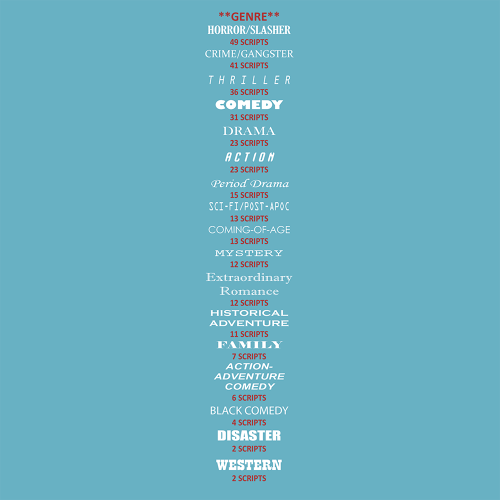
Perhaps the best takeaway is the list of “Recurring Problems” in order of their frequency. I thought I’d aggregate that list here:
* The story begins too late in the script (69 scripts)
* The scenes are void of meaningful conflict (67 scripts)
* The script has a by-the-numbers execution (53 scripts)
* The story is too thin (53 scripts)
* The villains are cartoonish, evil-for-the-sake-of-evil (53 scripts)
* The character logic is muddy (47 scripts)
* The female part is underwritten (46 scripts)
* The narrative falls into a repetitive pattern (45 scripts)
* The conflict is inconsequential, flash-in-the pan (44 scripts)
* The Protagonist is a standard issue hero (39 scripts)
* The script favors style over substance (35 scripts)
* The ending is completely anti-climatic (35 scripts)
* The characters are all stereotypes (34 scripts)
* The script suffers from arbitrary complexity (31 scripts)
* The script goes off the rails in the third act (30 scripts)
* The script’s questions are left unanswered (29 scripts)
* The story is a string of unrelated vignettes (29 scripts)
* The plot unravels through convenience/contrivance (28 scripts)
* The script is totally confused (28 scripts)
* The script is stoic to a fault (27 scripts)
* The Protagonist is not as strong as need be (24 scripts)
* The premise is a transparent excuse for action (22 scripts)
* The character backstories are irrelevant/useless (21 scripts)
* The supernatural element is too undefined (21 scripts)
* The plot is dragged down by disruptive lulls (19 scripts)
* The ending is a case of deus ex machina (19 scripts)
* The characters are indistinguishable from each other (19 scripts)
* The story is one big shrug (17 scripts)
* The dialogue is cheesy, pulpy, action movie cliches (16 scripts)
* The script is a potboiler (15 scripts)
* The drama/conflict is told, but not shown (14 scripts)
* The great setting is not utilized (13 scripts)
* The emotional element is exaggerated (13 scripts)
* The dialogue is stilted and unnecessarily verbose (13 scripts)
* The emotional element is neglected (11 scripts)
* The script is a writer ego trip (10 scripts)
* The script makes a reference, but not a joke (7 scripts)
* The message overshadows the story (5 scripts)
One thing that jumps out at me: How many of these issues are tied to poor character work. Not just items related directly to characters, but plot as well.
For example, if you develop your characters well, especially in determining what is going on with your Protagonist and his/her psychological journey, you should never have a problem with deus ex machina endings because the Protagonist will drive the plot toward the Final Struggle through his/her resolve to achieve their goal and bigger picture as part of their narrative destiny.
If you dig into your characters, they will surprise you with who they are and the choices they make which is a great way to avoid formulaic writing.
If you understand your characters, each will have their own respective goals, that becomes the foundation for conflict from scene to scene, especially when tied to their macro wants and needs which naturally leads to meaningful interactions.
For me, this is more evidence for the value of character based screenwriting.
How many of these problems do you struggle with in your own writing or see in scripts you read? Let’s head to comments to discuss. And be sure to check out the entire infographic here.
And if the Anonymous Script Reader who put together this information happens to see this post, I would love to do a interview with you (of course, you can continue to hide your identity) as I have some additional questions.
In any event, ASR, thanks for doing this. Each of us, as screenwriters, needs to strive to write better, a worthy resolution for the New Year and beyond. Let’s make life easier for script readers… and increase the chances of our own success!
Comment Archive