Go Into The Story Interview (Part 5): Katla Sólnes
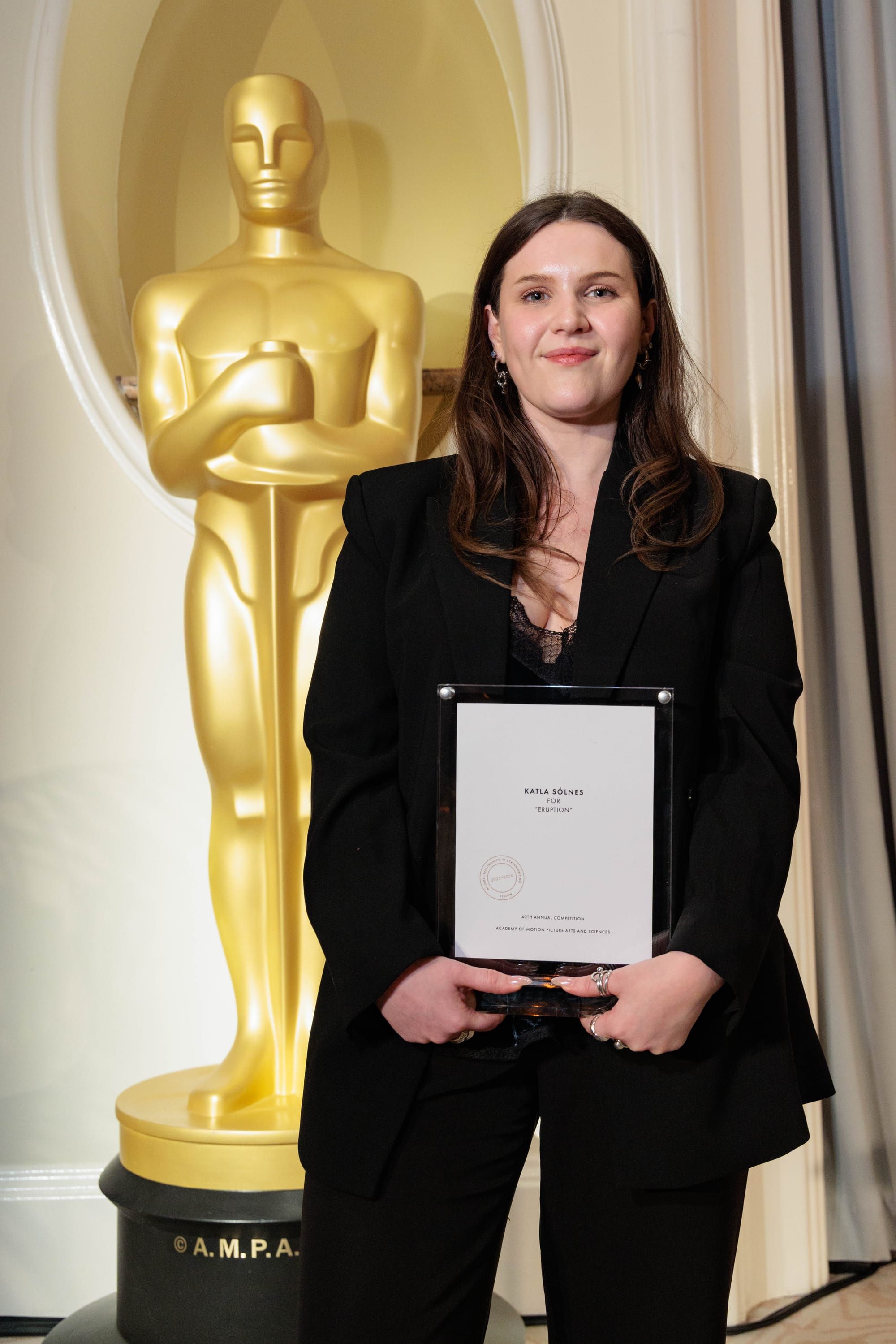
Katla Sólnes wrote the original screenplay Eruption which won a 2025-2026 Nicholl Fellowship in Screenwriting. I had an hour-long conversation with Katla exploring her creative background, analyzing her Nicholl-winning screenplay, and a discussion of key aspects of the screenwriting craft.
Today in Part 5, Katla describes her experience as a Nicholl recipient and answers some screenwriting craft questions.
Scott: The title of your script is Eruption. And there's a couple of moments between husband and wife where they do get at it in an explosive way.
Katla: Yeah.
Scott: That one that happens in Act Three, I couldn't help but recall that big blow up they do in flashback in Anatomy of a Fall.
Katla: Oh, yeah. I love that scene.
Scott: I watched that scene again last night, and the heightened level of anger and rage between the husband and wife reminded me of the scene in your script.
Katla: I'm floored by that because, I think, to write a confrontational scene… At our cores as writers, many of us are gentle people who struggle with yelling. But as with everything when you're writing core personality, I'm writing things I've said in arguments and things I wish I had said.
Scott: I don't want to give away the ending, but I think it's perfect the way it is, where the ending of the story is the beginning of the protagonist's new life.
Katla: Exactly.
Scott: Did you always have that in mind?
Katla: I would say so. I think in every draft, we've always left her there. When I pitched the idea my first ever time, eons ago, I always thought of the end, the Virginia Woolf novel “A Room of One's Own.” The importance of having a room of one's own, and that to me is the mood for the end.
Scott: Well, congratulations again. Well done with the script. And the Nicholl. What was that experience like?
Katla: It was incredibly magical and bewildering. I am grateful for Columbia for nominating me and I only have good things to say about my time there. I think the teachers are just world-class. And I remember when I got ‘’the’’ email, but it was a very sinister-feeling email from The Nicholl that almost felt that they were implying that I'd committed plagiarism or something.
I received this email while at a wedding in India, and which very much dimmed my exuberance that evening. Then I met with them on the day of my 30th birthday, where I thought it was going to be a tense conversation. I felt like I was getting ready for a jury or court or something. But instead they were all total sweethearts (clearly the email was a bit of a slight of hand to make the result not too obvious) and they let me know I'd been chosen, and I was just thrilled. I was also late, and I'm never late to anything because I miscalculated the time difference. So, it was an intense event, but the experience itself was absolutely wonderful. You're in LA, you get to see all these academy-related things and meet all these incredibly talented screenwriters, both my fellow fellows and then, fellows of years past and members of the Academy.
It was really galvanizing. It's just the rarest thing for people to read your work or care. I think it was in The Lost Daughter, the Maggie Gyllenhaal film where they talk about, "The rarest thing to give people is your attention."
So, it just feels really remarkable and lovely that someone cared to read it, and they liked it and through that to get to meet other people who write amazing things.
Scott: Okay, so let me ask you a few craft questions, to get into your screenwriting perspective on things. I'm curious about your prep-writing part of the process. You say you spend a lot of time thinking, it's like pre-writing, right?
Katla: Oh, yeah!
Scott: You mentioned the Eight Sequence Theory. So, at some point you've got to create something, a treatment, an outline? How do you go about wrangling your story?
Katla: I'd say the first step, which I said, is the thinking but very much crucial to thinking is walking. I try to walk 20,000 steps every day. I constantly walk … hours every day. Thankfully, I'm an editor, so I have my own hours because back at my advertising job, that would've been frowned upon if I kept leaving for hour-long walks. And every great philosopher and writer since the dawn of time talks about there's nothing more that activates the mind more than walking. So, I'd say that's the biggest writing tip. Go for a walk. But after that, I do just a very brief outline, and I try to think semi-structurally or, I just try to put on paper everything I've been thinking about. The major plot points, the turning points.
At that point, I'm probably already thinking ‘’this is probably what incites it, and this leads to Act One.’’ So, I kinda have a very skeletal, let's say, structure, and in that just my thoughts. And then through that, I'll write a treatment. I find the scene work the most fun, and structure and outline the most difficult. So, once I'm out of the skeletal outline into treatment form, that's when I start to have fun because then I can also bring in atmosphere, details, lines of dialogue that have been running through my mind … I'm a very visual thinker, and I love dialogue.
Then that stuff starts coming to fruition, which is my favorite part. So when I wrote that huge feverish thing, I don't think I had a long treatment, but I did have a two-page treatment which had an ambiance and in my mind, I already had some of the sentences the characters would say.
So, that's the process for me. Then, of course, doing scene work, writing, rewriting. I write chronologically starting at the top, and then if a scene is bumping me, I'll just write a quick, “This is where they fight,” and move on. I try to write the first draft quite speedily, not allowing too much reflection or doubt. That comes with the second draft.
Tomorrow in the final installment of this interview series, Katla offers advice to aspiring screenwriters.
For Part 1 of the interview series, go here.
Part 2, here.
Part 3, here.
Part 4, here.
I have interviewed every Nicholl winner since 2012. You may read those interviews here: LINK.