Analysis: “True Grit” (Part 2: Character)
In order to learn the craft of screenwriting, you must immerse yourself in movies. One of the best things you can do in that regard is analyze the movies you watch. I like to view them through four ‘lenses’: Structure, Character, Dialogue, Theme.
As an example, I’m going to analyze the Coen brothers’ remake of the movie True Grit in a 4-part series this week. Today: Character.
SPOILER ALERT: Major plot points reviewed here so if you haven’t seen the movie yet, do not read this post!
Note: All page references are to a version of the script which may be downloaded here at myPDFscripts.com.
True Grit is yet another movie where we can see five primary character archetypes at work. Here is my breakdown of those respective narrative functions:
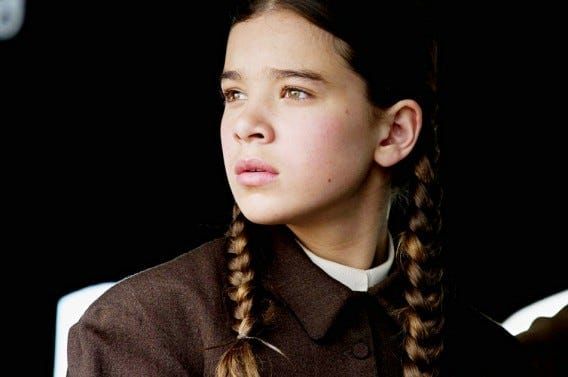
Protagonist: Mattie Ross (Hailee Steinfeld)
Why is she the Protagonist:
* The story is told through her perspective * It is the death of her father and her desire for revenge that initiates the story and provides the Plotline’s spine * The trek to find Tom Chaney, her father’s murderer, takes her out of her Ordinary World (home life) and into the New World of Adventure (the chase), befitting The Hero’s Journey * Mattie is the character who goes through the most significant metamorphosis
All of these point to her as the story’s Protagonist
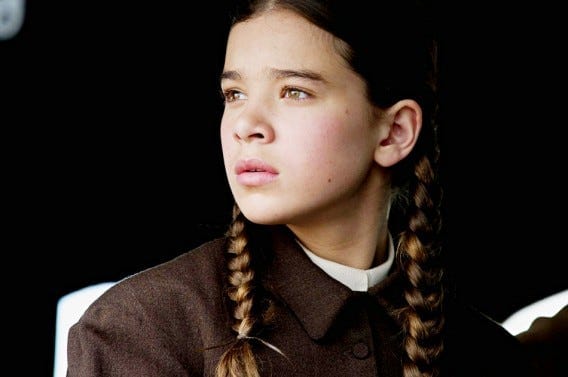
What does she want? To gain revenge for her father’s death by seeing to it Tom Chaney gets killed.
What does she need? When we meet Mattie, she is a singular individual, an adult in a juvenile’s body — intelligent, well-spoken, stubborn, headstrong, and crafty. All of those qualities which make her so compelling as a character also set her apart in her story universe. Imagine her with her peers. Would she fit in? Hardly. Likewise when she engages with adults, she confounds them and makes them ill at ease. I think she very clearly understands this about herself which only feeds her desire to be her own person and get things done in her own way. Throw into this mix three other elements:
(1) Speaking of her father who was a kindhearted man, Mattie says in V.O., “I did not get my mean streak from him.” What is the source of her “mean streak”? Could just be DNA. Or it could be in part the result of living a life where she always has the experience of being different, being set apart from others. If it’s true that the “best defense is a good offense,” might it be the case that Mattie’s mean streak is a way of pushing others away and announcing to the world she is different — before they can point at her and say it first?
(2) Again talking about her father in the movie’s introduction, she reflects on why he got involved trying to keep Tom Chaney from getting himself killed in a bar fight:
MATTIE You might say, what business was it of my father’s to meddle? My answer is this: he was trying to do that short devil a good turn. He was his brother’s keeper. Does that answer your question?
One layer of subtext here is this: My father trusted another man and tried to do good by him… and look what it got him. Dead. I won’t make that mistake.
(3) What is the motivation for her goal — to see Tom Chaney killed? We know she wants revenge. But what sort of emotion does Mattie attach to that goal? Does she seem saddened by her father’s death? No. Rather she seems driven by anger, indeed, a specific kind of anger. Is she angry at Tom Chaney? Certainly. However in Mattie’s mind, he’s just some dumb bastard, a “coward” as she calls him. I think the real source of her anger is directed at her father: How stupid he had been in trusting Tom Chaney, who had been “down on his luck,” in the first place.
In sum, we have a Protagonist who begins in a state of Disunity: (1) An adult-child, (2) a loner who does not trust people, (3) influenced strongly by a “mean streak” and her anger about the death of her father.
So again, what does she need? She needs to find some people with whom she can interact as equals, people who are as distinctive as she is, people in whom she can eventually trust, people who can help her gain revenge against Tom Chaney. Those would be two characters: Rooster Cogburn and LeBouef. But before we get to these two allies, let’s take care of the story’s Nemesis.
Nemesis: Tom Chaney (Josh Brolin)
Why is he the Nemesis?
* He killed Mattie’s father * The pursuit of him and his death is the end-point of Mattie’s want * He threatens Mattie’s life, both indirectly as the cause of her dangerous quest to find him and directly when he takes her hostage, then tries to kill her
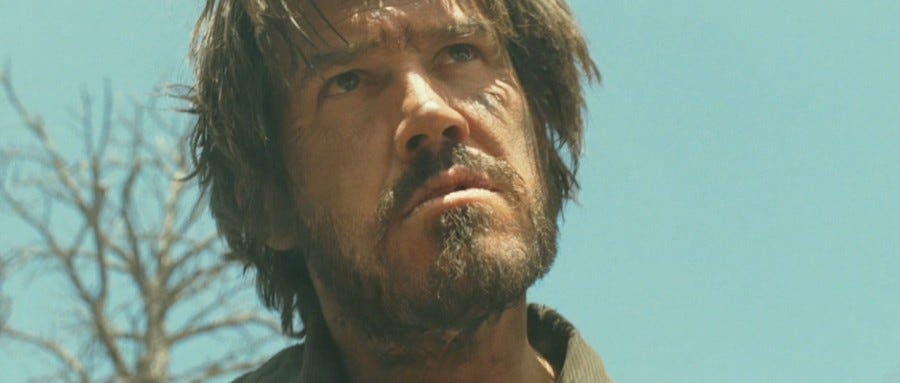
Jung talks about the shadow, those dark impulses we all have we try to repress. In stories, the Nemesis is often the physicalization of the Protagonist’s shadow. I think we can look at Chaney and infer that he represents a kind of mindlessness and out of control dynamic which would — frankly — scare Mattie. Does she have those type of impulses? Probably. You may think, “That’s impossible, she’s so in control.” But ask yourself: Why is she so under control? What has engendered that need for control? One thing is her lack of trust in others. By controlling matters, you minimize the need to trust other people (remember she won’t let Cogburn go off on his own to find Chaney, she can’t trust him enough to do that, rather she needs to go along on the journey and that, I would argue, is an example of her controlling personality). Another dynamic is her mean streak. I suspect she’s given herself over to that from time to time, and the raw unchecked power of that probably frightened her. So I suspect she exhibits the degree of self-control she does in order to keep her own anger in check. Therefore perhaps in Chaney we’re seeing a projection of her own “short devil,” a repressed instinct to go crazy from time to time, to let loose her anger.
One fact is unalterable: Mattie can’t find and kill Chaney on her own. She needs help. One ally she finds is Rooster Cogburn.
Mentor: Rooster Cogburn (Jeff Bridges)
Why is he a Mentor?
* He’s a tracker of criminals and therefore has knowledge Mattie wants * He knows the area and its criminal elements, again essential knowledge for Mattie * He has a wisdom about life and the world arising from his long, adventurous past * He knows how to kill a man
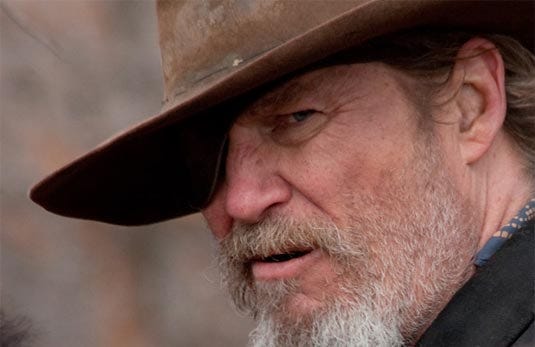
And there’s this: Mattie lost her father. Perhaps Mattie never really felt like she had a father, at least not one who she understood — or more importantly understood her. He was a kindhearted man, a generous man, trusting in the goodness of others. Does that sound like Mattie? On the other hand, how would we describe Rooster Cogburn: ornery, stubborn, loner, defiant, willful. Doesn’t that sound more like Mattie?
So in Rooster, Mattie finds someone who is as distinctive an individual as she herself is, someone who shares many of the same qualities as she does, and someone who becomes a sort of father figure for her.
Attractor: LeBouef (Matt Damon)
Why is he the Attractor:
* There is a romantic, even sexual subtext to their relationship * She develops strong feelings for LeBouef * The only time Mattie almost cries in the movie is when LeBouef departs at the end of Act Two
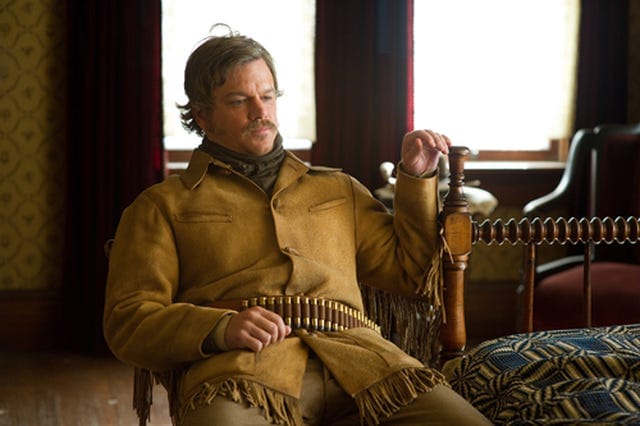
Their unfulfilled romance begins in their very first scene where Mattie wakes up in bed to discover LeBouef in the room with her.
LEBOEUF While I sat there watching you, I gave some thought to stealing a kiss.
In true romance fashion, Mattie loathes LeBouef from their first meeting. But by the movie’s Denouement when she is an old woman:
MATTIE I never did see Mr. LeBouef again but if he is yet alive, I would be pleased to hear from him.
Clearly she still harbors feelings for the man. Why? Here, too, I think Mattie finds someone who is as distinctive as she is: everything from the mystique of being a Texas ranger to the spurs he wears on his boots to the pipe he smokes. But more than that, consider his qualities: smart, well-spoken, idealistic, committed to those ideals, relentless. That sounds a lot like Mattie, too, doesn’t it?
And so with Cogburn and LeBouef, Mattie has found two people as different as she is, one who speaks to her mind, the other to her heart.
Trickster: Mattie’s Father
Why is he a Trickster:
* He’s an ally in that he fathered Mattie, both into this life and as part of their family * He’s an enemy in that his death creates a burden on Mattie — to gain revenge for his death * He tests Mattie by causing her to go on the journey to find and kill Chaney
Tricksters test the Protagonist to help steel them for their Final Struggle against the Nemesis. Even though her father is absent, he is present throughout the entire story because of his death and the ensuing events. And each one of the challenges that rise up along the way are a result, directly or indirectly, of her father’s death.
I have this theory about stories: One way to analyze them — and frankly write them — is to understand them as psychological journey. So I like to ask myself as I’m prepping a story this question: Why does this story have to happen to this character at this time?
With True Grit, I believe the death of Mattie’s father happened to put her into a relationship with Cogburn and LeBouef, that the pair represents two aspects of her psyche:
* In Cogburn, she senses a man who is like her in the respect that he is stubborn, defiant, and willful.
* In LaBouef, she senses a man who is like her in the respect that he is smart, idealistic, and single-minded.
Both, like her, are authentic, different-from-the-pack individuals. Together the three of them create a ‘family’ of sorts: Cogburn a substitute father, LaBouef a lover.

But what’s the meaning of the story? I’ll speak to that in Part 4: Theme. Tomorrow we’ll look at how the dialogue helps to delineate each of the primary characters.
For Part 1 on Structure, go here.
Note: The five primary character archetypes I laid out above are just one aspect of the approach we use at Screenwriting Master Class. I will be teaching it as part of a 4-week Core II: Character and Style course from January 31-February 27, 2011. For more information, go here.
Comment Archive