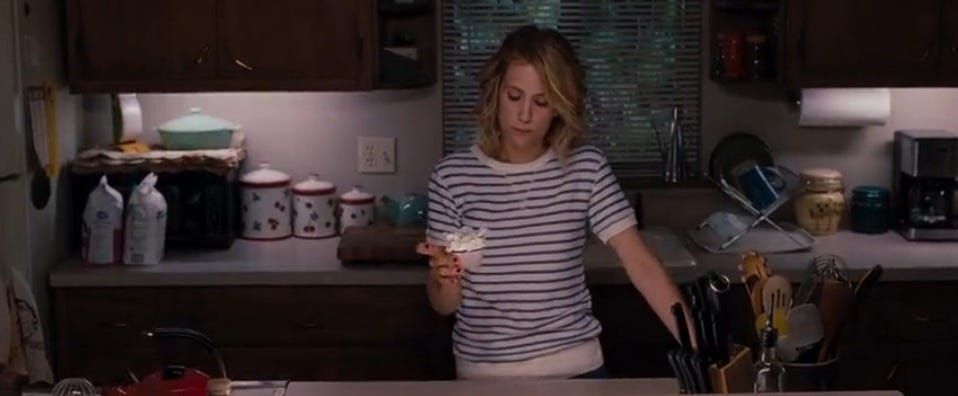
Annie Walker (Kirsten Wiig) in “Bridesmaids”: Protagonist identification
About a month ago as part of the GITS Script Reading & Analysis series, we studied a draft of a screenplay for the movie Bridesmaids. It was an excellent exercise including this follow-up Q&A with Universal Pictures story analyst Billy Mernit.
I’d like add to the mix a great piece of analysis by the Kid In The Front Row who in a blog post today focuses on Kristen Wiig’s character in the movie, Annie Walker. Excerpts and my analysis of Protagonist identification below the jump:
When you’re watching a comedy, you rarely think about its complexity. You just have a good time and wait for the next laugh to come. Wiig’s character, Annie Walker, was amazingly written and acted; a stunning performance from the lead actress. Not only is it worth noting — I think it’s worth exploring further.
Annie Walker was vulnerable and fragile throughout the whole film. At the beginning we find out that her business attempt, opening a bakery during the recession, has failed. When it did, her boyfriend left. Her best friend is getting married and her love life consists of casual sex with a man who doesn’t listen to her, doesn’t care about her needs, and doesn’t want her sticking around for the night.
— —
Wiig is noted for her comedic talents, which are undeniable. But the core of this movie is actually carried by her dramatic abilities. Those moments in between the laughs — little snapshots of her character that lived outside of the writing.
A great example is the scene where she makes a cupcake in her apartment. She takes the time to make a perfect cake, which she bakes and decorates to perfection. She places it carefully on the table, on its own — — before picking it up and scoffing it down herself. What a great, unique way to show loneliness! Lesser writers would have had her calling someone up and saying ‘I’m lonely’ or listening to ‘All By Myself’ — here we just have her eating a cupcake, and it tells us everything.
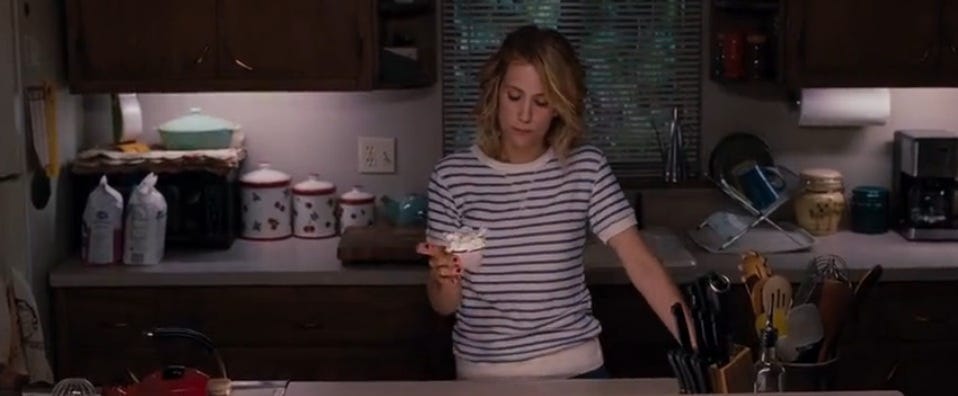
I can’t think of any other character in recent film history who shows the anxiety of insecurity and fear as well as Annie Walker does here.
The Kid’s whole post is well worth reading — which you can do here — if only to remind ourselves of one of the most critical jobs we have as screenwriters: Create reader identification with our story’s Protagonist.
In one of the first screenwriting lectures I wrote back in 2002, I made the point this way:
The Protagonist is almost always the most important figure in your story universe. S/he is your ‘hero,’ the one through whose experience you tell your story. Therefore it is imperative to do whatever you can to make the reader identify with this pivotal character. How? These five guidelines are a good start:
1. MAKE THE PROTAGONIST REAL: If the reader shares some common experience with the Protagonist, then it helps because you now have the reader using their memory/experience to solidify a bond.
2. MAKE THE PROTAGONIST VULNERABLE: If your Protagonist is perfect, you not only give them no room to grow, you distance yourself from the audience because people aren’t perfect. Your Protagonist should have personal issues to make them identifiable.
3. MAKE THE PROTAGONIST SYMPATHETIC: There is possibly no better way to establish a connection with your Protagonist than dumping a load of problems on them right from the start, virtually compelling the reader to feel sorry the character.
4. MAKE THE PROTAGONIST LIKABLE: Explore personal qualities in your Protagonist which entice the reader to warm up to the character.
5. MAKE THE PROTAGONIST FUNNY: There is almost nothing else that wins over a reader than a character who has a sense of humor, so use that quality to your advantage in creating a Protagonist.
A really big note: YOU MUST CREATE A FULLY DIMENSIONALIZED PROTAGONIST. A character who can carry the reader’s interest through 100 pages, who has multiple layers of internal struggle which can be explored, confronted, and resolved over the course of the story. That not only provides multiple points of potential connection for a reader, it also helps to create a compelling Protagonist.
If you haven’t screened Bridesmaids, you should. If you have already seen it, watch it again. Focus like The Kid did on the Protagonist Annie Walker. See the various ways the filmmakers and especially Wiig herself went about creating a character about whom we cared and with whom we identified.
A great reminder for our own stories: Create reader identification with our Protagonist.
Comment Archive