Are you ready for ‘New TV’?
If Jeffrey Katzenberg has his way, it’s the next new thing.
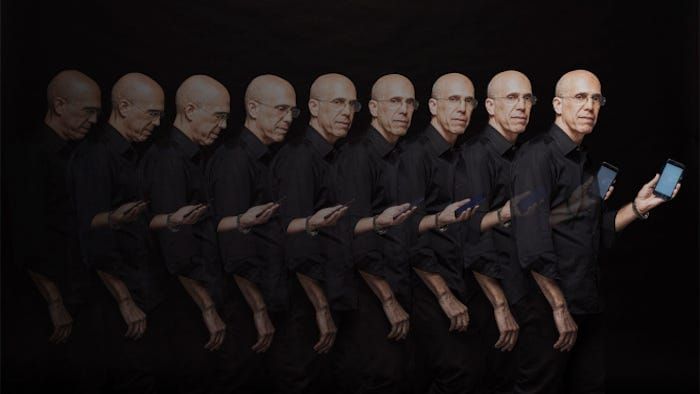
If Jeffrey Katzenberg has his way, it’s the next new thing.
Who is Jeffrey Katzenberg, you ask? If this is your question, you need to up your game about the entertainment business in Hollywood. You can go here to learn more, but allow me to provide some highlights of his career:
- President of production, Paramount Pictures (1980–1984)
- Chairman, Walt Disney Studios (1984–1994)
- Co-founder, DreamWorks SKG (1994–2004)
- CEO, DreamWorks Animation (2004–2016)
You know that little movie The Lion King? That was Katzenberg’s baby. That SKG at the end of DreamWorks? That’s (Steven) Spielberg. Katzenberg. (David) Geffen. When Comcast bought DreamWorks Animation last year, Katzenberg walked away from that deal with a cool $400M.
In other words, Katzenberg is a major player.
What’s he up to post-DreamWorks Animation? Not much. Just reinventing the very concept of TV. From Variety: Inside Jeffrey Katzenberg’s Plan to Revolutionize Entertainment on Mobile Screens:
When Jeffrey Katzenberg touched down in Sun Valley, Idaho, last week, it extended a streak of appearances at the annual conference going back more than 30 years, nearly to the time Allen & Co. first launched its event in 1983.
His ambitious goal at this year’s conference: getting one of the myriad tech and telco giants he’d been talking to in the intervening months to leverage its infrastructure and reach for his latest venture. The entry fee for the interested company: $2 billion to help bring his vision to fruition.
“Is this a gigantic undertaking? The answer is yes,” says Katzenberg in an exclusive interview with Variety in which he lays out the full scope of his plans. “Is it bigger than DreamWorks? I hope so.”
Katzenberg’s plan involves nothing less than the creation of a whole new species of entertainment targeting 18- to 34-year-olds: short-form video series produced with budgets and production values you might expect from primetime TV, along with top-shelf creatives on both sides of the camera. For example, imagine a drama akin to “Empire” or “Scandal” but shrunk to 10-minute episodes made for mobile consumption. Or a five-minute talk show, or a two-minute newscast — all with high-profile talent attached.
I encourage you to read the article for all the background, but let’s zero in on what this could mean for content creators:
To fully grasp Katzenberg’s vision for New TV, one has to reach back into entertainment history and think of the awkward transition from radio to television; those first TV programs were essentially radio broadcasts set to pictures. It took many years before TV found itself and began creating programs that weren’t really repurposed formats from another medium.
He also drew inspiration from yet another medium: publishing, where the works of best-selling authors Dan Brown and James Patterson featured a small but important tweak: Chapters were much shorter than what fiction readers typically expected. Katzenberg sees New TV in the same way: great storytelling but adjusted to smaller increments.
To wit, Katzenberg doesn’t just want New TV to take established genres and cut them down to size; he wants it to give birth to entirely new and different kinds of programming that are native to mobile. He sees mobile video as in a state of arrested development, subsisting on ersatz substitutes, largely in the form of viral videos that are barely monetizable yet eminently digestible.
“It’s unbelievable how many hours we all spend watching great TV content today and, separately, how much time we are consuming short-form content,” observes Katzenberg. “So why can’t those two worlds come together in what is a new creative and business alignment?”
The short answer is that while there have been tons of experimentation going back at least a decade with programming short-form content, the advertising dollars have long fallen short of the levels necessary to fund content at anywhere near levels comparable to traditional TV. Made-for-mobile content rarely exceeds a cost of $5,000-$10,000 per minute; Katzenberg wants to spend as much as $125,000 per minute.
To incentivize the creative community to participate, Katzenberg would take much of the $2 billion he’s looking to secure from a distribution partner and finance New TV productions. Producers or studios would earn fees consistent with what they make in traditional TV. Last but not least: Creators could retain the rights to their intellectual property.
“We need dozens and dozens of suppliers to be incentivized to see this as a financial boon to jump on the bandwagon,” says Katzenberg. “They’re not going to do it without a cut of the action.” [emphasis added]
Back in October 2016, I posed this question: Are “TV” and “Movie” terms bound for obsolescence? Katzenberg’s new venture is an attempt to respond to the changes in technology and cultural habits re TV.
Look, we all know about the shortening of attention spans in contemporary culture (thank you, YouTube, Periscope, Twitter, Facebook, etc). Why wouldn’t we expect stories showed on a video screen, no matter the size, to be told in 10 minute (or less) bite-sized chunks?
We’ve already seen this in multiple web series. I’ve tracked many of them over the years on the blog including the following:
Kyle Piccolo: Comic Shop Therapist, The Guild, Dr. Horrible’s Sing-Along Blog, Circle of 8, Project X: The True Story of Power Plant 67, Cataclysmo and the Time Boys, Cataclysmo and the Battle for Earth, Nora Breaks Free, Trunk: A Love Story, The Black Dawn, Gemini Division.
If Katzenberg gets New TV off the ground, I think as writers we need to look at it as a welcome opportunity. Katzenberg (or anyone else pursuing this path) will need content. And writers are KEY to the creation of that content.
If in this venture there are New TV series featuring 10 minute serialized limited series, what strikes me is how this is a throwback to the shift from single reel movies to multiple reel movies, a phenomenon which occurred in the first decade of the 20th century. What could filmmakers do to keep an audience engaged in a story when the poor projectionist had to take 2–3 minutes to switch reels?
End each reel with a cliffhanger!
You’re a writer-producer for New TV creating a limited series structured as a series of 10 minute sequences. What to do?
End each sequence with a cliffhanger!
Another thing. All of those film school students creating short films for their portfolio? They just might be quite welcome in the as yet open offices for Jeffrey Katzenberg’s New TV business.
For the rest of the Variety article, go here.