Character Archetypes: “Up”
Over the years, I’ve analyzed dozens of movies through the lens of five primary character archetypes: Protagonist, Nemesis, Attractor, Mentor, Trickster. This is my theory, that most movies have these five narrative dynamics at work in them:
A character or characters with a conscious goal toward which they are moving forward: Protagonist.
A character or characters who provide an oppositional force: Nemesis.
An ally who is most connected to the Protagonist’s emotional development: Attractor.
An ally who is most connected to the Protagonist’s intellectual development: Mentor.
A character who switches from ally to enemy, enemy to ally, and tests the will of the Protagonist: Trickster.
We see this set of narrative dynamics in movie after movie after movie, enough to suggest there is a pattern at work here. So this week, a series on these five character archetypes in movies.
Today: The 2009 Pixar movie Up, screenplay by Bob Peterson & Peter Docter, story by Pete Docter & Bob Peterson & Tom McCarthy, nominated for a Best Original Screenplay Oscar.
IMDb plot summary: A young Carl Fredrickson meets a young adventure-spirited girl named Ellie. They both dream of going to a lost land in South America. 70 years later, Ellie has died. Carl remembers the promise he made to her. Then, when he inadvertently hits a construction worker, he is forced to go to a retirement home. But before they can take him, he and his house fly away. However, he has a stowaway aboard: an 8-year-old boy named Russell, who’s trying to get an Assisting the Elderly badge. Together, they embark on an adventure, where they encounter talking dogs, an evil villain and a rare bird named Kevin.
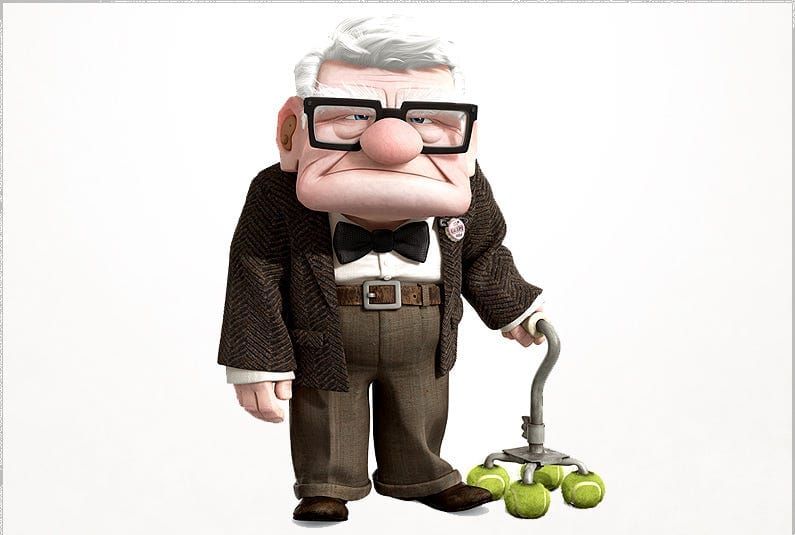
Protagonist: Carl Fredricksen (Ed Asner)
It’s Carl Frederickson as he hits on all the major P factors:
* The story is told from his perspective. The movie begins with young Carl where we learn about his love of adventure. The story follows Carl as he meets young Ellie, an adventurous soulmate. A montage takes us through their courtship, marriage, and the tragedy of Ellie’s death, all of which impacts Carl deeply. And for the rest of the story, no matter what characters are introduced, the dynamic is almost always based upon each of them in relation to Carl.
* It’s Carl’s goal — to fulfill his promise to Ellie and go to Paradise Valley in South America — that sets the plot into motion and creates the end-point of the movie.
* It’s Carl’s character who goes through the most significant transformation, realizing his goal of bringing Ellie — in the form of his memories of her, her Book of Adventure, and the house itself — to the exact spot atop Paradise Valley by the waterfall — then moving into a new adventure with Russell, Dug, Kevin and the rest. In addition, Carl evolves from disliking Russell to becoming Russell’s surrogate father figure. And Carl’s disposition changes as well — from cantankerous old man, just stringing out the days until he dies, to an upbeat, vital, and ‘alive’ version of himself.
Nemesis: Carl Muntz (Christopher Plummer)
The principal Nemesis figure is Charles Muntz. What’s interesting about Muntz’s character in relation to Carl is that Muntz serves as an inspiration to Carl when he’s a young boy, in some ways the very vision of who Carl imagines himself being and becoming. But Muntz ‘devolves’ into a Nemesis when he becomes obsessed with salvaging his legacy by finding a rare bird in the jungles of Paradise Valley, his fixation moving Muntz away from the initial innocence of exploration for discovery’s sake to the ‘dark side’ of exploration in service to one’s ego. In classic Nemesis fashion, Muntz not only provides opposition to the Protagonist reaching his goal — his efforts to kidnap Kevin, the rare bird who ends up as Russell’s pet and a member of Carl’s troupe, disrupting Carl’s plans — but also demonstrates how Carl could, if he chose, go down his own dark side path: If he insists on achieving the goal not so much to satisfy Ellie’s dream, but rather his own ego-needs to fulfill the promise he made to her.
By the end of the story, it becomes a classic Bad Guy vs. Good Guy battle with death on the line.
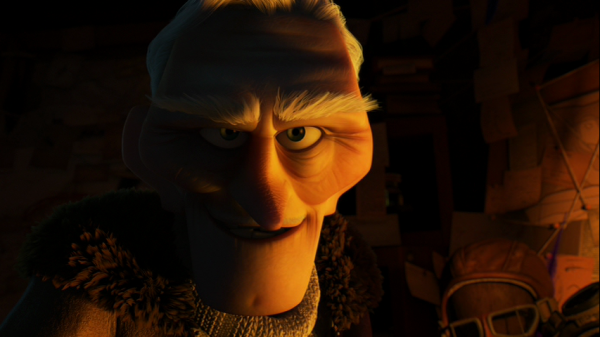
It’s interesting to note that after the movie’s opening newsreel sequence which features Muntz, this Nemesis character doesn’t reappear until very far into Act Two. The script does a good job of interweaving other characters who provide an oppositional dynamic to Carl — Russell, a thunderstorm, Kevin, and the ever-present hassle of having to move Carl’s house — until Muntz re-enters the plot.
Finally, Muntz’s dogs, most especially Beta (Delroy Lindo), are part of Muntz’s team and provide a nemesis function.
Attractors: Ellie (Elie Docter) and Russell (Jordan Nagai)
The two characters who are tied most directly to Carl’s emotional self are Ellie (Elie Docter) and Russell (Jordan Nagai). In young Ellie, Carl finds the love of his life and they get married. Indeed, it is the inability of Ellie to have a child and her death that drives home the necessity Carl feels to make her goal — going to Paradise Valley — his goal.
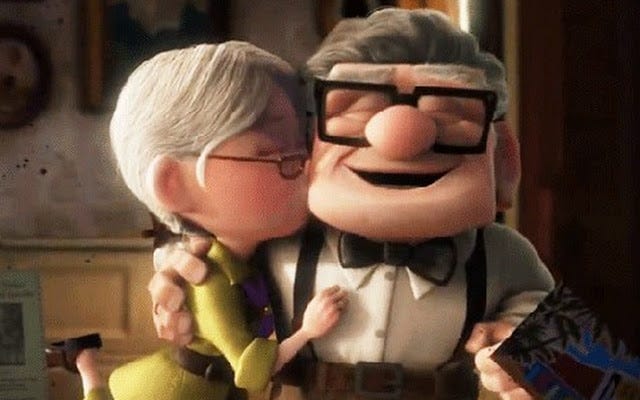
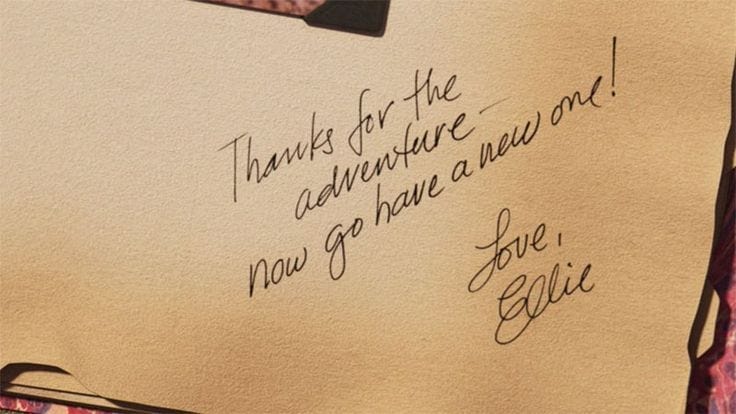
Even though Ellie is dead, she remains very much ‘alive’ to Carl throughout the story in part through a number of talismans which take on her ‘spirit’ — the house itself, the Book of Adventure, her photo, the grape soda pin. And when he finally manages to set the house on the exact spot atop Paradise Valley, as envisioned by Ellie, she magically ‘reappears’ to him through a series of touching photos in the Book of Adventure, ending with her handwritten note, thanking him for fulfilling the promise he made to her (“cross your heart”), then setting Carl ‘free’ with the admonition: “Now go have a new adventure.”
And in deft fashion, the script sets up another Attractor character with which Carl can have that new adventure: Russell. The Carl-Russell relationship has the feel of a classic rom-com dynamic — at first, Carl can’t stand the kid — but by the end of the movie, Russell’s dogged determination and basic goodness causes Carl to warm up to the boy. But symbolically, Carl’s biggest point of connection with Russell is that he is the embodiment of Ellie’s adventurous spirit. That’s what Carl gets from Russell. What Russell gets from Carl is a ‘father,’ someone who does show up for his merit badge ceremony, who does sit on the curb outside his favorite ice cream parlor counting red and blue cars, just like his absentee father used to do.
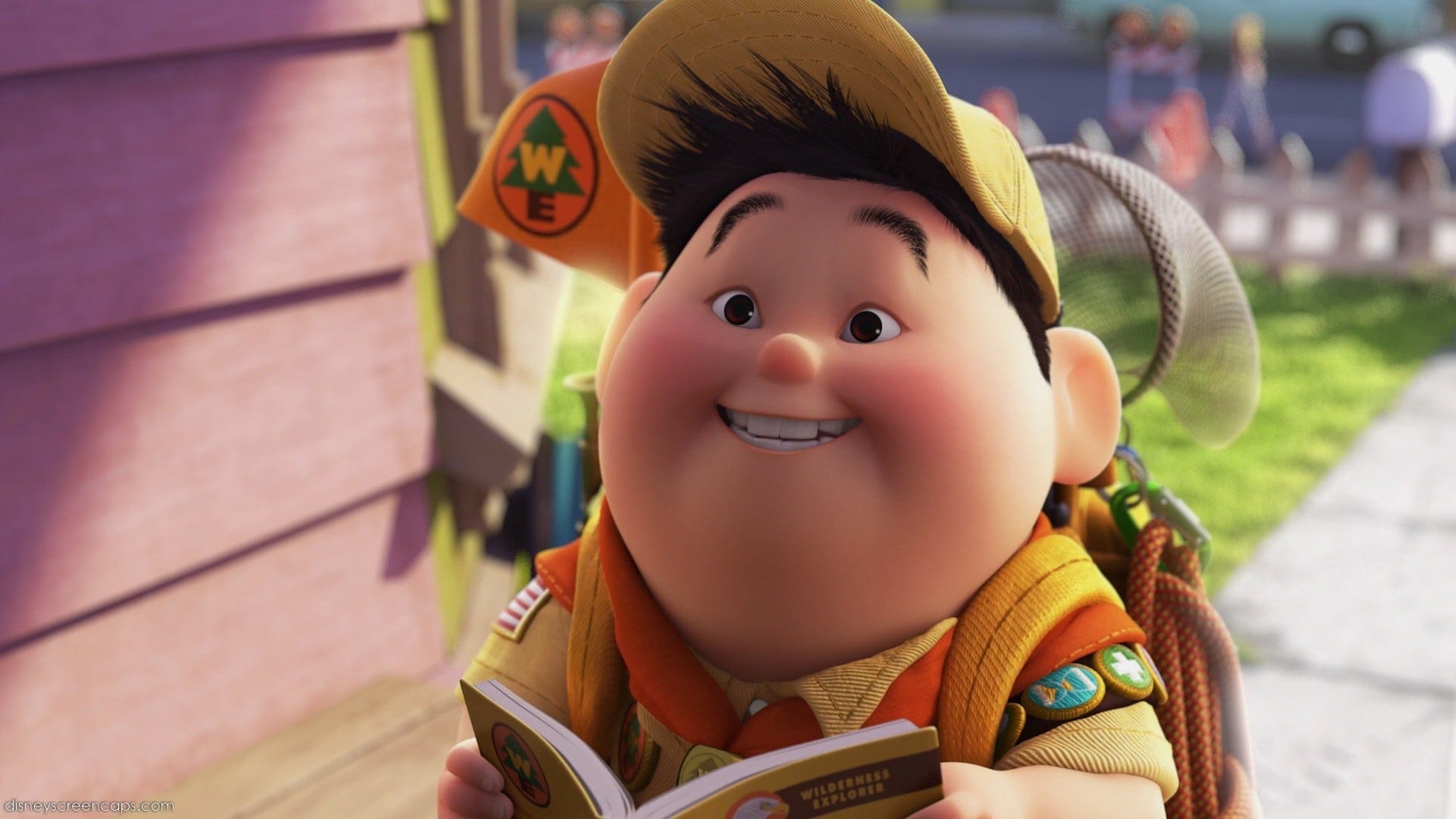
So the Attractor function is passed like a baton — starting with Ellie and her dream of going to Paradise Valley, and once that dream is realized, to Russell, as Carl’s goal shifts to embrace Russell’s goal: Save Kevin and reunite the bird with her babies.
One final thought re the Attractor: The house itself is an extension of the Ellie-Carl dynamic, so it’s interesting to note that after Ellie relieves Carl of the obligation to realize their shared dream, Carl becomes ‘free’ of the house as well. Of course, it’s a beautiful and fitting touch that the house ends up atop Paradise Valley, back on the spot where Ellie dreamed for all those years.
Mentor: Dug (Bob Peterson)
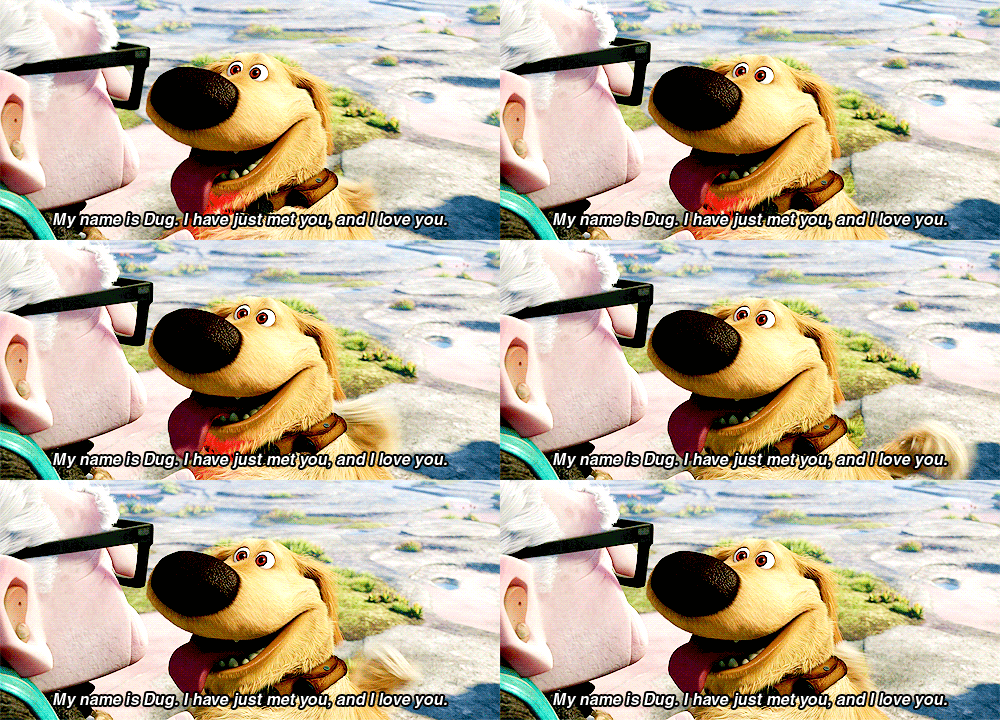
In my view, the Mentor is Dug, voiced by the movie’s screenwriter Bob Peterson. This may cause some head-scratching, but consider this. First, Dug is the character who has the most insight and understanding of the jungle, Muntz, and Muntz’s other dogs — and with this ‘wisdom’ fulfills at least one function of the Mentor character. Also Dug plays a pivotal role in assisting Carl in the Final Struggle, another role often played by the Mentor. But I think the most important mentoring Dug does is by providing a symbolic conduit for Carl to see Russell with ‘new’ eyes. For just as Dug is loyal, trustworthy, and dogged in his pursuit of that which is good, so is Russell. Indeed, the identification — as far as Carl is concerned — between Dug and Russell is such that they share an exact same beat: The house rises into the air, Carl settles into a chair, then a knock at the door. First time, it’s Russell; later, it’s Dug.
With Dug, Carl can envision what a companion can be — after all, that’s one of the primary descriptors of a dog in relation to its owner. Carl’s experience of Dug teaches Carl that Russell can be a good companion, too, opening up a possibility Carl had left for dead after Ellie was gone.
Trickster: Kevin
From scene to scene, this dynamic shifts from one character to another as at times Russell, Dug, and even the house present obstacles and roadblocks to Carl, but the primary Trickster character is Kevin.
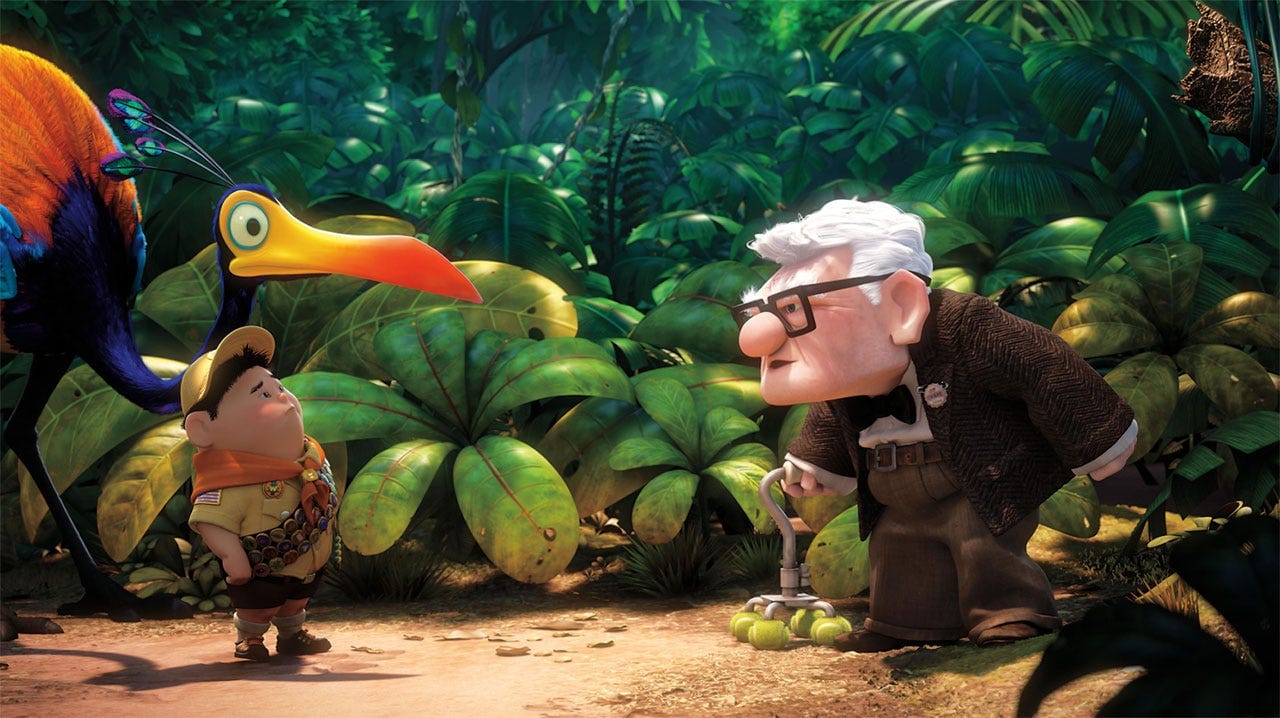
First off, Kevin is actually a girl, not a boy — a trick played on Russell and the others. Second, Kevin constantly messes with Carl: Kevin eats Carl’s walker; Kevin eats some of the house’s balloons; Kevin follows the group when she’s not supposed to, then disappears when they need her around. But most importantly, Kevin is the cause of the biggest test Carl has: Getting Kevin back from Muntz so Carl can (A) get the house to Ellie’s spot atop Paradise Valley and (B) save Russell’s life. In other words, it’s Kevin who brings the Nemesis back into the plot; without Kevin, there is no Final Struggle — no Big Test — at least as it’s played out in the movie.
This is just one of many movies which reflect these five primary character archetypes. That said, I am not suggesting this is the only way to approach writing a screenplay. There is no right way to write. Every writer is different. Every story is different. All I am suggesting is there is something going on here about this specific set of narrative dynamics as exhibited in the form of character types. And they can be a huge help for writers as we engage our characters, their interrelationships informing our story-crafting and plotting process.
What are your thoughts? Head to comments and let me know what you think.
Tomorrow: Another movie analyzed through the lens of character archetypes.