Classic 30s Movie: “The Informer”
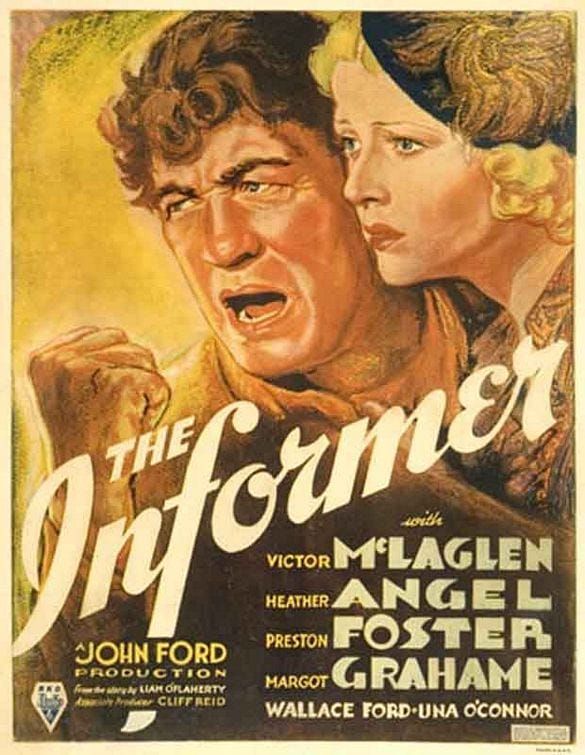
May is Classic 30s Movie month. Today’s guest post comes from Megaen Kelly.
Title: The Informer
Year: 1935
Writers: Screenplay by Dudley Nichols, based on a novel by Liam O’Flaherty
Lead Actors: Victor McLaglen, Heather Angel, Preston Foster, Margot Grahame
Director: John Ford
Plot Summary: Driven by desperation, impoverished Dublin resident Gypo Nolan (Victor McLaglen) turns a fellow Irishman friend of his in to British Occupying Forces in 1922. What happens in the following a span of less than 12 hours makes up The Informer.
Why I Think This Is A Classic 30s Movie
The decade of the 1930s was one of immense social and economic turmoil in the United States. The Great Depression had a firm hold on people, meaning that if people couldn’t afford to feed or clothe themselves how did they have disposable income to go see a ‘moving picture’. Even the advent of new technologies including sound and colour weren’t enough to get people into cinemas. Filmmakers (read: studios) therefore had to change the type of stories they were telling. This lead to lighter fare of a more fantastical nature. The 1930s were a time of screwball comedies and horror films. Straight dramas existed of course but getting an audience in to see them wasn’t easy.
However, American director John Ford had been developing a reputation for himself as a quality filmmaker, and thus a heavily dramatic film like The Informer could not only be made but also be wildly successful. This was due in large part to the high calibre of participants Ford surrounded himself with, including writer Dudley Nichols who worked on many Ford films, and character actor turned leading man Victor McLaglen. These two in addition to Ford won the Academy Award in their respective fields. The film lost out Best Picture to the Clark Gable-lead Mutiny on the Bounty.
The 1930s were still early enough in film history where actors didn’t have to be young, pretty boys like they are now. McLaglen was a professional boxer before he started working in silent films in the 1920s and his looks are certainly the type one expects of a boxer but not that of a leading film actor. But his charisma is undeniable and it is his solid performance as the ill-fated Gypo that holds the film together. Gypo runs the gamut of emotions from despair to love to resolution to guilt to denial and so on.
Gypo’s situation was similar to what many Americans were going through at the time — experiencing the tyranny of poverty and the tyranny of powerlessness. But John Ford played it smart by moving the action and location to Dublin during the Irish War of Independence. This way audiences could identify with the individual (Gypo) but not feel that their own hardships were being thrown in their faces as it were.
The Informer is a film that holds up well. In fact, for a time until Citizen Kane’s spell over movie-goers firmly took hold in the second half of the 20th Century, The Informer was considered by many to be the best film ever made.
My Favorite Moment in the Movie
Early in the film there is a semi-comical sequence of Gypo and a ‘wanted’ poster. It physically represented the fact that it was an idea that wouldn’t let go of Gypo.
Also, the haughtiness of the British military is so perfectly shown in the sequence when Gypo goes to the police station to report seeing his criminal friend.
My Favorite Dialogue in the Movie
Certainly the last line of the film is one of the most amazing and outstanding in all of film history. I won’t say what it is to avoid spoilers.
Much of the language used in the film, especially that of Gypo’s, may be considered typical Irish. Gypo refers to his friends as ‘boyo’ for example.
Key Things You Should Look For When Watching This Movie
Because it’s filmed in black and white it’s easy to showcase the duality that Gypo is going through. Wanting to alleviate his pennilessness, yet feeling guilt over having to betray a friend to do so, the cinematography helps in the storytelling as well.
It’s interesting that the leaders of the Irish resistance are dressed in trench coats. I’m not sure if this is historically accurate or not, but it lends a sense of creepy mystery to them. Gypo was once part of the movement but was kicked out, and he is keen to be accepted by them again. His lie about who ratted on his friend gains him access to the group but things don’t work out as you can probably guess.
Thanks, Megaen!
To show our gratitude for your guest post, here’s a dash of creative juju for you. Whoosh!
We already have a set of classic 40s movies, 50s movies, 60s Movies, 70s movies, 80s Movies and 90s Movies. This month, we’re working on 30s movies. And thanks to the GITS community, we’ve got at least 22 movies in the works and hopefully! Here’s our MVP list of contributors:
All Quiet on the Western Front — Michael Waters
Bride of Frankenstein — Marija Nielsen
Bringing Up Baby — Melinda Mahaffey
Captain Blood — John Arends
City Girl — Adam Westbrook
Dracula — Sheila Seaclearr
Duck Soup — David Joyner
Gone With The Wind — W. H. Morris
Gunga Din — Steve Huerta
It Happened One Night — Joni Brainerd
Make Way for Tomorrow — Susan Winchell
Midnight — Niki Leydecker
Snow White and the Seven Dwarves — Will King
Sabotage — Jeff Xilon
The 39 Steps — Felicity Flesher
The Adventures of Robin Hood — Clay Mitchell
The Informer — Megaen Kelly
The Petrified Forest — Rachel Sheridan
The Women — Liz Clarke
Topper — Wayne Kline
Vampyr — Megaen Kelly
For the original post explaining the series, go here.
For all of the 30s movies featured in the series, go here.